We use cookies to make your experience better. To comply with the new e-Privacy directive, we need to ask for your consent to set the cookies. Learn more.

Xiom An Jaehyun TMXi Pro vs Nittaku So-Ten – Two enjoyable composite blades but for different reasons

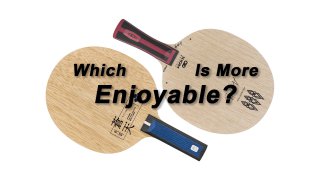
Xiom An Jaehyun TMXi Pro vs Nittaku So-Ten
- Two Enjoyable Composite Blades, But For Different Reasons
Hello TT-enthusiasts and TT11 blog readers! It's time for another blade review. This time, I tested two 5+2 ply composite blades: the Xiom An Jaehyun TMXi Pro and Nittaku So-Ten.
Testing Procedure
I evaluated the blades using well-used sheets of DHS Hurricane 3 (black, 2.15 mm, 40-degree) and Spinlord Waran II (red, 2.0 mm) short pips as my FH and BH rubbers, respectively. I attached the rubbers to the blades using one layer of the Revolution 3 normal viscosity glue on each of the rubbers and the blade. I tested the setups over several sessions each, playing a mix of regular and match-like drills against my regular high-level practice partner (two-winged looper) and practice matches against intermediate-level club members, using Neottec Neoplast Pro 40+ training balls throughout this test.
Xiom An Jaehyun TMXi Pro
The Xiom An Jaehyun TMXi Pro (AJH-TMXiP) is a 5+2 ply inner fiber blade designed for An Jaehyun from South Korea, the 2019 World Championship Men’s Singles bronze medalist. TMX stands for Trimetrix, which is the name of the artificial material surrounding the core ply. The Trimetrix weave combines three different fibers: carbon, Axylium, and Zephylium, the latter two being Xiom’s versions of Arylate and Zylon. A regular “non-Pro” version of the blade is also available, which has a smaller blade head. According to Xiom, the Trimetrix weave generates extra power while providing a unique hit feel.

Xiom rates the Korean-made AJH-TMXiP as follows in the categories of catapult, ball grab, repulsion, and precision categories: 9.4/7.9/8.2/9.1. For comparison, here are the ratings for three other top-end Xiom blades: Hugo Calderano HAL (8.7/7.5/7.7/9.1), Ice Cream AZX (9.7/8.5/8.5/7.7), and 36.5 ALXi (8.4/8.0/8.0/8.4). In other words, the AJH-TMXiP promises to be a fast yet controllable blade.
The AJH-TMXiP comes packaged in a modern-looking green and orange trapezoid-shaped cardboard box, which lists the blade name on the front lip. No other text is displayed on the box. The blade itself also looks very modern. The FH side of the straw-colored playing surface lists An Jaehyun’s name and signature, along with a couple of logos, including a unique triple rhomboid logo. The BH playing surface features the TMX logo alongside some marketing phrases. The handle sports a striking dark grey and raspberry color scheme, with vertical alternating stripes. On the FH side of the handle, there is an interestingly shaped raspberry-colored tag with the blade name and the triple rhomboid logo in black. A golden rectangular tag with holographic “Xiom Beyond” text is located at the bottom of the handle. The BH side of the handle features a small rectangular raspberry-colored tag with a black TMX logo. All in all, the AJH-TMXiP is a sharp-looking blade!
The medium-thick core, presumably made of ayous, is surrounded by the Trimetrix weave and a relatively thick intermediate ply, likely ayous as well. The outer ply, which is relatively thick, appears to be limba. As expected for the PRO version, the playing surface is larger than average, with a height and width of 160 mm x 152 mm, and a thickness of 6.0 mm. The FL handle has the following dimensions: 101.5 mm (length), 25.6-33.9 mm (width), and 23.7-26.7 mm (height). My AJH-TMXiP sample weighed 90 grams, consistent with the larger head and thicker design. When bouncing a ball on the naked blade, a resonance frequency of 1371 Hz is produced, suggesting that the AJH-TMXiP is a fast, but not extremely fast, blade. The blade’s center of gravity is approximately 3.5 cm from the handle.

Initial Impressions
The AJH-TMXiP has a lovely balance, slightly tilted towards the top due to its larger head size. However, the blade felt nimble and lighter than its 90-gram weight suggests.
Driving
The AJH-TMXiP produces a delightful, direct, and very crisp contact on FH drives without feeling overly metallic or ‘thin’, as many composite blades do. The sensation is more akin to flexible 7-ply all-wood blades than typical 5+2 composite ones. The AJH-TMXiP is a relatively fast blade (mid OFF), yet it offers exceptional control. My FH drives had a medium-long trajectory, plenty of clearance over the net, and were highly consistent. My BH drives felt even crisper thanks to the softer nature of the W2. I also noticed that my BH drives generated some spin inversion.
Looping
The AJH-TMXiP also produces a crisp feeling on FH loops, which boosted my confidence to use more aggressive stroke mechanics. The throw angle is medium to medium-high, offering ample safety over the net. Despite being a respectably fast blade, the shots still dipped near the end line. The spin levels on my FH loops appeared to be higher than with average 5+2 composite blades, as my practice partner missed a greater percentage of his blocks than usual. The AJH-TMXiP’s sweet spot is noticeably larger than other blades, consistently producing the same crisp, firm sensation even when I slightly mistimed my FH loops. The blade doesn’t feel particularly bouncy, which, together with other characteristics, afforded me some of the most consistent FH loops in match-like situations that I have experienced.
The AJH-TMXiP excels in FH loop-to-loop rallies far from the table, due to its OFF level speed and generous throw angle. The shots almost played themselves, with long, stable trajectories, requiring little physical effort.
Surprisingly, the AJH-TMXiP allowed me to play dangerous and consistent BH flat hits from a distance using my W2 short pips. As most TT players know, it is quite challenging to play away from the table with short pips due to their low throw angle. However, the AJH-TMXiP’s combination of speed, throw angle, and sweet spot made it possible to play effective BH fishing shots from a distance, all while producing a satisfying cracking sound and sensation.
Regular 3rd ball BH attacks with short pips against long pushes were quite enjoyable as well. The shots had just enough clearance over the net, combined with the perfect length to be both dangerous and consistent.
Blocking
The AJH-TMXiP produces a crisp, firm, and solid feeling when blocking, which is like thinner 7-ply all-wood blades. It doesn’t have a strong catapult or a strong holding feel. In other words, the blade feels very linear and predictable, providing full control over both passive and active FH and BH blocks. Using a wrist snap during FH blocks resulted in accelerated shots that were tough to return, while my BH short pip blocks showed a noticeable level of spin inversion.
Smashing
The AJH-TMXiP is reasonably fast with a large sweet spot, making it ideal for dangerous smashes and flat hits. Its excellent control allowed me to execute medium-fast flat hits from mid-distance, placing them in hard-to-reach areas.
Flicking
The AJH-TMXiP’s crisp feeling enhances flicking, especially when using softer rubbers like I do on my BH. The blade provided strong feedback, which boosted my confidence to attack short pushes aggressively.
Pushing
The AJH-TMXiP has a medium to medium-long dwell time, allowing for respectable spin generation on long pushes, making it more difficult for opponents to attack these shots. The crisp, non-metallic feel, even on low-impact shots, enabled me to execute effective, short, spinny pushes, though occasionally my shots tended to pop up slightly.
Serving
Much like my experience with pushing, I found that I could generate impressive levels of spin on serves. Whether it was short backspin pendulum serves or long top/side spin serves, the slightly longer contact time—compared to other composite blades—allowed for better spin production, without a noticeable catapult effect.
Conclusion
The Xiom An Jaehyun TMXi Pro is, without a doubt, one of the most enjoyable composite blades I’ve tested. The feel upon ball contact isn’t overly metallic, yet the blade is fast with a large sweet spot. I experienced excellent consistency across most shots. This blade is perfect for modern attackers who value speed, spin, and control in equal measure. In my opinion, the AJH-TMXiP has the potential to become a modern classic.
Nittaku So-Ten

The 5+2 ply inner fiber Nittaku So-Ten (NST) blade is a member of Nittaku’s new Irodori series. Irodori means “to color” in Japanese, a reference to the fact that TT players need specific equipment that suits their style so they can color their game to their liking. Nittaku asserts that the Irodori series embodies quintessential Japanese craftsmanship, combining two seemingly contradictory characteristics, i.e., "grab" and "distance", enabling over-the-table techniques that allow players to take the initiative and attacking power to overwhelm the opponent. Nittaku goes on to state that the So-Ten, which represents “blue sky”, offers an incredible sense of touch and spin due to the elastic properties of the KVC3 composite that surrounds the core, along with a high trajectory.
Nittaku rates the speed and shot feeling of the NST as 4 and 3, respectively, on a scale of 5. For comparison, the popular Mima Ito Carbon and Hina Hayata H2 composite blades get corresponding ratings of 4 and 5, and 4 and 3, respectively.
The NST arrives in a blue and white box that provides good protection for the blade during transport. The front of the box highlights that this is an inner fiber type blade from the Irodori series. The front lip lists the blade name in Japanese. The back of the box lists what appears to be technical information in Japanese. I don’t know if this is the box that will be used for international sales or if I received a Japanese import.
The blade is quite presentable and maintains the “blue” theme. Thus, the FH side of the straw-colored playing surface features the name of the blade and some key features in English written in blue font, as well as the blade name in Japanese. The BH side is devoid of text. The nice-looking handle is dark blue against a dark grey background, with a single white vertical stripe in the area where the thumb normally rests. The FH side of the handle has a tiny silver tag listing the blade name, whereas the BH handle side has no tags. A silver holographic rectangular Nittaku tag adorns the handle butt. The blade seems to be well-made, but neither the wings nor the handle has been sanded as far as I can tell.
The medium-thick core is surrounded by a thin weave of KVC3 (a type of Kevlar), a relatively thick intermediate ply, and a relatively thick outer ply of what looks like limba. The playing surface is slightly larger than normal, with a height and width of 158 mm and 153 mm, and a thickness of 5.7 mm. The FL handle has the following length, width, and height: 100.6 mm x 25.9-34.0 mm x 23.1-24.6 mm, respectively. Bouncing a ball on the naked blade produces a resonance frequency of 1242 Hz, which indicates that the NST is a relatively slow blade. The blade’s center of gravity is approximately 2.5 cm from the handle. My NST sample weighed 88 grams.
I used the same testing procedure as for the AJH-TMXiP blade listed above.

Initial Impressions
The NST feels well-balanced and nimble during gameplay. The handle is quite narrow, which allows my palm to press against the handle butt for added power and control.
Driving
From the first few FH drives, it was clear that the NST is quite different from the AJH-TMXiP. The ball impact feels woodier and more reverberating, but a crisper sensation is generated when a snappier wrist motion is used. The NST feels thinner, more flexible, and noticeably slower than the AJH-TMXiP, falling into the OFF- category. In many ways, the NST feels more like a fast 5-ply all-wood blade than a traditional 5+2 ply composite blade. My practice partner also noted that my FH drives had higher, shorter trajectories compared to the composite blades I have tested recently, including the AJH-TMXiP. The NST’s moderate speed and higher throw angle contributed to excellent consistency on FH and BH drives.
Looping
The H3/NST combination produces a relatively high throw angle, resulting in plenty of clearance over the net and excellent consistency of my FH loops, even when I contact the ball in the descending phase. The FH loops had shorter trajectories, dipping more aggressively due to the high amounts of topspin that are generated as a consequence of the blade’s extended dwell time. My forehand loops were noticeably spinnier compared to the AJH-TMXiP, causing my practice partner to overshoot his blocks more often.
My FH 3rd ball attacks against long pushes were very safe and spinny, though only moderately fast, requiring me to prepare for follow-up 5th ball attacks, which I had to play with more closed bat angles to avoid overshooting the table. The longer dwell time also allowed me to guide my shots more effectively, enabling me to execute around-the-net shots with more ease compared to other blades I have recently tested.
Although the NST is a slower blade, the high throw angle provides excellent control during FH loop-to-loop rallies. The shots have a high trajectory and are loaded with spin, though I occasionally overshot the table when using larger strokes. Using more compact strokes fixed this issue.
Surprisingly, the NST also performed well for BH fishing shots with short pips. The blade’s high throw angle and crispness give me the confidence to rip the ball from far away, while still landing the shots.
My 3rd ball BH attacks against long pushes with the Waran 2 short pips were consistent, thanks to the high throw angle. However, I had to use a flatter stroke to prevent overshooting the table. Since the BH attacks weren’t the fastest, they required me to be prepared for follow-up shots.
Blocking
The NST absorbs more incoming energy than the AJH-TMXiP, producing a more reverberating feeling on passive blocks. This, combined with the moderate speed and higher throw angle, rendered my blocking efficiency very good, though the blocks weren’t particularly fast. The excellent control of the blade allowed me to place blocks in hard-to-reach places. More active blocks generate a slight catapult effect, requiring a more closed bat angle to avoid overshooting the table.
Smashing
Due to the slower nature of the NST, it is slightly more challenging to make outright winners. However, using a wrist snap and fast acceleration through the ball activates a mild catapult effect, resulting in a satisfying cracking sensation.
Flicking
The flexible nature of the NST allows for controlled mini-loop type FH flicks to be executed. However, I would have preferred a crisper feel on these lower-impact shots for greater confidence. On the other hand, FH pancake-style flicks and BH flicks with the softer Waran 2 short pips produce a more direct and confidence-inspiring feeling.
Pushing
The NST’s extended dwell time allows for excellent control over long pushes and generation of high spin levels. This rendered it more challenging for my practice partner to attack the long pushes.
The moderate pace and lack of catapult on low-impact shots enabled me to produce low, short, and spinny short pushes that were difficult to flick.
Serving
Thanks to the longer contact time and relatively low speed of the NST, I was able to impart respectable spin on all types of serves.
Conclusion
The Nittaku So-Ten blade is an intriguing composite blade with a high throw angle, long dwell time, and a woody, reverberating feel. Wristy shots, however, produce a more direct feeling with a cracking sensation. In my opinion, the NST is well-suited for spin-oriented offensive players of nearly all skill levels, especially those transitioning from all-wood blades and concerned about losing too much feel when switching to a traditional composite blade.
Final Thoughts
The Xiom An Jaehyun TMXi Pro and Nittaku So-Ten are both highly interesting composite blades with distinct characteristics. The AJH-TMXiP is faster and more direct, yet offers excellent feel and a balanced combination of speed, spin, and control. On the other hand, the NST is slower and more flexible, with an even longer dwell time and higher throw angle, allowing for greater spin generation.
About the Reviewer
Patrick 'Pong Professor' Hrdlicka is a table tennis enthusiast with a Ph.D. in chemistry who combines his analytical and experimental skills with his love of table tennis in order to test and review a wide range of table tennis equipment.
