We use cookies to make your experience better. To comply with the new e-Privacy directive, we need to ask for your consent to set the cookies. Learn more.

Tibhar Oh Junsung – A Stiff Outer Composite Blade with a Muted Feel

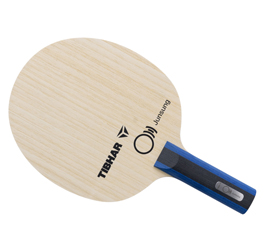
Tibhar Oh Junsung – A stiff outer composite blade with a muted feel
Hello again, TT11 blog readers.
Tibhar recently released a new 5+2 composite blade called the Tibhar Oh Junsung (TOJ), named after the young South Korean player who has already established himself as the best U19 player in his country and has cracked the Top 30 in the world rankings. According to Tibhar, the TOJ is a stiff, Korean-made outer carbon blade that offers a direct and crisp feeling, resulting in a stable and predictable trajectory. The blade is claimed to handle incoming energy well while also providing a precise short game, sharp flicks, and ample power for aggressive counter-attacking play. Tibhar recommends the TOJ for offensively oriented players seeking a direct feel and substantial power for topspin and attacking play.

The TOJ is delivered in Tibhar’s standard black minimalist box, which offers good protection during transport.
The blade itself has a clean, modern appearance. The playing surfaces are pale, straw-colored, with the FH side listing the blade name, while the BH side is devoid of text. The handle is dark grey with two vertical royal blue stripes. The FH side of the handle features an oval silver tag listing the blade name in black text, whereas the BH side features a small circular tag depicting Oh Junsung’s logo. A standard rectangular silver Tibhar tag is positioned at the bottom of the handle. The playing surfaces feel slightly rough, and the wings have not been sanded. Nonetheless, the overall build quality appears good.
I was unable to locate official information regarding the TOJ’s ply composition. The blade has a relatively thick core, which I suspect is kiri wood, followed by a comparatively thin intermediate ply. This is, in turn, surrounded by a relatively thick black-and-green composite weave. Judging by the color and grain pattern, the outer ply is almost certainly koto.
The TOJ has the following playing surface dimensions (height x width x thickness: 157 mm x 150 mm x 5.75 mm). The FL handle has the following dimensions (length x width x height): 101 mm, 26.3-34.1 mm, and 22.3-24.6 mm. My TOJ weighed approximately 83 grams. Bouncing a ball on the naked blade produced a resonance frequency of approximately 1477 Hz, which suggests the blade is rather stiff and firmly within the OFF to OFF+ range.
Testing Procedure
I evaluated the TOJ using well-used sheets of DHS Hurricane 3 (H3, black, 2.15 mm, 40-degree orange sponge) and Yasaka AntiPower (YAP, red, 1.5 mm) antispin as my FH and BH rubbers, respectively. I attached the rubbers using one layer of the Revolution 3 normal viscosity glue on both the rubber and blade. I tested the setup over four sessions, playing a mix of regular and match-like drills against my regular high-level practice partner (a two-winged looper), using Neottec Neoplast Pro 40+ training balls throughout this test.

Playing Impressions
Initial Impressions
The TOJ felt light, well-balanced, and comfortable in the hand, with a relatively large and comfortable grip.
Driving
The TOJ felt somewhat less stiff on FH and BH drives than I initially expected based on Tibhar’s description and the blade’s high resonance frequency. While the blade is unquestionably fast, its muted feel and lack of bounciness on lower-impact shots make it play slightly slower than its raw stiffness would suggest. Upon contact, FH drives produced a soft, dampened sensation with minimal residual vibration reaching the hand. To some extent, this softness masks the blade’s underlying rigidity. Consequently, FH drives tended to have relatively long and flat trajectories, requiring good timing to consistently achieve sufficient net clearance. The TOJ did not strike me as particularly springy on FH drives, but rather uniformly fast and direct. The blade’s feedback was somewhat more pronounced during BH drives, presumably due to the softness of the YAP antispin rubber, although the overall impression remained similar: a muted, low-vibration response.
Looping
FH looping with the TOJ/H3 combination produced long, relatively flat trajectories. Dwell time is on the shorter side, and spin production when the ball was contacted at its zenith was somewhat lower than with more flexible or inner-carbon offensive blades. I was able to generate noticeably more spin when contacting the ball during its descending phase, but at no point did I feel that spin generation was the blade’s primary strength. Although FH warm-up looping was highly consistent, I found myself missing the end of the table slightly more often than usual during match-like third-ball attack drills. In other words, the blade rewards precise timing and active footwork.
The TOJ offered ample power during FH loop-to-loop rallies, making it easy to keep the ball in play from mid and long distance. However, when attempting decisive finishing shots, I occasionally overshot the table by a few centimeters, which I attribute to the blade’s relatively low throw angle combined with its strong rebound characteristics at higher impact levels.
My BH antispin flat hits against backspin were somewhat more timing-dependent than with other blades. Once again, I attribute this to the blade’s stiff nature and the relatively flat trajectories it produces.
Blocking
FH blocking during warm-up was stable and consistent. However, the blade’s muted feedback, short dwell time, and nonlinear response made it slightly difficult to judge exactly how aggressively to engage the ball. During more match-like blocking and counterlooping exchanges, I occasionally overshot the table by a substantial margin as the blade’s composite structure became more strongly engaged on higher-impact shots.
The blade provided clearer feedback during BH blocking with the softer antispin rubber, resulting in improved distance control. The resulting blocks were extremely fast, flat, and difficult to counterattack.
 " alt="">
Smashing
Considering the TOJ’s speed and stiffness, it is unsurprising that it performs well on smashes and flat hits. There is abundant power available to finish points decisively. However, the blade’s muted feel and sudden increase in rebound on harder impacts meant that I occasionally overshot the table by a noticeable margin. It is definitely a blade that requires some adjustment.
Flicking
I found it easy to execute FH and - especially - BH pancake-style flicks with the TOJ, likely due to the blade’s inherent stiffness and direct response. Somewhat surprisingly, considering the blade’s short dwell time, it also performed well on mini-loop style FH flicks. Presumably, this is because the blade remains relatively controlled and non-bouncy on lower-impact shots. Consequently, I was able to lift short pushes confidently and place FH flicks accurately into difficult locations with good consistency.
Pushing
Considering the blade’s stiffness and short dwell time, I initially expected FH pushes to be relatively tame. However, my long FH pushes were generally of very high quality, producing long trajectories combined with substantial spin. This combination made it difficult for my practice partner to generate outright third-ball winners. The absence of excessive catapult on lower-impact shots, coupled with the tacky and comparatively slow nature of my H3 FH rubber, likely explains this behavior.
Equally surprising was the TOJ’s performance on short FH pushes and BH antispin drop shots. The blade allowed for controlled pushes that consistently remained short and low. Once again, the blade’s soft touch on lower-impact shots and absence of a strong catapult appear to be the determining factors.
BH antispin chopping from mid and long distance also worked remarkably well, considering the blade’s inherent stiffness and speed. It is important, however, to use soft hands while chopping, as more direct contact causes some chops to travel long. With proper technique, it was possible to execute flat, high-quality BH chops with good consistency.
Conclusion
The Tibhar Oh Junsung exhibits a distinctly nonlinear response: low-impact shots feel soft, muted, and controlled, whereas higher-impact shots engage the composite structure and produce a much stiffer and stronger catapult. As a result, the TOJ is more demanding than most other contemporary composite blades, rewarding precise timing, active footwork, and confident acceleration through the ball. Advanced offensive players will appreciate the blade’s combination of strong power, flat trajectories, and controlled short-game touch. However, players who prefer high throw angles, prolonged dwell time, abundant feedback, or a greater margin for error may find the TOJ challenging to handle.
About the Reviewer

Patrick 'Pong Professor' Hrdlicka is a table tennis enthusiast with a Ph.D. in chemistry who combines his analytical and experimental skills with his love of table tennis in order to test and review a wide range of table tennis equipment.