We use cookies to make your experience better. To comply with the new e-Privacy directive, we need to ask for your consent to set the cookies. Learn more.

Andro TP Ligna CI OFF and CO OFF

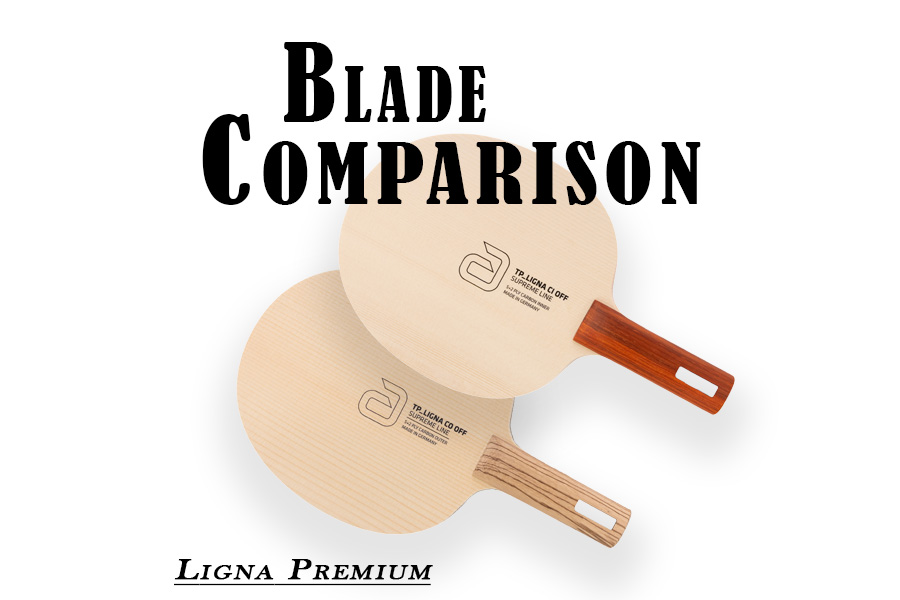
Andro TP Ligna CI OFF and CO OFF
Premium Soulspin-Made Blades
This time, I have been testing two blades from Andro’s TP Ligna series, i.e., the Andro TP_Ligna CI OFF (LCI) and the Andro TP Ligna CO OFF (LCO). These blades have a carbon inner and carbon outer 5+2 ply construction, respectively. These premium blades are made by Soulspin. Accordingly, only the highest-quality veneers – similar to those used in musical instruments – are selected, with particular attention paid to how they are sawn. Moreover, only the finest woods are chosen to make the special ergonomic shape of the flared handles that integrate seamlessly with the blade.

Andro TP_Ligna CI OFF

Andro TP_Ligna CO OFF
According to Andro, the LCI offers precise ball feedback and excellent precision without loss of speed and pressure, whereas the LCO is asserted to produce a direct and clear stroke that still produces a lot of feeling.
The blades are delivered in Andro’s sturdy “supreme line” boxes, which are grey with yellow accents. Generic information about Andro blades is provided on the back of the boxes. The boxes have blade-specific stickers on the front lip of the inside box.
Both TP Ligna blades look great with their straw-colored surface plies and beautiful, brown vertical wood grains. The Andro logo and the blade name are printed on the FH side, whereas the BH side is without text. Both blades have a rather wide shape near the handles that is a hallmark of many Andro blades. The LCI’s gorgeous FL handle looks like it is made of redwood or mahogany and has irregular dark striations and a rectangular metallic Andro tag on the FH side and a rectangular metallic tag listing the blade name on the handle butt. The BH side has no tags. The LCO’s handle is also gorgeous and is made of a light-brown wood type (walnut?) featuring prominent dark-brown, almost black, vertical wood grain. The LCI handle is exceptionally smooth, whereas the LCO handle feels more porous. The blades are very comfortable to hold, in part because the blade wings are extensively sanded.
The LCI has an inner ply construction with a relatively thin kiri core that is surrounded by a carbon ply, followed by a thin intermediate ayous ply, and a thick outer spruce ply. The LCO has an outer ply construction with a medium-thick kiri core that is surrounded by a thin spruce ply, followed by a carbon ply that seems thicker than in the LCI, and a medium-thin outer spruce ply.
The playing surfaces of both blades have the following dimensions: 156 mm x 150 mm x 6.2 mm (height x width x thickness). The ergonomic FL handles have the following dimensions (length x width x height): 99.2 mm, 25.5-32.5 mm, and 22.6-28.1 mm (LCI) and 99.8 mm, 25.4-32.1 mm, and 22.4-27.5 mm (LCO). Note: the ergonomic shape of the handles made it challenging to measure the handle height, as there is no abrupt transition to the thumb rest. Moreover, the butt of the handle is fairly rounded. The LCI and LCO weighed 86 grams and 93 grams, respectively. Bouncing a ball on the naked blades produced resonance frequencies of 1523 Hz and 1301 Hz for the LCI and LCO, respectively. Somewhat surprisingly, this suggests that the LCI is either significantly stiffer and/or faster than the LCO. In fact, this would suggest that the LCI is in the OFF+ range, whereas the LCO is in the OFF- range.
Testing Procedure
I tested the blades using well-used sheets of DHS Skyline 3 (S3, black, 2.1 mm, 40-degree, blue sponge, provincial version) and Spinlord Waran II (W2, red, 2.0 mm) short pips as my FH and BH rubbers, respectively. I attached the rubbers to the blade using one layer of the Revolution 3 normal viscosity glue on both the rubber and the blade. I tested the setup over 4-5 sessions, playing a mix of regular and match-like drills against my usual high-level practice partner (two-winged looper) and practice matches against various club members, using Neottec Neoplast Pro 40+ training balls throughout this test.
Playing Impressions
Driving
The LCI produces a soft and woody feeling on FH warm-up drives. The carbon characteristics are subtle. My FH drives had a rather long and flat trajectory, which was slightly confusing for me as I typically associate a soft feeling with slower blades. The LCI almost gave me hinoki-blade-like associations, but it is less bouncy. The speed is greater (low-to-mid OFF) than the blade’s muted feeling would have you think. BH drives with the short pips felt a little crisper due to the softer sponge of the Waran 2. I enjoyed excellent consistency on FH and BH drives despite the relatively low throw angle, presumably since the blade is only slightly bouncy, which makes it quite predictable.
The LCO produces a slightly crisper sensation on FH warm-up drives, and the outer carbon ply is felt more clearly than with the LCI. Nonetheless, the overall feeling is still quite soft with the LCO. The LCO’s throw angle is minimally lower and the overall blade speed marginally higher (mid OFF) compared to the LCI. The LCO’s carbon characteristics shine through more clearly on BH drives, as the blade feels moderately stiff. The shorter dwell time and flatter throw angle meant that my BH drives had a greater tendency of going into the net with the LCO vis-à-vis the LCI.
Looping
The LCI produces relatively long and flat trajectories on FH warm-up loops. I used a little more wrist action to ensure that the shots cleared the net. The spin levels on the shots seem to be average, good, but unexceptional. The feeling remains quite soft on these higher-impact shots. FH third ball attacks against long pushes are not spectacularly fast but can be placed in hard-to-reach places as the blade behaves predictably, with no excessive catapult. My short pip BH openers against backspin were similarly controlled and relatively dangerous because I had the confidence to hit the ball a little harder. I found the LCI also to work well in FH loop-to-loop rallies. It offers plenty of speed to land the ball comfortably without undue physical effort, though I needed a slightly more upward motion to ensure that the ball cleared the net. I was also able to execute BH mid-distance fishing shots with good consistency, even though the feeling was relatively soft.
The LCO feels a little sharper than the LCI on FH warm-up loops, but overall produces shots with similar characteristics. In other words, my FH loops were relatively flat and long, but not extremely fast. Spin levels were average due to the shorter dwell time of the outer spruce plies. My third ball FH attacks were slightly more dangerous, but with an increased probability of going long. I found it important to maintain a relaxed forearm to prevent overshooting the table. My short pip BH openers against backspin felt stiffer than with the LCI but also caught the top of the net on more occasions, resulting in a reduced consistency vis-à-vis the LCI. My BH mid-distance fishing shots, on the other hand, were significantly snappier than with the LCI, resulting in quite dangerous shots. The LCO works great on FH loop-to-loop rallies as the stiffer and faster nature helps propel the ball deep onto the table.
Blocking
The LCI also produces a relatively soft feeling on FH blocks. The blade seems quite capable of absorbing the incoming energy and redirecting it in a controlled manner, as only a mild catapult is activated. BH blocks, with the softer Waran 2, felt slightly more crisp and were equally well-behaved.
In comparison, the LCO produces a slightly sharper feeling on FH and – especially – BH blocks. I enjoyed excellent blocking consistency. The shots seemed to have relatively long trajectories, even though they aren’t fantastically fast.
Smashing
The LCI is sufficiently fast to allow you to finish any balls that sit up. However, the blade’s relatively soft feeling makes it a little challenging to assess how cleanly you have hit the ball. I found myself preferring to loop-drive, rather than smash, the shots instead. In comparison, the LCO produces a significantly sharper feeling on smashes, especially BH smashes. Said differently, the feeling when smashing seems more appropriate with the LCO than the LCI.
Flicking
Both Ligna blades worked very well for FH flicks. The soft nature of the LCI is better suited to mini-loop-type flicks than pancake-type ones. I was able to lift short pushes over the net in a controlled fashion in pinpoint locations. The slightly sharper nature of the LCO, conversely, favors pancake-type FH flicks whilst still allowing for the execution of mini-loop-style flicks. The fast but not extremely fast nature of the LCO ensured that my flicks didn’t overshoot the table.
Pushing
Both blades were very pleasant to push with. The slightly longer dwell time of the LCI allowed for slightly greater spin generation, producing deep pushes that forced my practice partner to use a more upward motion when looping. The LCO produces slightly faster pushes, which in turn gives my practice partner less time to prepare his loop. The relatively soft feeling of both blades gave me the confidence to slice the ball quite aggressively.
Short pushes and touch shots are relatively easy to execute with both Ligna blades, as the catapult effect is modest, allowing for predictable shot execution. Short pushes with the LCI seemed to be a tad lower and spinnier than those with the LCO. The soft, almost all-wood-like feeling facilitates touch play.
Serving
The soft feeling produced by the two Ligna blades suits serving very well. The LCI works very well for short spinny serves, whereas the LCO shines on longer topspin serves, as the more direct feeling gives an impression of the rubbers biting into the ball.
Conclusion
The Andro TP Ligna CI OFF (LCI) and the Andro TP Ligna CO OFF (LCO) are two exceptionally beautiful and well-crafted high-end 5+2 composite blades that produce a soft feeling on ball impact. The LCI almost feels like an all-wood blade, whereas the carbon plies shine a little more clearly through with the LCO, especially in combination with softer rubbers. Both blades are in the mid OFF category, even though their soft nature can give the impression that the blades are slower than that. In my opinion, these blades will suit spin-offensive players who rely primarily on loops, flicks, and short pushes. The LCO, with its slightly stiffer and direct feeling, will generally provide more feedback, especially when blocking and smashing, which some players will prefer. These are excellent blades for players looking to transition from all-wood blades.
About the Reviewer
Patrick 'Pong Professor' Hrdlicka is a table tennis enthusiast with a Ph.D. in chemistry who combines his analytical and experimental skills with his love of table tennis in order to test and review a wide range of table tennis equipment.
