Nous utilisons les cookies pour vous offrir une meilleure expérience utilisateur. Pour se conformer à la nouvelle directive concernant la vie privée, nous devons vous demander votre consentement pour sauvegarder des cookies sur votre ordinateur. En savoir plus.

Tibhar Alexis Lebrun Krypto Carbon and Tibhar Felix Lebrun Hyper Carbon blades

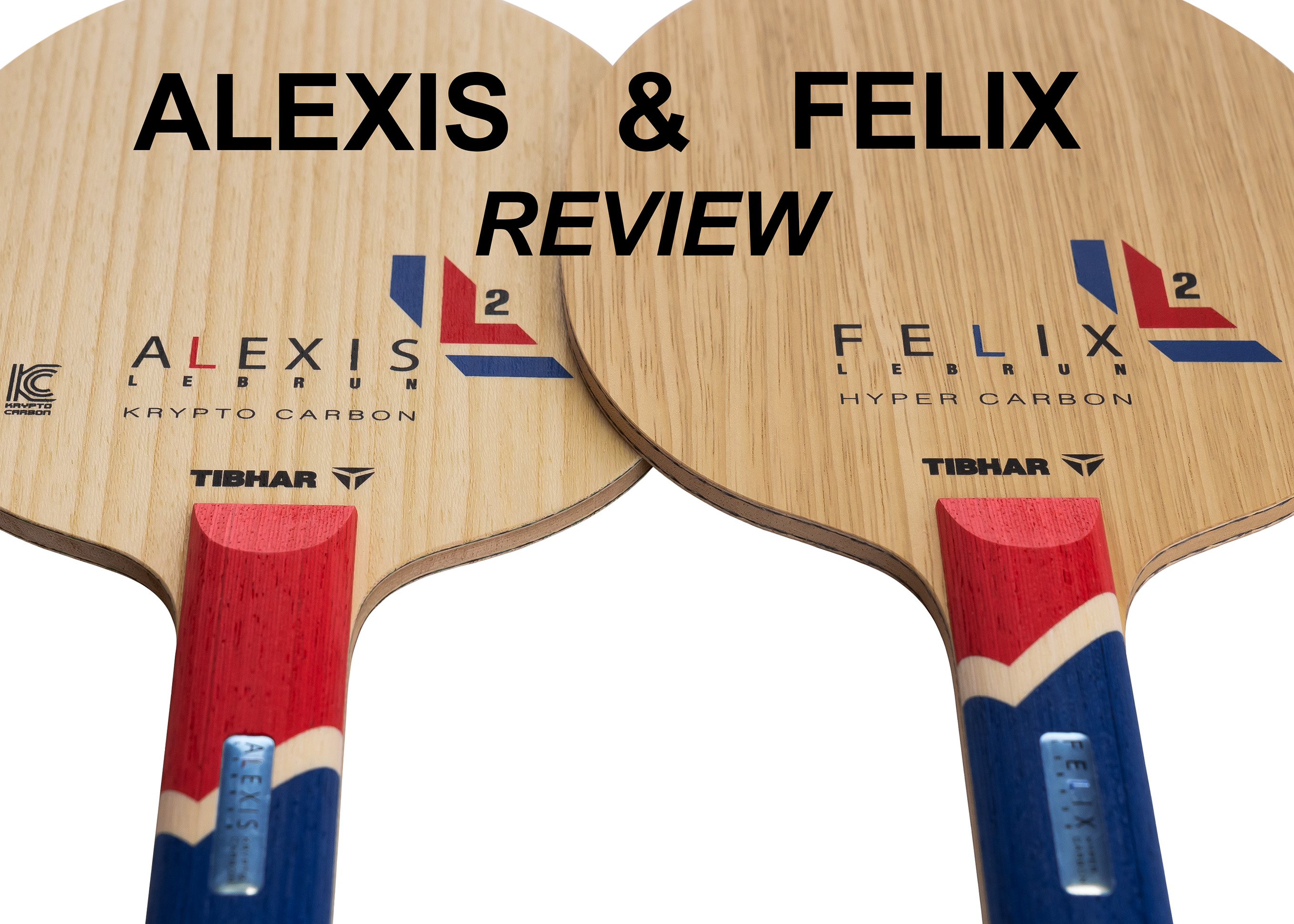
Tibhar Alexis Lebrun Krypto Carbon and Tibhar Felix Lebrun Hyper Carbon Blades
Hello TT-enthusiasts and TT11 blog readers. We’ve got something special for you this time: a side-by-side review of the Tibhar Alexis Lebrun Krypto Carbon and Tibhar Felix Lebrun Hyper Carbon blades, which are used by the talented Lebrun brothers who have made quite the splash on the table tennis scene in recent years, including Felix, who reached the semi-finals of the 2024 Olympic Games.
As one might expect from watching the Lebrun brothers play, these are fast 5+2 ply composite blades. The Alexis Lebrun Krypto Carbon (ALKC) has a layer of Krypto Carbon placed directly below the hard koto outer ply. Krypto Carbon is a special type of carbon fabric that is quite “fluffy, ”which, according to Tibhar, results in longer dwell time, better ball sensation, and improved control without a loss of power. Tibhar further states that “though not designed for amateurs, the blade is constructed to allow players to change the speed and/or rotation at any time”.
The Felix Lebrun Hyper Carbon (FLHC) blade has an inner fiber composition, i.e., a blended weave of synthetic carbon fibers that surround the core veneer. According to Tibhar, this construction generates the high stiffness and catapult effect that a fast-attacking blade requires, while resulting in a longer and more sensitive ball contact. Tibhar recommends the FLHC to players who seek a powerful attacking game but still want to play sensitive and varied strokes.
Tibhar rates the speed/control of the ALKC and FLHC blades as 9/7 and 9-/8-, respectively, as compared to ratings of 9-/7+, 9/,8 and 9+/8- for the Samsonov Force Pro Black Edition, Dynamic JC, and Fortino Force blades, respectively.
The two blades come in grey cases that offer good protection during transport, except for the very bottom of the handle, which is exposed to the elements. As one might expect, the ALKC features a grey tone head shot of Alexis along with a light blue LL2 symbol in the lower right corner (presumably the LL2 symbol denotes the two Lebrun brothers), whilst the FLHC features an equivalent photo of the younger brother and a red LL@ symbol in the lower left corner. No additional information is provided on the front lip or the back of the packaging.
The two blades share a similar design. The FH side of each blade lists the blade name and features Tibhar and blue and red LL2 logos, while the BH side is devoid of text. The handles are kept in a red, white, and blue color scheme (i.e., the colors of the French flag), with the white section having the shape of a checkmark (✓). The checkmark goes through the lens on the ALKC, whereas it is located above the lens on the FLHC. The silver lens on the FH side of the handle lists the blade name in black font, with the “L” in “Alexis” and “FeLix” being slightly raised and colored red and blue, respectively. A silver tag depicting the Tibhar logo adorns the handle butt. The handle on the BH side of the blade has the same color scheme as the FH side and features a small, square, silver tag with the LL2 logo. The pale, straw-colored surface veneer of the ALKC is quite clearly koto as it has a prominent “fish scale” pattern. The surface veneer of the FLHC is straw-colored and appears to be limba. Both blades have a modern appearance and seem to be well-made. Neither blade has been sanded.
The ALKC has a thick core, a thin intermediate ply, a thin weave of Krypto Carbon, and a comparatively thick outer ply of koto wood. The FLHC has a thick core, a relatively thick weave of Hyper Carbon, a thin intermediate ply, and a very thin outer ply of limba wood. According to my measurements, the playing surfaces of the FLHC are slightly larger than those of the ALKC(height x width: 158 x 152 mm and 157 x 151 mm, respectively), with thicknesses of 5.75 mm. And 5.95 mm, respectively. Both blades weighed in at 87 g. Bouncing a ball on the naked blades produces low main resonance frequencies of 1570 Hz and 1406 Hz for the ALKC and FLHC, respectively. This suggests that both blades, but the ALKC in particular, are stiff and fast. The center of gravity for the ALKC and FLHC is approximately 2.3 cm and 4 cm from the handle, respectively.
The FL handle dimensions for the ALKC are as follows: length 100.6 mm, width 26.1-33.8 mm, and height 22.5-24.6 mm, whereas the FL handle dimensions for the FLHC are: length 100.6mm, width 25.6-33.4 mm, and height 23.7-25.3 mm.
Testing Procedure
I evaluated the ALKC and FLHC blades using well-used sheets of DHS Hurricane 3 (H3, black, 2.15 mm, 40-degree) and Spinlord Waran II (W2, red, 2.0 mm) shortpips as my FH and BH rubbers, respectively. I attached the rubbers to the blades using one layer of the Revolution 3 normal viscosity glue on each of the rubbers and the blade. I tested the setups over several sessions each, playing a mix of regular and match-like drills against my regular high-level practice partner (two-winged looper) and practice matches against intermediate-level club members, using Neottec Neoplast Pro 40+ training balls throughout this test.

Playing Impressions ALKC
Driving
The ALKC produced a somewhat disengaged, almost hinoki-like sensation on FH drives with the relatively hard-sponged H3, whereas the blade offered a little more feedback on BH drives with the softer W2. The trajectories of my FH/BH drives were relatively flat (medium-low) but sufficient to clear the net comfortably. Contrary to my expectations, the ALKC turned out not to be spectacularly fast. I would categorize it as a low OFF blade. Accordingly, the trajectories of my drives were only medium-long when using standard levels of input power.
Looping
The feeling on FH loops was similarly muted. The shots had medium-low throw angles and were more direct than spinny in nature. The ALKC’s moderate pace meant that I enjoyed good consistency on diagonal warm-up FH loops, but some of my down-the-line FH loops caught the top of the net. The medium-low throw angle and lack of catapult meant that I had to work a little harder and time my 3rd ball attacks well, to generate enough power. The spin levels were respectable for a composite blade, but lower than with all-wood blades like the Tibhar Samsonov Force Pro Black Edition. Often, I had to be ready for follow-up 5th and 7 counter-drives to finish up the point.
The ALKC/H3 combination worked reasonably well in FH loop-to-loop rallies, though I had to use more wrist and pull more upwards than normal to land the shots due to the relatively flat throw angle. The moderate speed of the ALKC meant that I managed to keep a high proportion of these shots on the table.
Consistent with my prior findings, BH openers against long pushes felt livelier and crisper due to the softer ALKC/W2 combination. Thus, I was able to feel the ball more clearly, resulting in more consistent 3rd ball BH attacks.
Blocking
The ALKC’s moderate speed, muted feeling, and lack of catapult render it a capable blocking blade. The ALKC easily absorbed the energy from incoming high-quality loops with both the harder H3 and softer W2. The medium-low throw angle ensured that the blocks landed on the table, rather than overshooting it. The absorbing nature of the blade also enabled
Me to execute aggressive counter-loops off the bounce with good consistency, without overshooting the table.
Smashing
While smashes can be competently and consistently executed with the ALKC, this wouldn’t be the main playing style given the blade’s moderate speed, unless it is paired with a fast and softer rubber with a strong catapult.
Flicking
The combination of the ALKC and H3 produced a muted feeling on FH flicks. Thus, players have to rely on automated movement patterns from the practice hall as the blade doesn’t provide much feedback. That being said, the soft feeling and moderate speed enabled me to execute controlled FH flicks with good consistency. Once again, the feeling was crisper on the BH side when using the ALKC in combination with the W2. Thus, I was able to better feel the ball making contact with the blade, which gave me the confidence to execute more aggressive BH banana flicks.
Pushing
I enjoyed excellent consistency on FH long pushes with the ALKC/H3 combination. The dwell time feels a little longer than with other composite blades (but shorter than with most all-wood blades), resulting in a slightly longer contact. This, coupled with the lack of catapult and comparatively moderate speed, meant I was able to cut through the ball quite aggressively and impart respectable amounts of spin on the ball. Accordingly, my practice partner had to use a more upward motion on his loops. Similarly, I was able to execute long BH pushes with the W2 with good levels of spin and control. The ALKC’s moderate speed and linear nature allowed me to execute effective short FH/BH pushes and touch shots. I would have preferred a sharper sensation when striking the ball, but that’s simply personal preference.
Serving
The ALKC’s characteristics allow for the execution of good-quality serves. There is no catapult to worry about, and since the dwell time is slightly longer than with other composite blades, it is possible to impart good (but not spectacular) amounts of spin on serves.
Conclusion
The Tibhar Alexis Lebrun Krypto Carbon is a low OFF level 5+2 ply composite blade that produces a soft, somewhat muted feeling on ball impact. It is a balanced blade that supports controlled offensive playing styles that mix up loops, flicks, and blocks with touch shots. In my opinion, you will want to combine the ALKC with fast rubbers with hardnesses ranging from medium-soft to medium-hard, to feel the ball more clearly, and unfurl greater power reserves.

Playing Impressions FLHC
Driving
The initial contact when striking the ball with the FLHC on FH drives feels quite soft, yet at the same time, the blade is clearly very stiff, producing a slight cracking sound. In fact, the FLHC is possibly the stiffest 5+2 inner fiber blade that I have tested. Accordingly, my FH drives felt rigid and were fast with a flat trajectory. The stiffer nature of the FLHC was even more obvious on BH drives with the softer Waran 2 short pips. The pips felt far more glassy than usual and produced a stronger sink effect than with most other blades. All in all, the feeling on BH drives was crisp, and I enjoyed excellent consistency. The blade is fast (OFF), although the softer outer ply, to some degree, masks the blade’s speed on these shots. The blade has a noticeable, but not super strong, catapult effect.
Looping
Warm-up FH loops produced a soft but slightly cracking feeling that never left me in doubt that I was using a composite blade. The FH loops were fast with a low throw angle but clearly lacked spin relative to other setups. My FH 3rd ball attacks, when played as part of a regular drill, were fast and quite deadly. However, the consistency of my FH loops in more random, match-like situations was significantly lower than usual since I had a hard time feeling and imparting spin on the ball. Moreover, the FLHC/H3 has a low throw angle, which results in flat shot trajectories, but also in many shots that go too long unless one uses softer hands and/or steps away from the table. The FLHC has plenty of power to engage in effective loop-to-loop rallies far from the table. Once again, when combined with the H3, the shot trajectories are quite flat, which compromises consistency a little bit. The FLHC had enough power to enable me to use the softer Waran II pips for fast BH fishing shots and smashes away from the table.
Blocking
The stiff nature of the FLHC works great on FH warm-up blocks, resulting in fast, flat, and consistent blocks. However, many of my FH blocks careened off the table during more random match-like situations, as the blade seemed incapable of fully absorbing the incoming energy due to its stiff nature and short dwell time. I made similar observations when blocking BH. The FLHC works great during warm-up BH blocks and produces a prominent sink effect, but my BH blocks had a tendency of going long during match-like situations, unless I went ultra-aggressive and used a lot of wrist action to keep the block low. In general, I found that engaging the ball aggressively on blocks resulted in a massive acceleration, presumably due to the Hyper Carbon plies.
Smashing
The relatively fast and stiff nature of the FLHC lends itself very well to smashes on both the FH and BH sides. I won many outright points smashing with either FH or BH, as the shots are fast and flat.
Flicking
The FLHC felt too soft and too stiff for my taste on FH flicks. Given the short contact time, it is important to time FH flicks well, as it is challenging to mini-loop short pushes over the net. I liked the FLHC better for BH flicks with the softer Waran 2, as I was able to lift the ball over the net with excellent consistency and high pace.
Pushing
Long FH and BH pushes were fast and flat, which gave my opponents less time to prepare for their attacking shots. However, the spin level is relatively low due to the short dwell time. Considering how fast the FLHC is, it proved surprisingly capable on short pushes and touch shots. When using soft hands, the blade’s stiffness doesn’t kick in as much, and the shots are dictated more by the softer outer limba ply rather than the stiff Hyper Carbon plies.
Serving
My short backspin pendulum serves were low and with average spin levels, whereas long side-/top-spin serves seemed to lack spin, presumably since the stiff Hyper Carbon ply kicked in, reducing the dwell time.
Conclusion
The Tibhar Felix Lebrun Hyper Carbon is a fast and stiff blade for (highly) advanced, uncompromisingly aggressive players, who rely on loop-drives and smashes (including with short pips) as their main playing style. I would recommend using the FLHC from mid-distance as it is easier to generate higher ball trajectories from there. The blade produces a rather flat trajectory, which may compromise shot consistency with hard rubbers. I would therefore recommend using this blade with softer and high-throwing rubbers.
Final Thoughts
The Lebrun blades are geared towards advanced-level players with modern aggressive playing styles, with the ALKC being more balanced and docile than the FLHC.
About the Reviewer
Patrick 'Pong Professor' Hrdlicka is a table tennis enthusiast with a Ph.D. in chemistry who combines his analytical and experimental skills with his love of table tennis in order to test and review a wide range of table tennis equipment.
