Nous utilisons les cookies pour vous offrir une meilleure expérience utilisateur. Pour se conformer à la nouvelle directive concernant la vie privée, nous devons vous demander votre consentement pour sauvegarder des cookies sur votre ordinateur. En savoir plus.

Four Different 3-Star 40+ Balls Used on the World Table Tennis (WTT) Tour

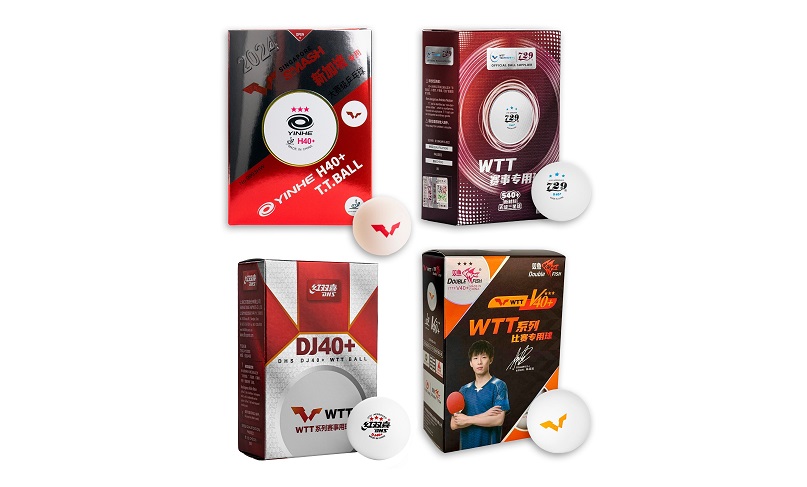
Four Different 3-Star 40+ Balls Used on the World Table Tennis (WTT) Tour
Dear TT11 blog readers,
Balls are an essential part of our sport. I returned to the sport in 2014, right when the switch from celluloid 40 mm balls to the new plastic 40+ balls was starting. Initially, the quality of the seamed 40+ balls, in which two halves are fused together, was very poor as they lacked consistent roundness, felt light, broke easily, and represented poor value. I strongly preferred seamless balls from XSF and YinHe back in the early days of the 40+ era, as these balls were much more consistent and harder. A couple of years later, 2017-2018, if memory serves me right, a second generation of 40+ plastic balls was introduced, which are based on Acrylonitrile Butadiene Styrene (ABS) as the key polymer. That completely changed the landscape, and to my knowledge, most 40+ balls are now ABS-based.
In this test report, I am evaluating four 3-star balls that are used on the World Table Tennis tour, i.e., the seamed Double Fish V40+ 3*** WTT ITTF (V40+), DHS DJ40+ 3*** WTT ITTF (DJ40+), and Yinhe 40+ 3*** WTT ITTF (H40+) balls, as well as the seamless 729 40+ 3*** S40+ WTT (S40+) balls. Given that they are used for this top tournament series, expectations are that these should be top-quality balls. But are they?
The seamed Neottec Neoplast Pro 40+ (NP40+) training balls serve as my reference point in this test. We have used the NP40+ at our club for the past 4-5 years and found them to be excellent training balls.
Packaging, Marketing, and Appearance
The Double Fish V40+ balls arrive in a black and orange box featuring 2019 Women’s Singles and Mixed Doubles World Champion Liu Shiwen on the front, as she is Double Fish’s main brand ambassador. The reverse side lists Double Fish’s major table tennis ball production and tournament milestones. A description of the seamed ball manufacturing process is also listed on the reverse side. Double Fish asserts that the balls will not deform easily even when experiencing environmental changes, promising “high stability, fastness, and durability”. Double Fish goes on to state that the balls have a high bounce and high speed and provide for an excellent playing experience. The side of the package lists the different quality controls that the balls have passed and Double Fish’s contact information. The V40+ ball is off-white-colored and features a Double Fish logo that is mostly red with some black text. The opposite side of the ball features a moderately sized orange WTT logo. The surface of the V40+ is very rough.
The DHS DJ40+ balls arrive in a shiny, mostly red and silver box that features an illustration of the ball on the front and back. The side of the box, presumably, lists major milestones (written in Chinese), the different quality controls that the balls have passed, and DHS’s contact information. The DJ40+ is off-white-colored and features a DHS logo that is mostly black with some red text. The opposite side features a small black WTT logo. The surface of the DJ40+ is slightly rough.
The YinHe H40+ balls arrive in a shiny, mostly red and silver box that features renditions of the ball on the front. The reverse side lists safety and contact information for YinHe, while the side of the box states that the balls are ITTF-approved. The H40+ is off-white-colored, featuring a YinHe logo that is mostly black with some red text. The opposite side of the ball features a large, dark-red WTT logo. The H40+ has a surface roughness that falls between that of the V40+ and DJ40+.
The 729 S40+ balls arrive in a glittery, mostly wine-red and silver box that features an illustration of the ball on the front and back. The box features a rectangular silver logo on each of its sides, which states that the S40+ is used in the WTT Youth Series. The sides of the box list safety and contact information, as well as the different quality controls that the balls have passed. The S40+ is bright, almost blueish white, which gives it a thinner and more fragile appearance compared to the other balls. The S40+ features a 729 logo that is mostly black with some blue text. A circular blue WTT stamp, featuring the text “youth”, is placed on the opposite side of the ball. The S40+ has by far the smoothest surface of the four 3-star ball types tested.
Preliminary Measurements and Tests
I measured the diameter of six balls of each type using calipers. The diameters of all balls were within the measurement error that I estimate at ± 0.1 m), with the 729 S40+ balls being particularly uniform. The 729 S40+ and YinHe H40+ balls are marginally larger (~40.1 mm) than the DHS DJ40+ (~40.05 mm), Double Fish V40+ (~40.0 mm), and Neottec NP40+ (~40.0 mm) balls.
I weighed six balls of each type using a high-precision balance. The order - from lightest to heaviest - is as follows: Neottec NP40+ (2.576 g ± 0.014 g), Double Fish V40+ (2.738 g ± 0.011 g), YinHe H40+ (2.743 g ± 0.007 g), 729 S40+ (2.749 g ± 0.004 g), and DHS DJ40+ (2.759 g ± 0.005 g) (± denotes standard deviation). Thus, the DHS DJ40+ balls are slightly heavier than the other 3-star balls, whilst the training balls are noticeably lighter. I was pleasantly surprised to see that the tolerances are tight for all ball types, with the 729 S40+ having the tightest standard deviation (0.15%), while even the Neottec NP40+ training balls have a tight standard deviation (0.54%).
I bounced randomly selected balls of each type against each other to determine the order of bounce height. As far as I could determine, the order from highest to lowest bounce is as follows: Neottec NP40+ > 729 S40+ > Double Fish V40+ and YinHe H40+ > DHS DJ40+.
I also evaluated the roundness of the balls by spinning them around their axis (6 balls of each type were tested). As far as I could tell, all of the balls were very round, with the YinHe H40+ and 729 S40+ possibly being ever so slightly more perfectly round than the other types.
Playing properties
Double Fish V40+

The V40+ felt noticeably harder, heavier, and slower than our regular NP40+ training balls. Moreover, the sound that is produced when the ball bounces on the table is significantly louder, crisper, and more satisfying. Backspin serves travelled a significantly shorter distance and bounced lower than with the NP40+. Topspin shots, on the other hand, seemed to travel further. Both observations are likely an effect of less spin being imparted on the ball (backspin makes balls sit up, while topspin makes balls dip). Playing with the V40+, I felt as if I had a fraction of a second more time to get into position. The shot trajectories were as expected, with no fluttering, indicating that the balls are perfectly round. The new V40+ balls only left a little bit of residue on our rubbers, and there was only a little bit of color transfer from our rubbers onto the balls.
DHS DJ40+

While very clearly an ABS ball, the DJ40+ felt slightly subtler compared to the V40+. Thus, it didn’t feel quite as hard, heavy, and slow as the V40+. The sound produced when bouncing on the table is also slightly quieter. I got the impression that my backspin serves travelled slightly longer and had a slightly higher trajectory. Topspin shots seemed to have a more pronounced arc, resulting in a slightly higher and shorter trajectory, leading me to think that it is slightly easier to impart spin on the DJ40+. Moreover, I felt that I didn’t have quite as much time for each shot as with the V40+. Shot trajectories were completely predictable, and the balls seemed to be perfectly round. The new DJ40+ balls only left a little bit of residue on our rubbers, but there seemed to be a little bit more color transfer from our rubbers onto the balls than with the V40+.
The YinHe H40+

The YinHe H40+ balls felt slightly faster and softer than the V40+ and DJ40+, but the differences are minor. The sound when hitting the table is also less prominent than with the V40+. My backspin serves travelled slightly longer than with the V40+. Topspin shots also seemed to have a slightly flatter trajectory than with the DJ40+ and more akin to the V40+. Of the three-seamed WTT balls, I felt that I had the least time for shot preparation with the H40+. The H40+ behaved completely predictably with no fluttering, indicating that they are perfectly round. The H40+ was the only ball type where I could see the logo whilst playing. The H40+ balls only left a little bit of residue on our rubbers, but there seemed to be considerable color transfer from our rubbers onto the balls.
The 729 S40+

The 729 S40+ balls felt noticeably different from the three other WTT balls and resembled our Neottec Neoplast Pro 40+ training balls most closely. The S40+ sounds significantly softer and feels lighter and faster, and has the flattest and longest topspin trajectories. I had a harder time seeing the brightly white S40+ ball in the lighting of our venue, as the slightly reflective surface seemed to generate a slight strobing effect, which I didn’t notice to the same extent with the other, more matte and off-white-colored WTT balls. The S40+ balls only transferred a slight amount of residue onto our rubbers and seemed to have the greatest resistance towards transferring color from our rubbers, as they maintained their bright whiteness almost perfectly.
Conclusion
As one might have expected and hoped, all four types of 3-star WTT balls are excellent. The dimensions and weights are within narrow distributions. The three-seamed ball types (i.e., the V40+, DJ40+, and H40+) have very similar playing properties, and it would be challenging to tell them apart in a blind test. They are harder and feel heavier, and slower than the seamless S40+, encouraging a more physical playing style. The seamless S40+, while also very consistent, feels lighter (even though it isn’t) and faster and more akin to the initial generation of 40+ balls. The bright white color of the S40+ may render it challenging to see clearly for aging eyes. For what it’s worth, my preference would be the Double Fish V40+ ball, but I would be perfectly content playing tournament with any of the four WTT balls.
About the Reviewer
Patrick 'Pong Professor' Hrdlicka is a table tennis enthusiast with a Ph.D. in chemistry who combines his analytical and experimental skills with his love of table tennis in order to test and review a wide range of table tennis equipment.
