We use cookies to make your experience better. To comply with the new e-Privacy directive, we need to ask for your consent to set the cookies. Learn more.

YinHe PRK-520 – A Highly Controllable Blade for a High-spin Game.

July 4, 2026
|
View: 28
YinHe PRK-520 – A Highly Controllable Blade for a High-spin Game.
Hello again, TT11 blog readers,
This time around, I am reviewing the YinHe PRK-520, a high-performance blade designed for players who prioritize spin, control, and precision over outright speed. The blade features a 5+2 ply innerforce construction that is intended to increase dwell time, allowing for high-arcing topspins while providing consistent feedback and effective vibration dampening. YinHe recommends the blade for spin-focused attackers seeking maximum precision, all-around players transitioning to a more offensive style, and athletes looking for professional-grade equipment.
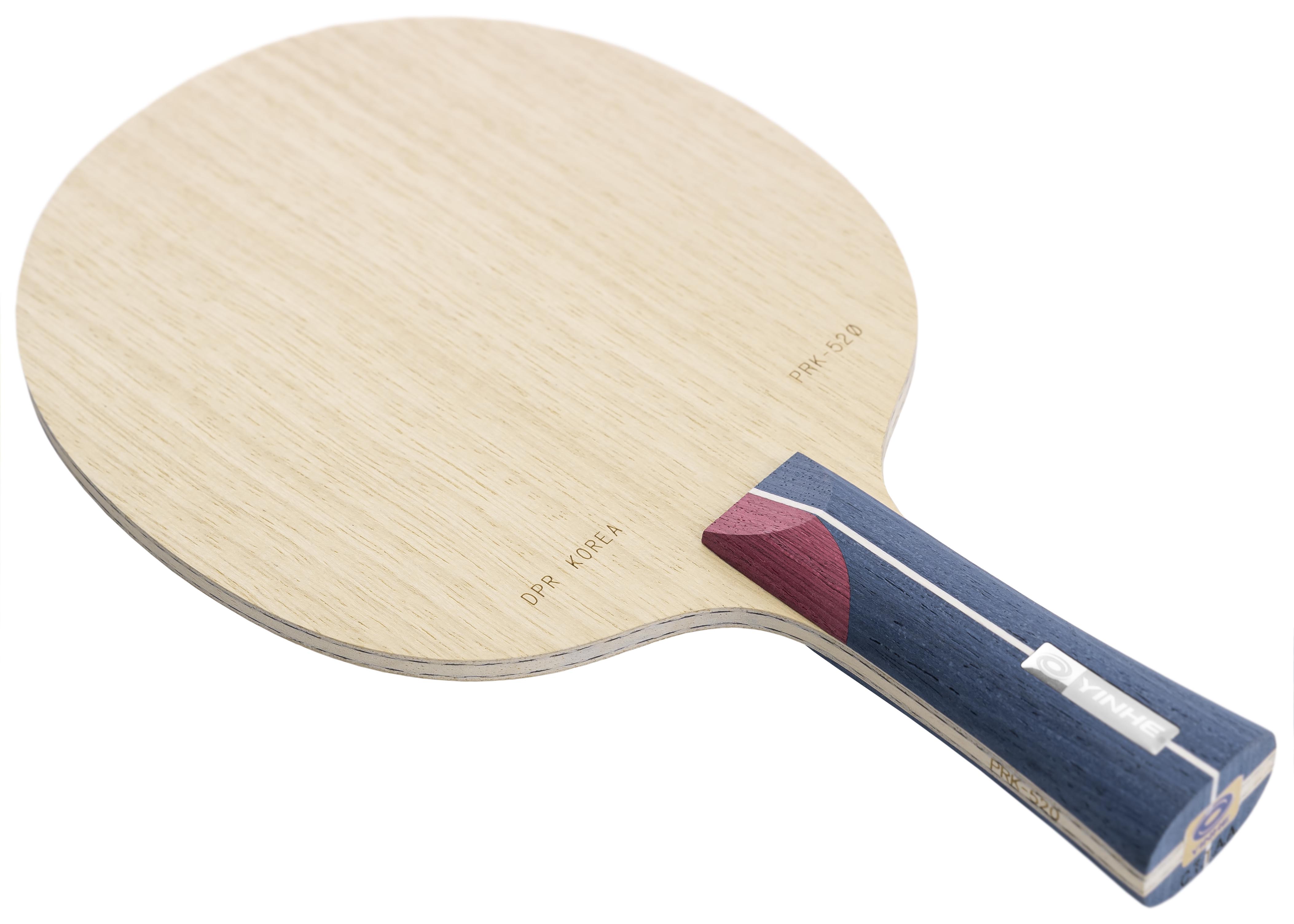
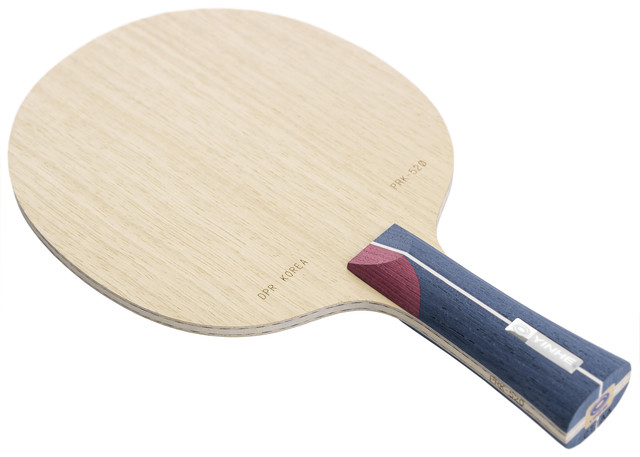
My PRK-520 sample arrived shrink-wrapped in YinHe plastic but without a box. The blade design is simple. Neither of the straw-colored playing surfaces feature any text or graphical elements. Only one side - presumably the FH side - has a “DPR Korea PRK-520” inscription above the top of the handle. The handle is predominantly blue, with a thin vertical white stripe and a burgundy section toward the upper left part of the handle that would be covered by a left-hander’s thumb. The FH side of the handle features a rectangular silver YinHe tag, while a small oval silver tag with the YinHe logo is embedded in the BH side of the handle. A blue-on-gold YinHe tag is positioned at the bottom of the handle.
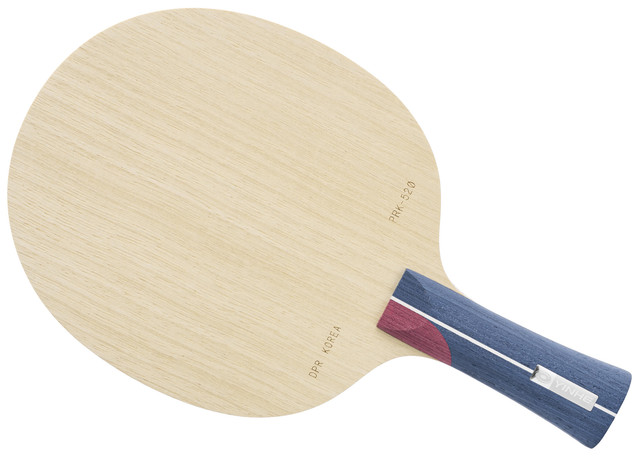
My inspection of the blade revealed smooth playing surfaces that appear lightly varnished. The blade wings have not been sanded, but do not feel sharp. I was unable to find reliable information about the exact ply composition; however, the color and vertical grain suggest a limba outer ply, followed by a comparatively thick intermediate layer, a thin blue-and-white composite weave, and a medium-thick core (likely kiri).
The PRK-520 has the following playing surface dimensions (height x width x thickness): 158.5 mm x 151 mm x 5.95 mm. The FL handle measures 101.5 mm (length), 27.3-35.7 mm (width), and 23.2-25.0 mm (height). In other words, the handle is quite long and unusually wide and flared. My sample weighed ~87 grams. Bouncing a ball on the bare blade produced a resonance frequency of ~1395 Hz, indicative of a relatively fast blade in the low OFF range.
Testing Procedure
I evaluated the PRK-520 using well-used sheets of DHS Hurricane 3 (H3, black, 2.15 mm, 40 degrees) and Yasaka AntiPower (YAP, red, 1.5 mm) as my FH and BH rubbers, respectively. I attached the rubbers using one layer of the Revolution 3 normal-viscosity glue on both the rubber and the blade. Testing was conducted over four sessions, including a mix of regular and match-like drills against my regular high-level practice partner (a two-winged looper), using Neottec Neoplast Pro 40+ training balls throughout this test.
Playing Impressions
Initial Impressions
The PRK-520 feels very comfortable in the hand, with a slightly head-heavy center of gravity. Transitions between FH and BH strokes felt quick and natural throughout testing.
Driving
The PRK-520 produces a surprisingly soft, almost all-wood-like feeling during FH warm-up drives, with just a touch of added stiffness from the composite layer. The ball impact feels moderately crisp. FH drives had a relatively long arc, good net clearance, and excellent control. On these medium-impact strokes, the blade plays like a solid OFF-. BH antispin drives were equally controllable, with similarly long trajectories. Overall, this is a blade that inspires confidence and consistency on basic drives.
Looping
FH looping with the PRK-520/H3 combination is effortless. The feel is again relatively soft, with subtle underlying stiffness from the composite layer. The dwell time of the ball is above average, resulting in a medium-high throw angle, which provides plenty of clearance over the net. The extended dwell time also facilitates strong spin generation, particularly when contacting the ball in its descending phase. My practice partner’s blocks frequently overshot the table, suggesting increased spin and depth. On higher-impact shots, the blade exhibits more flex, contributing to longer, deeper trajectories. Consistency during warm-up looping was excellent.
Third-ball attack drills against long pushes further confirmed these impressions. While the PRK-520 is not exceptionally fast, it enables highly precise, spin-heavy FH loops with outstanding consistency. This is a blade for players who value ball feel and precision over raw power.
The PRK-520 truly shines in FH loop-to-loop rallies. Its combination of controlled flex, above-average dwell time, high throw angle, and sufficient base speed allows for sustained, high-quality exchanges. In fact, I was able not only to match my practice partner but occasionally put him under pressure through the consistency and depth of my spinny loops.
BH antispin flat hits against long pushes were equally reliable and difficult to counter. The longer trajectory required attention to bat angle - an open angle produced dipping, effective shots, whereas a more closed angle increased the risk of overshooting the table.
 " alt="">
Blocking
Warm-up FH blocking felt smooth and controlled. The blade’s moderate stiffness helps absorb incoming topspin while still allowing for precise and consistent redirection of power. BH antispin blocks behaved similarly, offering excellent control.
In more dynamic, match-like situations, the PRK-520 remained predictable and stable, allowing accurate placement of fast FH blocks into hard-to-reach areas. This made it challenging for my practice partner to mount effective fifth-ball attacks. Very passive blocks occasionally overshot the table, likely due to the blade’s dwell time and throw angle, but this was easily corrected using a slightly more active stroke.
Smashing
While not a classic flat-hitter’s blade - it is simply too soft and controlled for that - the PRK-520 performs adequately in situations where smashes are needed, even with H3. Pairing it with a faster European/Japanese rubber would likely improve performance in this area.
Flicking
Regular readers will know that FH flicks are not a strength of mine - yet with the PRK-520, this changed noticeably. Mini-loop FH flicks against short pushes consistently found their target successful, likely due to the blade’s dwell time and higher throw angle, resulting in excellent net clearance. BH antispin flicks were even more effective. The blade provided excellent feedback and gave me the confidence to use an aggressive wrist action, hitting the ball in its zenith, resulting in flat, dangerous flicks.
Pushing
My practice partner commented on the excellent quality of my long FH pushes on several occasions, noting their depth and spin. The blade seems to hold the ball slightly longer, resulting in strong contact and enhanced spin generation. Consistency on these pushes was excellent.
The quality of my short FH pushes against backspin serves were among the best I have achieved, the shots staying low and tight, limiting my opponent’s attacking options.
BH antispin chops from mid to long distance were flat, controlled, and highly consistent, forcing my opponent into patient, low-speed topspin rallies. Overall, the PRK-520 is sufficiently controlled and non-bouncy to support defensive play when needed.
Conclusion
The YinHe PRK-520 is an outstanding 5+2 inner composite blade that is ideally suited for players transitioning from all-wood blades to composite constructions. It offers an excellent balance of dwell time, spin generation, and control, combined with a flexible yet stable feel. While it is not designed for players seeking maximum stiffness and outright speed, it excels in controlled offensive play, particularly in looping and counter-looping scenarios. For players who prioritize precision, spin, and consistency, the PRK-520 is an exceptional choice - and one of the most balanced and confidence-inspiring blades I have tested. I strongly recommend this blade to players of all levels.
About the Reviewer

Patrick 'Pong Professor' Hrdlicka is a table tennis enthusiast with a Ph.D. in chemistry who combines his analytical and experimental skills with his love of table tennis in order to test and review a wide range of table tennis equipment.