We use cookies to make your experience better. To comply with the new e-Privacy directive, we need to ask for your consent to set the cookies. Learn more.

YINHE Big Dipper – Is It a Hurricane 3 Alternative?

YINHE Big Dipper – Is It a Hurricane 3 Alternative?
Dear TT11 blog readers,
I am excited to share my first review of a product from YINHE, which is a growing brand that currently supports the Democratic People's Republic of Korea National Team and several Chinese provincial teams and Super League players.
More specifically, I tested two versions of YINHE’s flagship Big Dipper rubber, i.e., the YINHE Big Dipper Pro (BDP) and the 40-degree YINHE Big Dipper Pro National (BDN). A lower-priced regular Big Dipper (BD)is also available but was not tested. I have seen quite a bit of favorable chatter about the Big Dipper rubbers over the years and was therefore excited to try them out. As a long-time Hurricane 3 (H3) user, I am always interested in evaluating possible H3 alternatives.
YINHE describes the regular BD as a tacky, high-performance rubber with a medium-hard sponge that caters to versatile offensive players who rely on looping, hitting, and serving. The BDP is described as a more advanced version with greater speed, and it is purported to enable powerful and fast strokes due to the built-in tensor effect from YINHE's MAX TENSE sponge. The BDN is described as a modern take on traditional Chinese rubbers that is engineered to provide unparalleled grip, rendering it a top choice for players who demand exceptional spin and precise control.
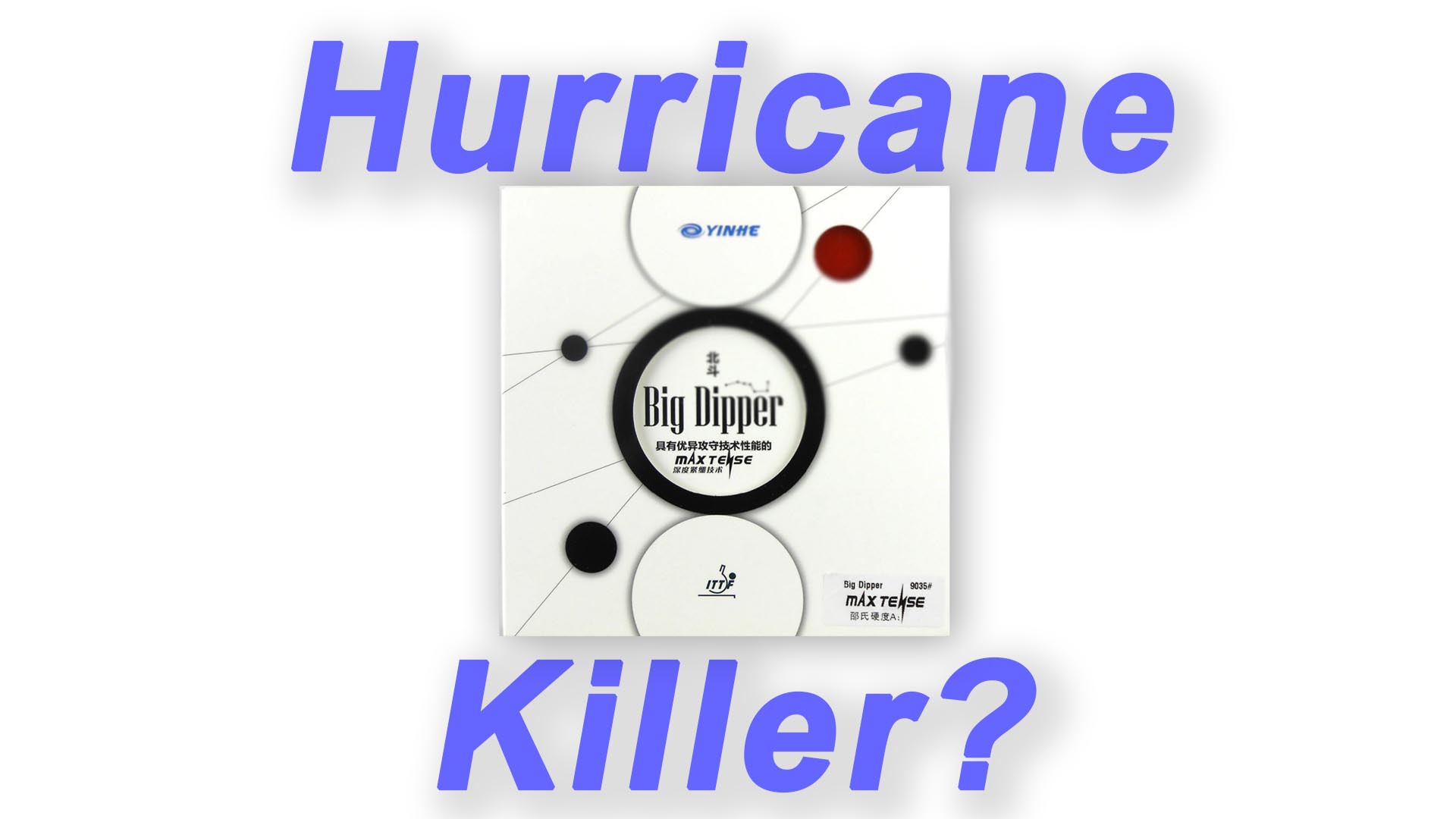
The BDP arrives in a simple, grey cardboard wrapper that features a green circle with the Big Dipper constellation on the front. The model number (9035P) and the sponge hardness (37 degrees) are listed on the front, while technical and marketing information are listed on the reverse side. When opening the package, I immediately noticed a strong fishy smell, indicative of extensive factory boosting. The upper corners of the BDP sheet are cut (similar to provincial H3 sheets) and the topsheet is covered by a thin transparent adhesive plastic film, while the sponge is covered by an opaque plastic film. YINHE includes an additional, thick, non-adhesive, protective sheet that can be used to protect the topsheet once the thin disposable film is peeled off the rubber. The BDP topsheet is very sticky and grippy, with pimples faintly visible below the surface. The salmon-colored medium-hard sponge has a high density of microscopic pores and arrives with a pre-applied sticky glue/boost layer. The BDP weighed 64-65 grams uncut (166 mm x 166 mm, width x height) and 48 when cut to the 158 mm x 151 mm test blade, which is similar to a DHS H3 Neo, rendering it as a reasonably light rubber.
The BDN arrives in a vacuum-sealed plastic wrapper. The golden front lists the model number (9035L) and hardness (40 degrees), whereas the transparent back provides uninhibited views of the blue sponge. Unlike the BDP, none of the BDN’s corners are cut. The BDN sheet has a rubbery smell. Although the BDP and BDN use the same topsheet, as evidenced by the identical ITTF approval codes, BDN’s black topsheet seemed slightly stickier than the BDP’s red topsheet. Like the BDP, the BDN topsheet is covered by a thin, adhesive, disposable plastic film, while the dark blue sponge does not come with a pre-applied glue/booster layer. The firm sponge has a high density of almost undiscernible pores. The BDN was quite a bit heavier than the BDP, weighing ~72 grams uncut (168 mm x 165 mm, width x height) and 53 grams when cut to the 158 mm x 151 mm test blade, which is quite heavy but still lighter than most sheets of DHS Hurricane 8, Nittaku Hurricane Pro 3 Turbo Orange, or Nittaku Hurricane Pro 3 Turbo Blue.
Testing Procedure
I evaluated the BDP (red, max) and BDN (black, 2.0) rubbers using the Tibhar Samsonov Force Pro Black Edition 7-ply all-wood blade and Spinlord Waran 2 short pips in my BH. I attached the brand-new YINHE rubbers to the blade as received (i.e., no additional boosting) using two layers of the Revolution 3 normal viscosity glue. I tested the setups over several sessions each, playing a mix of regular and match-like drills against my regular high-level practice partner (two-winged looper), using Neottec Neoplast Pro 40+ training balls in the process.

Playing Impressions – BDP
Initial Observations
The BDP is very tacky and easily capable of lifting the ball for several seconds. It felt harder than the purported 37 degrees on the DHS scale, both to touch and whilst playing. If I didn’t know better, I would have pegged it at 38 degrees.
Driving
The BDP felt quite slow on FH warmup drives (ALL+ to OFF-). Although the rubber’s throw angle is quite high, the trajectory of my FH drives was very short, dipping shortly after the net. Accordingly, I had to use more power to lengthen my FH drives.
Looping
The BDP has a high throw angle, which I attribute to its high tackiness. This, in turn, allowed me to execute controlled but relatively slow FH warmup loops. I was able to impart high levels of spin on the ball when I executed my FH loops from a low starting position. Whenever I hit the ball more directly, the trajectory flattened out quite substantially, to the extent that I started overshooting the table, even though no catapult was activated.
The low speed and high tackiness of the BDP meant that I had to rely on precise ball placement and high spin levels, rather than brute force, when playing 3rd ball FH attacks against long pushes to win points.
The BDP worked respectably well in FH loop-to-loop rallies far from the table despite the rubber’s low inherent speed and linear nature, as the high throw angle provided the necessary safety over the net. Occasionally, it seemed as if the BDP held onto the ball for a fraction longer than expected, resulting in an excessively high throw angle, which caused me to overshoot the table.
Flicking
I found the BDP to work really well on FH flicks. The rubber’s moderate speed, coupled with its high tackiness, allowed me to lift short pushes and place moderately fast FH flicks in hard-to-reach places with excellent consistency.
Blocking
While the BDP’s low inherent speed helped me keep shots on the table when blocking, its high tackiness means it is very spin sensitive, as the ball holds on to the rubber longer than normal. It is therefore important to take this into account when FH blocking to maintain high consistency. The BDP’s spin sensitivity might be the reason why the rubber doesn’t work particularly well when counterlooping. Passive blocks, executed using a fairly open bat angle, are the way to go and can be executed with good consistency.
Flat Hitting
Since the BDP is a relatively slow, linear, and very tacky rubber, it is not exactly designed for flat hitting and smashing. That said, the test blade was sufficiently fast and stiff to enable me to execute controlled FH smashes that my practice partner struggled to return.
Pushing
The BDP worked supremely well on long FH pushes against backspin serves. I was able to impart tremendous amounts of spin on the ball, which rendered it very challenging for my practice partner to attack my pushes effectively. The ball bites into the tacky topsheet and holds on for longer than normal, resulting in maximal spin production.
The BDP also works supremely well on short FH pushes. My shots were low and loaded with spin, which rendered it difficult for my practice partner to execute flicks.
Serving
Since the BDP is quite slow and linear, I had to use a more aggressive motion on my pendulum back/side-spin serves, as the ball otherwise went into the net. Consequently, my backspin serves were loaded with spin. Conversely, it seemed as if my long top/side-spin serves caused my practice partner less problems.
Conclusion
The YINHE Big Dipper Pro is an excellent prototypical Chinese rubber for intermediate players, but will probably be too slow for more advanced players, unless it is coupled with a very fast blade. The BDP allows for controlled spin-offensive strategies, pushing, and quality short game.
Other rubbers this reminds me of: A higher-throwing DHS Hurricane 2.

Playing impressions – BDN
Initial Observations
The black BDN is an exceptionally tacky rubber, and easily capable of not only lifting the ball for many seconds, but even holding the ball when the blade is held perpendicular to the table. The BDN felt like a 40-degree rubber to the touch, but felt more like a 39-degree rubber during gameplay.
Driving
The first couple of FH warmup drives immediately revealed the BDN to be a significantly faster rubber than the BDP (high OFF-). Additionally, the BDN felt much more dynamic and produced a rather prominent clicking sensation that seemed to emanate from the topsheet-sponge interface, resembling a well-boosted blue-sponged H3. Accordingly, the trajectories of my FH drives were significantly longer than with the BDP, with plenty of clearance over the net, thanks to the high throw angle. All in all, I enjoyed excellent consistency on my FH drives and felt like I could go on all day without making any mistakes.
Looping
Just like the BDP, the BDN has a high throw angle, presumably due to the flypaper-like qualities of the topsheet. This gave my FH warmup loops plenty of clearance over the net, but unlike the BDP, the shot trajectories were significantly longer with the BDN, presumably due to the faster, more elastic, and presumably factory-boosted sponge. The clicking and dynamic feeling rendered FH warmup loops very enjoyable.
My 3rd ball FH attacks against long pushes were also far more dangerous with the BDN than with the BDP due to the faster inherent pace of the rubber. The spin levels on my FH loops were excellent, albeit slightly lower than with H3. The biggest difference relative to H3 is that the throw angle is higher, resulting in a higher bounce than with the H3, which is characterized by a flat bounce.
The BDN worked exceedingly well on FH loop-to-loop rallies far from the table due to its high throw angle and dynamic nature. I enjoyed excellent consistency, and my shots were more dangerous than normal.
Flicking
Just as with the BDP, I found the BDN to work really well on FH flicks against short backspin pushes. The highly tacky nature of the BDN enabled me to easily lift the ball over the net, and the higher speed of the rubber vis-à-vis the BDP meant my shots had longer trajectories and were more dangerous.
Blocking
The BDN is sensitive to incoming spin, which impacts blocking. However, I felt that the faster, more dynamic sponge reduced this concern, rendering the BDN less sensitive than the BDP. Thus, I enjoyed good consistency on FH warmup blocks, as well as FH blocks during match-like play. The blue dynamic sponge enables active, open-face hits through incoming topspin balls, rendering the BDN a more dangerous blocking rubber than the BDP. Akin to my observations with the BDP, I found counterlooping perhaps to be the weakest point of the BDN. Sometimes an incoming topspin ball reacted with the topsheet, resulting in a very flat shot trajectory that ended in the net, and other times the block had a high throw angle that led to overshooting the table. Once again, flat hitting with an open bat angle worked better, resulting in fast and hard-to-return blocks.
Flat Hitting
The faster and more dynamic nature of the BDN renders it a far better smashing rubber than the BDP or H3. Thus, I was often able to finish off points with decisive smashes that were near-impossible for my practice partner to return.
Pushing
Just like the BDP, the BDN worked supremely well on long FH pushes against backspin serves, as I was able to impart very high levels of spin on the ball. The faster nature of the sponge relative to the BDP did not seem to decrease my consistency, but only rendered my pushes even more dangerous. The ultra-tacky topsheet grips the ball very well and allows for maximal control on pushing. This is one of the best rubbers that I have tested for this shot category.
FH short pushes were also a breeze with the BDN, although they were slightly harder to keep low and spinny compared to the BDP and H3. Nonetheless, the BDN also shines in this category.
Serving
The BDN is an excellent service rubber. While the spin levels perhaps are marginally lower than with a well-boosted H3, they are still very high. Thus, my short pendulum back/side-spin serves as well as my long top/side-spin serves were loaded with spin.
Conclusion
The YINHE Big Dipper National is an outstanding rubber that approaches the levels of blue-sponged DHS Hurricane 3, although it has slightly different characteristics. Thus, it is higher-throwing, faster on low-to-medium impact shots like FH drives and warmup loops, but perhaps doesn’t produce quite as much power on high-impact shots like FH loops due to slightly weaker coupling between player, sponge, and ball. However, most players will likely find the BDN to be more forgiving than a blue-sponged H3, and I could easily see players using this in lieu of a blue-sponged 39-degree DHS Hurricane 3. Top-level players would probably hope for a 41-degree version of this rubber for improved power coupling.
Other rubbers this reminds me of: A higher throwing version of a boosted, blue-sponged 39-degree DHS Hurricane 3.
About the Reviewer
Patrick 'Pong Professor' Hrdlicka is a table tennis enthusiast with a Ph.D. in chemistry who combines his analytical and experimental skills with his love of table tennis in order to test and review a wide range of table tennis equipment.
