We use cookies to make your experience better. To comply with the new e-Privacy directive, we need to ask for your consent to set the cookies. Learn more.

XIOM Hugo Calderano HAL

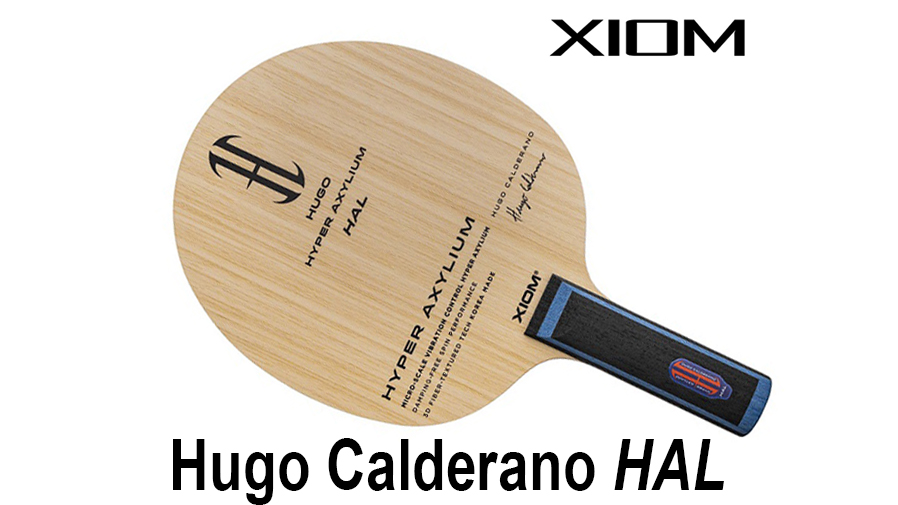
XIOM Hugo Calderano HAL – An excellent blend of speed and control
Welcome back to another blade review! If you follow this blog regularly, you know that I have reviewed many Xiom blades recently, including the Hayabusa series, the Ice Cream AZX PRO, and several members of the TMX/TMXi series, such as the Hugo TMXi PRO (HTP). I have generally found Xiom blades to be of excellent quality and have therefore been looking forward to testing the Xiom Hugo Calderano Hyper Axylium (HAL), which the “Thrill from Brazil”, Hugo Calderano (2025 World Cup Men’s Singles champion; silver medalist at the 2025 World Championships), is currently using.

The HAL is a 5+2 composite blade with outer koto plies. The composite material used in the construction of the HAL is Hyper Axylium, a high-quality, carbon-free, orange Arylate developed by XIOM. According to XIOM, Hyper Axylium quickly captures vibrations after ball impact, resulting in a clear feeling, improved repulsive power, and well-balanced performance. XIOM goes on to say that the Korean-made HAL is an all-around/offensive blade that offers a lot of feeling and control, yet provides high speed and power if larger stroke mechanics are used. The blade’s longer dwell time maximizes ball grip, rendering it more forgiving of errors, especially with harder rubbers.
Xiom rates the HAL as follows in the catapult, ball grab, repulsion, and precision categories: 8.7/7.5/7.7/9.1. Other top-end Xiom blades have the following corresponding scores: Hugo TMXi PRO (9.4/7.9/9.1/8.2), Ice Cream AZX PRO (9.7/8.3/8.3/7.7), Cho Daeseong TMX PRO (CD-TMXP, 9.3/7.6/8.3/9.0), and An Jaehyun TMXi PRO (AJH-TMXiP, 9.4/7.9/8.2/9.1). This suggests that the HAL will be a slower and more linear blade with high control.
The HAL is packaged in one of Xiom’s modern-looking, trapezoid-shaped boxes. The exterior of the HAL box features a blue “HC” logo against a metallic green background. The inner box is silver and metallic orange. Aside from a sticker listing the blade name (noted as “HUGO Hyper Axylium”) and grip type on the front lip, there is no other text on the box.
The first thing I noticed about the HAL is the somewhat unusual shape of the playing surface, which is more drop-shaped than most other blades. The surface is straw-colored with a vertical, light-brown wood grain that shimmers like koto.
The FH side features the HC logo, blade name, and a brief description of the main characteristics of Hyper Axylium, i.e., “micro-scale vibration control, damping-free spin performance, and 3D fiber-textured tech”. The BH side also features the HC logo and blade name along with the text “Future from another future”. The handle is dark grey with royal blue lines along the edges. Both sides of the handle feature the same tag that has a prominent red “HC” logo and blade name against a dark blue background. A tag depicting the text “Xiom HAL” is placed on the handle butt. All-in-all, the HAL is a good-looking blade. The build quality appears to be good, even though the playing surface feels a little rough and the narrow wings haven’t been sanded. Players who change their rubbers frequently might want to lightly seal the blade.
As far as I know, Xiom has not officially disclosed the ply composition of the HAL. My best guess is that the thick core is made of ayous wood, followed by a thin intermediate ply of limba, followed by an ultrathin weave of red Hyper Axylium, and a relatively thick outer ply of koto. The playing surface of the HAL has the following dimensions (height x width x thickness): 158 mm x 149.5 mm x 5.9 mm. The FL handle has the following dimensions (length x width x height): 103.6 mm, 26.4-34.3 mm, and 22.6-24.7 mm. My HAL weighed 87 grams. Bouncing a ball on the naked blade produced a resonance frequency of ~1418 Hz, which is higher than that of the AJH-TMXiP (1371 Hz) but lower than the HTP (1477 Hz) and CD-TMXP (1523 Hz), which are also 5+2 ply composite blades, but use Trimatrix as the composite ply. This suggests that the HAL is a blade in the OFF range.
Testing procedure
I evaluated the blade using well-used sheets of DHS Hurricane 3 (H3, black, 2.15 mm, 40-degree) and Yasaka AntiPower (YAP, red, 1.5 mm) antispin as my FH and BH rubbers, respectively. I attached the rubbers using one layer of the Revolution 3 normal viscosity glue on both the rubber and the blade. I tested the setup over several sessions, playing a mix of regular and match-like drills against my regular high-level practice partner (a two-winged looper), using Neottec Neoplast Pro 40+ training balls throughout this test.

Playing characteristics
Initial impressions
A hallmark of a well-balanced blade is that you don’t notice anything “weird” about it while playing. The HAL is such a blade. It felt nice and natural, with no apparent top-heaviness. It is comfortable to hold, and the handle is plenty long to accommodate my relatively large hands. I found it easy to make micro-adjustments between my slightly different FH and BH grips.
Driving
As I was playing the first couple of FH drives, I immediately noticed three things about the HAL: i) the feeling is butter-soft, almost hinoki-like and certainly not like a typical outer ply composite blade, ii) the throw angle is high, even very high, and iii) the blade is deceptively fast given how soft it feels, resulting in long trajectories. Thus, the HAL feels like an ALL+/OFF- blade, but it is a mid-OFF blade. Interestingly, this discrepancy does not arise because a strong catapult is activated. On the contrary, the blade feels linear. My guess is that these playing characteristics are a consequence of a very soft and thin Hyper Axylium ply, and a naturally fast koto outer ply. Whatever the underlying reasons, I enjoyed exquisite precision on my FH drives. Of note, my antispin BH drives easily cleared the net and had long, dipping trajectories that were uncomfortable for my practice partner.
Looping
The high throw angle of the HAL meant that my warm-up FH loops had plenty of clearance over the net. The fast nature of – and the soft feeling produced by - the HAL meant that I occasionally overshot the table in the beginning, especially on down-the-line FH loops. Once I adjusted the level of input power, I was able to execute these shots with very high consistency. I also noticed that the HAL’s extended dwell time allowed me to impart high levels of spin on the FH loops. However, when doing 3rd ball attack drills (FH loops against long pushes), my practice partner and I noticed that while the FH loops had long trajectories, they weren’t particularly fast, allowing him relatively stress-free blocking. It therefore became important for me to place my FH 3rd ball loops in hard-to-reach places – something that was quite easy to do thanks to the excellent control of the blade.
Similar to the HTP, the HAL works very well in FH loop-to-loop rallies from mid- and long-distance thanks to the high throw angle and long trajectory, and thus suits Hugo’s playing style. My shots were dangerous and consistent, making it a lot of fun to use the HAL for these shots.
Somewhat unusually, I also practice 3rd-ball attacks with my BH antispin rubber. I found the HTP to work very well, resulting in long, dipping shots that are uncomfortable. The blade’s excellent control was also evident here, as I was able to execute these shots with excellent consistency.
Blocking
While I normally favor setups that produce a sharp feeling when blocking, I must say that the HAL works very well for FH blocking. Although the feeling is quite soft, the high throw angle and relatively moderate speed helped ensure that the shots cleared the net while staying within bounds. The FH blocks were not lightning fast, but I was able to place them in hard-to-reach places with excellent consistency. Similarly, I was able to land my active antispin BH blocks with high consistency, causing all sorts of headaches for my practice partner.
Smashing
The HAL is not a flat-hitter’s blade, but still fast and stable enough to put away shots with authority, especially because it has an excellent speed-to-control ratio.
Flicking
Unlike the HTP, which lends itself well to pancake-type flicks, the HAL is better suited for mini-loop-style flicks, given the blade’s softness and extended dwell time. As a result, I could lift FH flicks over the net with excellent consistency. Yet again, the shots were not super-fast, but I was able to place them in hard-to-reach places. On the other hand, I was able to use the pancake-type technique for my BH antispin flicks, which turned out well, with deep and dipping trajectories.
Pushing
I enjoyed excellent control on my long FH pushes with the HAL. The blade’s extended dwell time, along with the high tackiness of the H3, allowed me to impart high spin levels on the shots, which were flat and deep, rendering it challenging for my practice partner to attack these shots. The soft, linear nature of the blade also allowed for delicate touch shots and short pushes to be executed with confidence.
I also tried using the HAL to chop from afar with the antispin rubber. Once again, I found the control to be excellent. The blade’s linear nature and extended dwell time gave me the confidence to chop aggressively and produce long, flat, floating chops that were challenging for my practice partner to return.
Conclusion
The Xiom Hugo Calderano Hyper Axylium is an outstanding blade that offers a very high level of control for how fast it is. The HAL’s unique feel—soft yet dynamic—makes it an attractive option for players seeking a more woody, carbon-free touch without giving up offensive power. This blade is geared for spin-offensive players who want to take advantage of the extended dwell time, to spin the ball and place shots in hard-to-reach places. Due to its manageable speed, it can be used by players of a wide range of skill levels. Well done, Xiom.
About the Reviewer
Patrick 'Pong Professor' Hrdlicka is a table tennis enthusiast with a Ph.D. in chemistry who combines his analytical and experimental skills with his love of table tennis in order to test and review a wide range of table tennis equipment.
