We use cookies to make your experience better. To comply with the new e-Privacy directive, we need to ask for your consent to set the cookies. Learn more.

Victas V > 22 Double Extra vs Xiom Vega Asia Hybrid – Two different takes on modern 50-degree rubbers

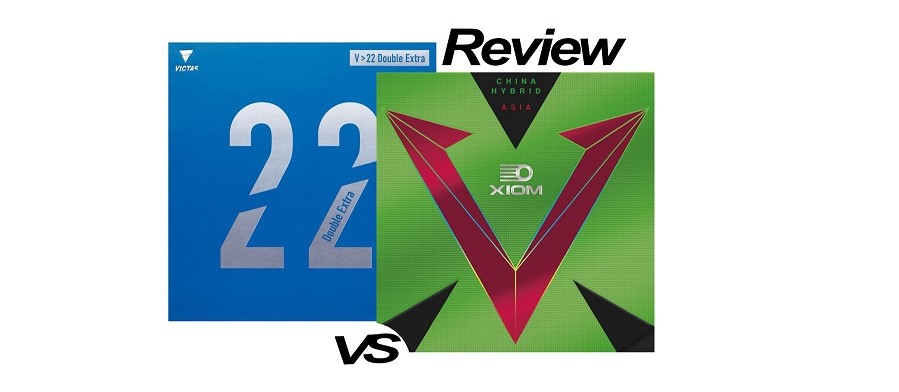
Victas V > 22 Double Extra VS Xiom Vega Asia Hybrid
Two Different Takes on Modern 50-Degree Rubbers
Hello again, fellow table tennis enthusiasts!
This time, I am reviewing the Victas V > 22 Double Extra (V22) and Xiom Vega Asia Hybrid (VAH) rubbers, which are both 50-degree rubbers. While this is my first review of an inverted Victas rubber, I did recently review two other rubbers from Xiom, i.e., the Xiom Omega VII Guang China (O7GC) and Xiom Vega Pro H (VPH). I was particularly impressed by the VPH, finding it to be a predictable offensive rubber and an excellent choice for intermediate-level offensive players, as it supports all aspects of the modern game, from looping and pushing to counter-driving.
Victas V > 22 Double Extra
International top players Koki Niwa and Liam Pitchford were involved in the development of V22, which Victas asserts offers “almost unbelievable speed and spin ratings”. Victas claims that the topsheet “guarantees perfect coupling of the ball” while the sponge supports “powerful, speed-reliant attacking styles”, all whilst providing high stability that “enables highly precise placement of your own attacks”. Victas gives the German-made V22 speed/control/spin/trajectory/sheet strength ratings of 9.6/8.0/9.1/6.7/9.0, while the popular V > 15 Extra and V > 20 Extra rubbers are rated at 9.4/8.1/8.8/7.4/9.2 and 9.2/8.5/9.2/6.8/7.2, respectively.

The V22 arrives in a silver-on-blue Victas cardboard wrapper, which lists the blade name on the front and typical technical and marketing information on the back. Inside the wrapper, you’ll find the V22 rubber covered by a simple paper sheet. The V22 has a sweet scene, suggesting that it has been factory-boosted. The matte red topsheet has pimples that are faintly visible below the surface and is quite grippy. The cream-colored sponge has a high density of medium-sized pores. The V22 weighs ~68 grams uncut (170 mm x 170 mm, width x height) and 49 grams when cut to the 158 mm x 151 mm test blade, which is fairly average for a 50-degree rubber.
Testing Procedure
I evaluated the VAH (black, max) and V22 (red, max) rubbers using one of my standard reference blades, i.e., the Tibhar Samsonov Force Pro Black Edition 7-ply all-wood blade with Spinlord Waran II short pips in my BH. I attached the brand-new rubbers to the blade as received using two layers of the Revolution 3 normal viscosity glue. I tested the setups over 3-4 sessions each, playing a mix of regular and match-like drills against my regular high-level practice partner (two-winged looper), using Neottec Neoplast Pro 40+ training balls throughout this test.
Playing Impressions V22
Initial Impressions
The V22 feels significantly softer to touch and during gameplay than its 50-degree hardness designation would suggest. I could easily have been fooled into believing this to be a ~47-degree rubber. The minimally sticky topsheet can lift the ball, but only for half a second or so.
Driving
The first couple of FH warmup drives revealed that the V22 is a rather soft, exceedingly bouncy, and rather fast rubber (high OFF, if not low OFF+ on medium and medium-high impact strokes). A prominent click and crisp feeling are produced when hitting the ball. The trajectories of my FH drives were long and relatively flat, but still with sufficient clearance over the net to provide good consistency.
Looping
My warm-up FH loops with the V22 were long, fast, and consistent, provided I moderated my input power. Whenever I used more than 60%-70% of my max power, a very prominent catapult was activated, which often caused me to overshoot the table, as it was challenging to precisely gauge when the catapult would activate and how strong it would be. A prominent clicking sound is produced on FH loops, which gave me flashbacks to speed-glue rubbers from the 1980s and 1990s. Spin levels on the warmup FH loops were below average, judging by the fact that my practice partner had no problems whatsoever returning the shots.
My 3rd ball FH attacks against long pushes had sufficient clearance over the net, thanks to the medium throw angle. However, while my FH attacks were fast, they lacked spin. Consequently, the FH loops dipped less than with other rubbers, resulting in long trajectories. Whenever I used high levels of input power on my FH loops, a prominent catapult activated, often causing my FH loops to go long. Accordingly, it was very important for me not to “overplay” the rubber and instead use soft hands, moderate amounts of input power, and rely on the crisp feeling to place the shots in hard-to-reach areas.
The V22 works very well in FH-to-FH loops, rallies far from the table due to its high inherent speed and ultra-dynamic nature. I could use 50%-60% of my regular input power to not only land fast shots but also do so with excellent consistency. However, once again, whenever I tried to use full input power, my shots often went long.
Blocking
FH warm-up blocks feel very crisp and fast with the V22 and are accompanied by a loud clicking sound. The V22 can absorb incoming kinetic energy just fine on passive blocks, but more active blocks lead to activation of the catapult effect, resulting in ultrafast and flat shots. Care needs to be taken to prevent the blocks from going long.
Smashing
The V22 works quite well on flat hits due to its fast and bouncy nature, but there are limits to how much power can be transferred onto the ball, given the rubber’s soft nature. Notwithstanding, I was able to finish off many points with flat hits, especially when using a wristy motion.
Flicking
The V22 works well on FH flicks. First off, the rubber is not particularly sensitive to incoming spin. Moreover, the rubber is sufficiently soft to allow the ball to sink into the sponge a little bit and to be lifted over the net using the mini-loop technique. The catapult is not activated on these low-input-power shots, and thus the rubber behaves predictably. The V22 also worked well for pancake-type on any short pushes that sat up a little bit. The wristier motion was enough to activate the catapult and unleash additional power reserves, resulting in dangerous flicks.
Pushing
While I struggled to generate much spin on long pushes against short backspin serves, the pushes were flat and fast, which gave my practice partner limited time to react. However, if correctly positioned, it became relatively easy for him to attack the pushes due to the relatively low spin levels. My consistency was relatively good since the catapult generally wasn’t activated on these low-power shots.
Short pushes against short backspin serves were relatively easy to execute with the V22 since it isn’t particularly spin sensitive or bouncy on these shots. I found it important to focus on keeping the pushes flat rather than spinny, as they tended to pop up whenever I tried to spin the ball more aggressively. Good feeling in the hand is necessary.
Serving
The V22 proved surprisingly capable on serves, especially long side-/top-spin serves. I got the impression that the combination of a fast and soft sponge and reasonably grippy topsheet allowed the ball to penetrate the sponge and spin and speed to be generated.
Conclusion
The Victas V > 22 Double Extra is a hyper-bouncy and soft-feeling rubber. As a FH rubber, I see the V22 best fit for intermediate and advanced players who need the rubber to produce some of the speed for them. More advanced players will bemoan the rubber’s limited power transfer potential, which caps the speed that can be generated with this rubber. The V22 may very well have broader appeal as a BH looping rubber to compensate for the lower amount of input power that can be generated from the BH side.
Other rubbers (s) this reminds me of: The V22 shares many characteristics with the Nittaku GeneXTion.
Xiom Vega Asia Hybrid
Xiom describes the German-made VAH as a hybrid rubber with “micro tackiness” (H-touch) and Asian hardness. Xiom promises that the VAH has an “easy clicking impact for topspin” and a “low and fast rebound from the opponent’s court”, which I assume means a flat and fast trajectory. Xiom rates the VAH’s speed/spin/precision at 7.6/8.2/7.8 as compared to 7.4/8.4/8.2 for the VPH, 9.0/9.0/9.5 for the O7GC, and 8.4/9.8/8.9 for the Jekyll & Hyde C55. This would seem to suggest that the VAH is faster but less spinny and controllable than the VPH and inferior to O7GC and the C55.

The VAH arrives in a glossy red and black on an intense-green cardboard wrapper. The front of the wrapper lists the blade name, while extensive information is provided on the back, including a general description for the Asia H concept (“Hybrid of offensive arc and speed from hard sponge”), a brief background behind the “H-Touch” philosophy, and the rubber hardness. The packaging looks modern and sleek. Inside the wrapper, you’ll find the VAH covered with an opaque non-adhesive plastic film on the topsheet. The VAH gives off a sweet smell, suggesting that it is factory-boosted. The matte black topsheet has faintly visible pimples and is grippy but not sticky. The medium-hard black sponge has a high density of tiny pores. The VAH weighs a hefty ~78 grams uncut (169 mm x 169 mm, width x height) and 56 grams when cut to the 158 mm x 151 mm test blade. This renders it as one of the heaviest non-prototypical Chinese rubbers that I have tested.
Playing Impressions VAH
Initial Impressions
The VAH feels like a genuine 50-degree rubber, and it is noticeably harder than the V22. The minimally tacky topsheet can only lift the ball for a fraction of a second.
Driving
The VAH is noticeably slower than the V22 on FH warm-up drives (OFF- level) and feels more solid and less bouncy. Although the VAH also produces a clicking sound on these shots, it is considerably less pronounced than with the V22. In addition, the VAH’s throw angle is higher than V22’s, which, coupled with the lower inherent speed, gives the impression of greater net clearance and better control. Compared to the VPH, the VAH felt a little faster, with a slightly flatter throw angle.
Looping
FH warm-up loops were more predictable with the VAH than with the V22. The shot trajectories were higher (medium-to-medium high) but shorter, resulting in better net clearance. The catapult effect, while present, is weaker. The loops seemed spinnier, though far from Hurricane 3 levels.
Despite being slower, my third ball FH attacks against long pushes were generally more dangerous than with the V22 due to the VAH’s higher spin levels and greater predictability. Thus, the VAH was fast enough to enable me to win points outright when using high levels of input power, but also allowed me to set points up for effective 5th ball attacks by putting more spin on my loops. The less bouncy nature of the VAH relative to the V2 gave me the confidence to play higher-risk shots, such as down-the-line shots or highly angled shots. Compared to the VPH, I found the trajectories to be slightly flatter, and the VAH to allow for a slightly better power coupling.
I found the VAH to be very stable on FH loop-to-loop rallies far from the table, as it is sufficiently fast and predictable, producing enough clearance over the net. The lack of a strong catapult meant that I rarely overshot the table. However, this is not a rubber that will overpower your opponent like a H3 can.
Blocking
The predictable nature of the VAH was also apparent on the FH warmup blocks. The rubber is not sensitive to incoming spin and absorbs energy from high-quality loops well, resulting in stable blocks. I was often able to direct shots in hard-to-reach places with high consistency during match-like drills, which drove my practice partner crazy. Like the VPH, the VAH behaved well on counterlooping, resulting in controlled shots.
Smashing
While the VAH isn’t the fastest rubber in the world, it is sufficiently fast to enable the successful execution of effective smashes. The power coupling is better than with the V22 due to the firmer sponge, allowing for better top-end speeds.
Flicking
The spin-insensitive nature of the topsheet and docile characteristics of the VAH enable me to execute consistent, albeit only moderately fast, FH flicks against short pushes using the mini-loop technique. For the same reason, pancake-type flicks were not overly fast.
Pushing
The VAH’s more linear nature, lack of spin-sensitivity, and moderate pace meant that I felt confident playing long FH pushes against short backspin serves. Spin levels were higher than with the V22, but still not so high as to give my practice partner massive problems. However, its excellent blocking characteristics (see above) meant that I was able to win a lot of points by being the more passive player.
I found short FH pushes to be easy to execute with the VAH due to its lack of spin sensitivity and strong catapult. Thus, even though the pushes weren’t particularly spiny, I managed to keep the shots low and short.
Serving
I was surprised by the amount of spin that I was able to impart on the ball with the VAH on serves, although the balls clearly were less spinny than with rubbers like H3. The topsheet grips the ball well, allowing for respectable spin generation.
Conclusion
The Xiom Vega Asia Hybrid is a predictable rubber that allows for all modern table tennis strokes to be executed competently. While it wouldn’t allow top players to generate top-end levels of power, it is a fine rubber for intermediate and advanced-level players. Compared to the Xiom Vega Pro H, I would say that it is a little more linear, lower-throwing, and solid-feeling. Where the VPH is a rubber for those who emphasize looping over blocking, I would categorize the VAH as a rubber for players who emphasize blocking over looping. However, the differences between the two rubbers are modest.
Other rubber(s) this reminds me of: Xiom Vega Pro H.
Final Thoughts
The V22 is a rocket, especially on medium to medium-high impact shots, when the catapult effect is felt most clearly. In comparison, the VAH is a more docile and linear rubber. Thus, despite both being 50-degree rubbers, they feel very different.
About the Reviewer
Patrick 'Pong Professor' Hrdlicka is a table tennis enthusiast with a Ph.D. in chemistry who combines his analytical and experimental skills with his love of table tennis in order to test and review a wide range of table tennis equipment.
