We use cookies to make your experience better. To comply with the new e-Privacy directive, we need to ask for your consent to set the cookies. Learn more.

Tibhar Hybrid MK & MK Pro

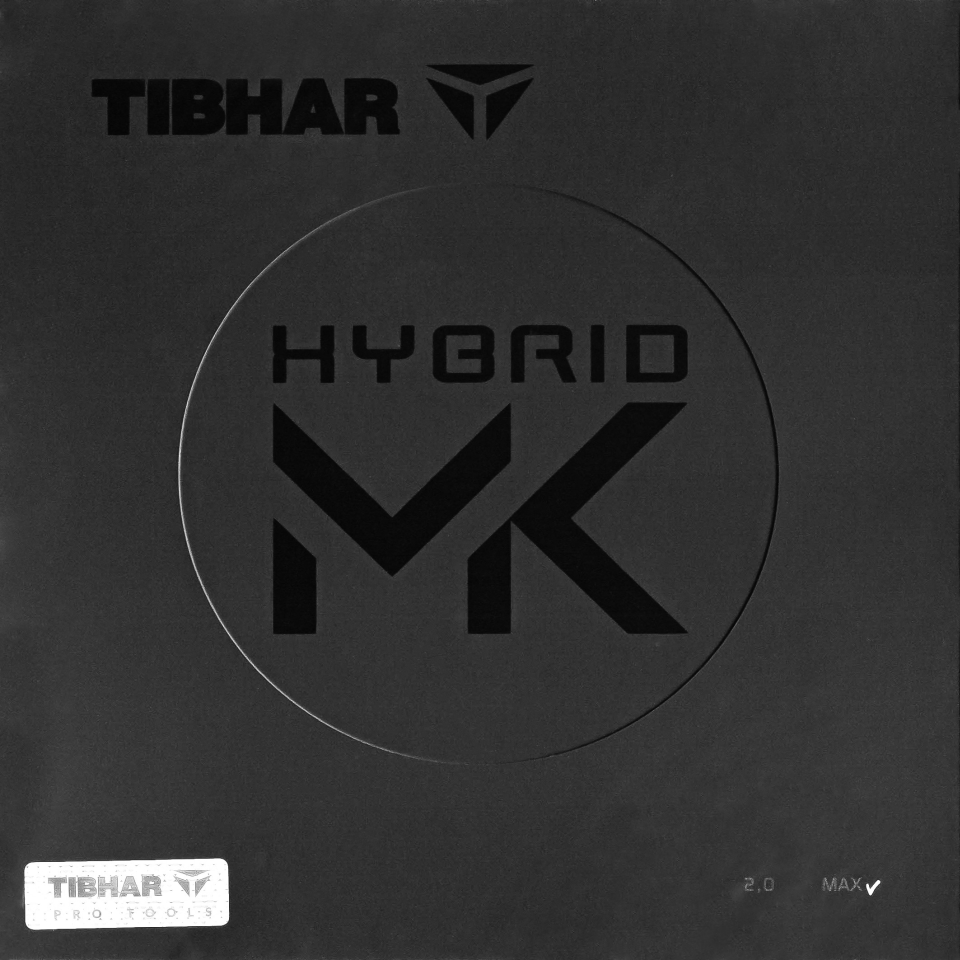
Tibhar Hybrid MK & MK Pro
Welcome back, fellow TT-enthusiasts and TT11 blog readers !!
This time, I am providing a test report of the Tibhar Hybrid MK and the Tibhar Hybrid MK Pro rubbers. These rubbers, which have been tailored to the Japanese top player Kenda Matsudaira, are described as an evolution from the Hybrid K3 rubber. Tibhar has a track record of producing excellent rubbers such as the Hybrid K3 and the Evolution series, and I am excited to share my findings with you.
According to Tibhar, the Hybrid MK (MK) offers an extraordinary touch, high spin potential, long contact time, a high arc, and enough speed reserves to pressure opponents. The Hybrid MKPro (MK-Pro) has the same topsheet as the MK but comes with a harder sponge, i.e., 51- vs 48-degrees on the German scale (corresponding to approximately 39- and 37-degrees on the Chinese scale). The MK-Pro has been designed for expert attacking players in mind, seeking even more power and speed through improved energy conversion, while maintaining the advantages of the MK.
Tibhar rates the German-made MK and MK-Pro as follows in the speed/spin/control categories:125/125/110 and 130/125/105, as compared to 118/130/100 and 128/121/80 for the 53-degree Hybrid K3 and 50-degree MX-P 50. Promisingly, this suggests that the MK and MK-Pro rubbers are as fast as the MX-P 50, almost as spinny as the Hybrid K3, but with better control than either reference rubber.
The MK and MK-Pro are packaged in matte black and glossy purple, respectively, modern-looking cardboard wrappers that list general descriptions and technical information on the back. Both sheets have a faint, sweet, rubbery smell. The topsheets, which have a minimalistic design, are somewhat shiny and translucent, with the pimples faintly visible. The topsheets are very grippy but non-tacky. The base of the topsheet is relatively thick, whilst the pimples are short and wide, without any taper as far as I can tell. The MK has a cream-colored sponge with a high density of tiny pores, whereas the MK-Pro has a purple sponge with a high density of medium-sized pores.
The MK and MK-Pro weigh 68 and 70 grams uncut (both: 170 mm x 169 mm, width x height) and 47 and 49 grams when cut to the 158 mm x 151 mm test blade, which renders them relatively light rubbers.
Testing Procedure
I evaluated the MK and MK-Pro (black, max) rubbers on the popular Tibhar Samsonov Force Pro Black Edition 7-ply all-wood blade using Spinlord Waran II short pips in my BH. I attached the brand-new rubbers to the blade as received using two layers of the Revolution 3 normal viscosity glue. I tested the setups over several sessions, each playing a mix of regular and match-like drills against my regular high-level practice partner (two-winged looper) and practice matches against intermediate-level club members, using Neottec Neoplast Pro 40+ training balls throughout this test.
Side-By-side Playing Impressions
Driving
Right from the get-go, I got major Evolution MX-P vibes when playing forehand (FH) drives with the regular MK. The FH drives are fast and medium-long and accompanied by a prominent catapult, clicking sound, and crisp feeling when striking the ball. The interface between the topsheet and the sponge feels lively. The throw angle on FH drives is medium to medium-low, but sufficient for the shots to clear the net with good consistency. The MK is a fast rubber in the mid OFF range.
The MK Pro feels slightly different, despite having an identical topsheet. It feels slightly more linear and muted, with a less pronounced catapult and clicking sound. The feeling upon striking the ball is still crisp and dynamic, likely due to the relatively soft topsheet. The more linear nature of the MK Pro gave me the confidence to swing faster through the ball. As a result, my FH drives ended up being as fast as with the bouncier MK. Stated differently, the MK Pro behaves.
More predictably, there are fewer concerns about a super-strong catapult suddenly activating and propelling the ball beyond the confines of the table. Accordingly, the MK Pro allows you to play FH drives at high OFF levels.
Looping
I enjoyed the speed-glue-like feeling that the regular MK provides on warm-up FH loops, which were fast, with medium-long trajectories and medium to medium-low throw angles. Spin levels are what you would expect for a modern, high-quality, non-tacky rubber: good, but not spectacular. The catapult effect of the MK is quite strong, and the rubber generally feels and plays softer than its 48-degree sponge hardness would suggest.
The MK’s topsheet gripped the ball well on third-ball attacks against long backspin pushes, yet I struggled to generate very high spin levels on these shots. The FH loop trajectories were relatively long and aided by the rubber’s prominent catapult effect. The throw angle is high enough to provide adequate clearance over the net. The strong catapult effect and soft feeling sometimes caused me to overshoot the table, but my consistency was still excellent.
The strong catapult of the MK allowed for effective and consistent FH loop-to-loop rallies, but my practice partner didn’t seem fazed by the spin levels I was able to generate.
Switching to the MK Pro, FH warm-up loops produced a speed-glue-like feeling, albeit less pronounced than with the regular MK. The contact was still crisp and clearly felt, allowing me to produce fast and deep FH loops with good consistency. The throw angle is a touch lower than with the MK, meaning there is a greater likelihood of grazing the net. The overall harder nature of the MK Pro allowed me to impart a touch more spin on my forehand loops than with the regular MK.
A feature of both the MK and MK Pro rubbers is that they grip the ball very well. My third-ball FH attacks against backspin were faster with the MK Pro than with the MK, as I had more confidence to swing more aggressively through the ball. This, in turn, allowed me to impart a little more spin on the ball. However, the throw angle is slightly lower, which means that more forehand loops grazed the net unless the timing was perfect.
The reliable nature of the MK Pro also manifested itself in FH loop-to-loop rallies, as I had no problems hammering shots from a distance and still landing them on the table with excellent consistency. The shots were long and flat but did not seem to be super spinny.
Blocking
The feeling during FH warm-up blocking with the MK is very crisp, and the shots are very fast. However, its bouncy nature occasionally made the MK seem moderately spin-sensitive during match play, and not fully capable of absorbing the energy from incoming high-quality topspin shots. Counterlooping with the MK is excellent, as the ball bites into the topsheet and is propelled forward.
The MK Pro is slightly more stable and predictable on FH blocks. The rubber had no problems absorbing the incoming kinetic energy from the high-quality topspin shots. I was able to play exceedingly fast blocks with a snap of the wrists, with excellent control of ball placement. The firmer nature of the MK Pro, however, results in a lower throw angle, and a significant proportion of my FH blocks catch the net edge.
Smashing
Despite being a bouncy and fast rubber on moderate impact shots, I sometimes felt that I couldn’t fully transfer my input energy when flat-hitting and smashing with the regular MK.
This is presumably due to the softer sponge of the MK, but don’t get me wrong, smashes are still fast and dangerous.
The MK Pro, on the other hand, transferred my input power more effectively, resulting in even more dangerous smashes.
Flicking
I enjoyed the regular MK on FH flicks against short pushes. Its soft, grippy, and bouncy nature allowed me to lift the ball over the net while imparting a respectable amount of power on these medium-impact shots. Mini loop-type FH flicks also benefit from the relatively clearly felt ball impact, which gave me the confidence to engage the ball more aggressively. Well-timed pancake-type flicks could also be executed with good consistency and had sufficient pace to be dangerous.
The MK Pro displays similar characteristics but is a little less forgiving for FH flicks due to its overall harder nature. Mini-loop-type FH flicks can still be lifted over the net but require slightly better timing and feel more muted. The same goes for pancake-type FH flicks.
Pushing
FH pushes against backspin serves executed with the regular MK were deep, quite flat, and carried respectable amounts of spin. Occasionally, the pushes floated long if my ball contact was too thick due to the strong catapult effect. Short pushes and touch shots against backspin were easy to perform with the MK when using soft hands, resulting in low, hard-to-attack shots.
The MK Pro worked even better on pushes. The more linear nature of the rubber meant that fewer of my pushes floated past the endline. The excellent grip of the topsheet and linearity of the MK Pro became especially apparent on short FH pushes, as I was able to contact short backspin serves right off the bounce and slice aggressively through the ball, without the ball popping up. This resulted in short pushes that were difficult for my practice partner to attack.
Serving
The MK worked wonderfully on short backspin and especially long side/top-spin serves. Its relatively fast and grippy nature enabled me to get extra acceleration and spin on the ball while still controlling the ball placement.
The MK Pro performed almost equally well on serves. I felt that my backspin serves were a touch spinnier, whereas my side-/top-spin serves were slightly less effective than with the MK. I credit this to the less bouncy nature of the MK Pro.
Conclusion
The Hybrid MK and MK Pro are excellent additions to Tibhar’s rubber range. They offer a crisp feeling and are more stable than the popular Evolution MX-P rubber, and a touch more dynamic, but less spinny, than the Tibhar Hybrid K3 rubber, one of the best rubbers on the market. The MK is slightly less timing-dependent than the MK Pro and has a slightly higher throw angle, making it easier to play with. Conversely, the MK Pro is slightly less bouncy and more predictable and has better power-coupling characteristics.
These are relatively fast rubbers, and the MK Pro in particular requires strokes to be played with good timing. Accordingly, these rubbers are best suited for advanced to professional-level offensive players. While they can be used competently close to the table, they are particularly enjoyable from mid-distance and further away. I can’t help but think that the blocking master, Vladimir Samsonov, would have loved to play with the MK rubbers during his active career.
About the Reviewer
Patrick 'Pong Professor' Hrdlicka is a table tennis enthusiast with a Ph.D. in chemistry who combines his analytical and experimental skills with his love of table tennis in order to test and review a wide range of table tennis equipment.
