We use cookies to make your experience better. To comply with the new e-Privacy directive, we need to ask for your consent to set the cookies. Learn more.

Review: Tibhar Evolution MX-P

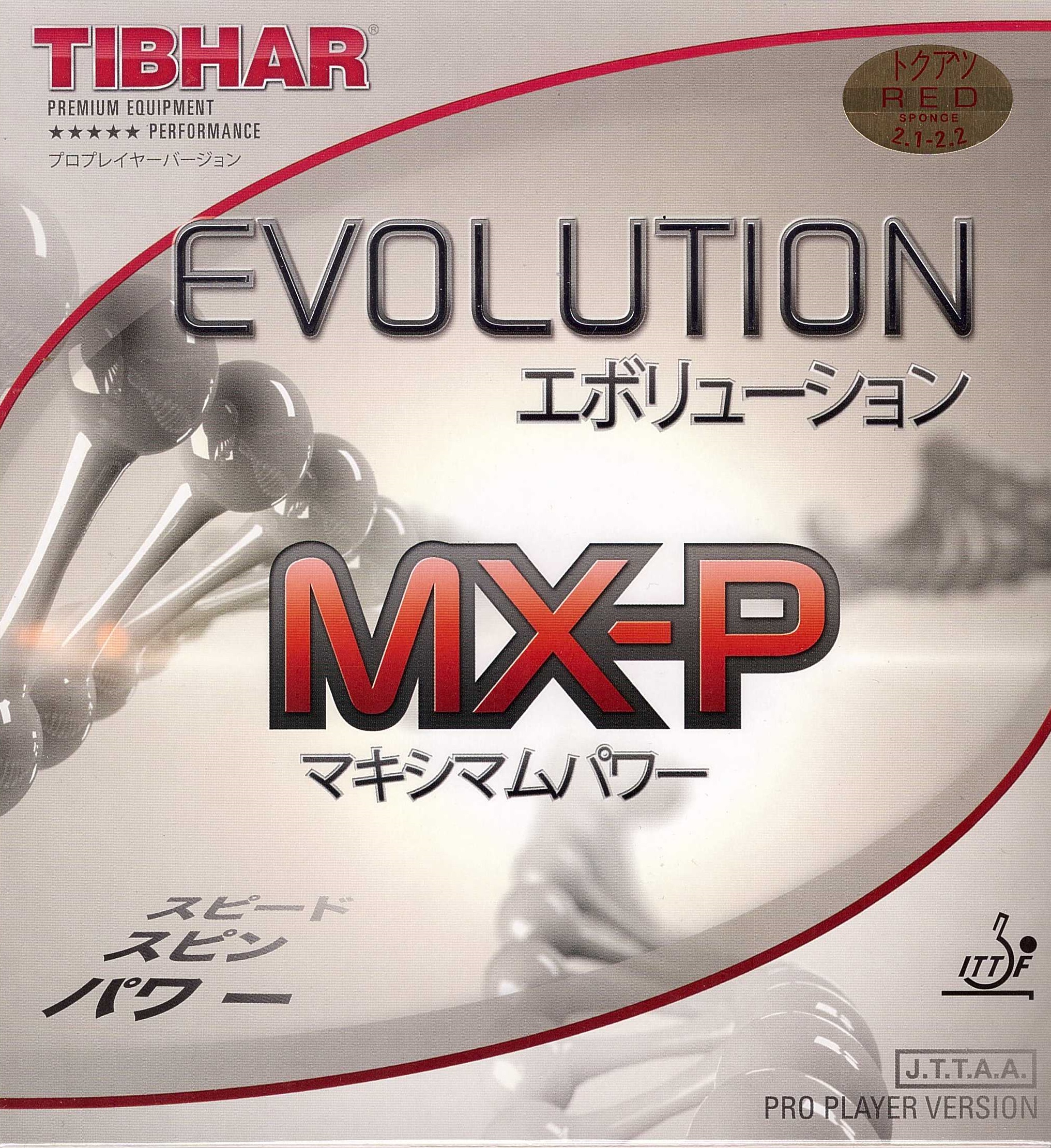
Tibhar Evolution MX-P – A comparison between the original and the new 50-degree version.
Before switching to DHS Hurricane 8 and – eventually – DHS Hurricane 3, I used to play with the original Tibhar Evolution MX-P rubber in my forehand, which has a medium-hard 47.5-degree sponge. As you can read in my original review of the Evolution series, I was a fan of this rubber and still consider it one of the best rubbers of its kind even though the newest generation of rubbers are beginning to give it a run for the money. TT11 customers agree as the MX-P has been the best-selling rubber for several years now.
I always hoped that Tibhar would release a harder-sponged version of MX-P, as such a rubber likely would offer even better control in the short game and reduced probability of hitting “through the sponge” during loop-to-loop rallies. In fact, when TT11 interviewed Tibhar owner Roland Berg in 2018, I submitted a question asking if a 50-degree version – more akin to the version professional players use – would ever be released. At the time, Roland did not seem to think there would be enough demand for such a rubber among non-professional players. Nonetheless, less than a year later and following the introduction of two prominent hard-sponged rubbers by Butterfly (i.e., Tenergy 05 Hard and Dignics 05), here we are: please welcome, the 50-degree version of the Tibhar Evolution MX-P.
According to Tibhar, the topsheets of the original and 50-degree MX-P versions are identical. The latter has a harder and more fine-pored bright red sponge, which is purported to result in a more direct and increasingly forward-oriented trajectory.
The MX-P 50 comes in the same type of cardboard packaging as the original MX-P. In fact, the only difference appears to be a holographic silver sticker on the front with the number “50” on it. Both sheets exude a prominent and sweet booster smell, yet they do not dome significantly upon unpacking. The uncut sheets of the original and 50-degree versions weigh 72 g and 76 g, respectively (2.1-2.2 mm black, 178 mm x 168 mm). Sheets cut to the 158x151 cm test blade weighed 49 g and 52 g, respectively, placing them in the typical range of ESN rubbers with similar sponge hardnesses. The topsheets are glossy, slightly profiled, and have a very slight hint of tack. I included some reference rubbers in a simple blind press test and found the following order (from firmest to softest): Tibhar Evolution MX-S ≥ Donic Bluefire M1 Turbo ≥ MX-P 50-degree > MX-P original ≥ Andro Hexer Powergrip ≥ Xiom Omega V Tour. In other words, perhaps a little softer than I had expected.
Unboxing original MX-P: https://youtu.be/jvr4yrE06OE
Unboxing MX-P 50: https://youtu.be/OMHmjezm-s4
Testing procedure: I tested the original and 50-degree versions of the Tibhar Evolution MX-P rubbers on a Stiga Rosewood NCT VII blade with Nittaku Moristo SP AX (1.8 mm, red) short pips in my backhand. As usual, I attached the rubbers using 2-3 layers of Revolution 3 normal viscosity glue without any form of boosting. I tested the MX-P rubbers over a couple of sessions, playing a mix of simple drills and practice matches against my regular clubmates, using DHS 3-star D40+ plastic balls in the process.
Playing impressions with original MX-P: I stand by the observations and conclusions described in my initial review of the original MX-P rubber, in which I used a more flexible 5-ply OFF- blade. I should note that my playing style has evolved from a more hit-oriented style to an increasingly loop-focused style. The original MX-P is a fast and bouncy rubber. The feeling on drives and loops is superbly crisp. FH drives are ultra-fun to play due to the rubber’s high speed. The trajectory on FH loops is medium-low, and thus requires a more open bat angle, which is especially noticeable having played with tacky Chinese rubbers. The spin levels on opening loops against backspin are slightly lower than with the newest generation of ESN rubbers such as Andro Hexer Powergrip, rendering it easier for opponents to return loops with lightning-fast blocks, which can cause problems if you are not prepared. MX-P’s catapult effect kicks in very strongly on shots played with medium-fast and fast arm swing speeds such as loop-drives played close to the table, which is an area where the rubber really shines. In contrast, I found the MX- somewhat difficult to use in loop-to-loop rallies away from the table for two reasons: first, the arc is relatively flat resulting in insufficient safety over the net, and second, the relatively soft 47.5-degree sponge did not give me enough resistance on these high impact shots. Consequently, I had some difficulties finding the right balance between depth and arc. Other areas in which the original MX-P shines due to its limited spin sensitivity, high speed, and catapult effect, include blocking and flat hits close to the table. Both types of shots are stable and lightning fast, even with the only moderately fast Stiga Rosewood NCT VII blade used in this test. The pronounced catapult effect means that aggressive service returns are fast but care must be taken not to overshoot the table. Pushes against short backspin serves can be kept short and low if using soft hands, albeit significantly less spin is produced than with prototypical Chinese rubbers. My aggressive long pushes had a tendency of going long since I had a hard time of judging when and how strongly the catapult would kick in. The original MX-P works very well for short and low serves, and – especially – fast topspin-sidespin serves, although spin levels do not match those generated using tacky Chinese rubbers.

In my opinion, the original version of MX-P is especially well-suited for advanced aggressive players who stay close to the table and have a more direct and less spin-oriented driving, hitting, and blocking style. In fact, the original MX-P is among the absolute best rubbers on the market for this style. More loop-oriented players would be well-advised to use the MX-P with more flexible blades than the Rosewood NCT VII.
Serves: 9/10
Serve receives and short game: 9/10
Looping: 9/10
Flat hitting: 9.5/10
Blocking: 9.5/10
Playing impressions 50-degree version of MX-P: The first couple of FH drives quickly revealed that the new version of MX-P offers a firmer and slightly less direct feeling than the original MX-P. In addition, the catapult is less extreme, which provides better regulation of the amount of input power that goes into a stroke, resulting in improved consistency. The MX-P 50 is still a fast rubber, but simply not as crazy fast as the regular version. FH drives are fast, solid, and more controlled. My FH loops were more consistent than with the original MX-P, with similar levels of spin being produced on opening loops against backspin. The ball trajectory remains medium-low and long, which can pose a challenge when having to loop continuously against backspin balls from choppers or push-blockers. A slightly higher arc would provide more safety over the net. Also, in a few isolated instances it felt like the ball did not bite sufficiently into the topsheet, but please keep in mind that I normally use very tacky Chinese rubbers, which offer a completely different feeling. Power-drives played close to the table are slightly slower than with the regular MX-P if the same arm swing speed is used. However, the firmer sponge of the MX-P 50 allows for faster swings through the ball, which compensates for the rubber’s slightly lower inherent speed, all while providing better control of the ball depth. My consistency in close-to-the-table counter-loops and mid-distance loop-to-loop rallies improved significantly vis-à-vis the regular MX-P, as the firmer sponge absorbs more of the incoming energy, reducing the risk of hitting through the sponge and engaging an erratic catapult effect. Blocking with the MX-P 50 is very solid. The blocks are medium-fast when using soft hands, whereas blocks played with a slight wrist snap results in blistering fast returns that can be outright winners. Flat hits are similarly solid and fast but require slightly more physical effort than with the original MX-P to produce the same end-speed. The firmer sponge of the new MX-P has positive ramifications for aggressive service returns as the firmness of the sponge instills confidence, especially when executing “pancake” flicks (flicks played with a mostly flat bat angle). Conventional flicks (mini-loops) against low backspin serves to require very good timing and technique as the harder sponge is less forgiving of poor timing. Short pushes or dropshots can be kept short and low, thanks to the less pronounced catapult effect, but spin levels seem lower than with, e.g., Andro Hexer Powergrip or prototypical Chinese rubbers. Aggressive pushes are easier to control than with the original MX-P but it is still easy to overshoot the table if you are not careful. The MX-P 50 works excellent on all types of serves but – just like its original counterpart – does not reach the highest spin levels.
Having recently tested the new Butterfly Tenergy 05 Hard, I see many similarities between the two rubbers, with the MX-P having a slightly flatter trajectory. The substantially lower price of the MX-P 50 will offer a competitive advantage. In my opinion, the new Tibhar Evolution MX-P 50-degree rubber will appeal to advanced aggressive players with a more forward- and less spin-oriented game style who predominantly play from mid-distance.
Serves: 9/10
Serve receives and short game: 9.2/10
Looping: 9.2/10
Flat hitting: 9.3/10
Blocking: 9.5/10
About the Reviewer
Patrick Hrdlicka is a table tennis enthusiast with a Ph.D. in chemistry who combines his analytical and experimental skills with his love of table tennis in order to test and review a wide range of table tennis equipment.
