We use cookies to make your experience better. To comply with the new e-Privacy directive, we need to ask for your consent to set the cookies. Learn more.

Testing the DHS RS40+ ball

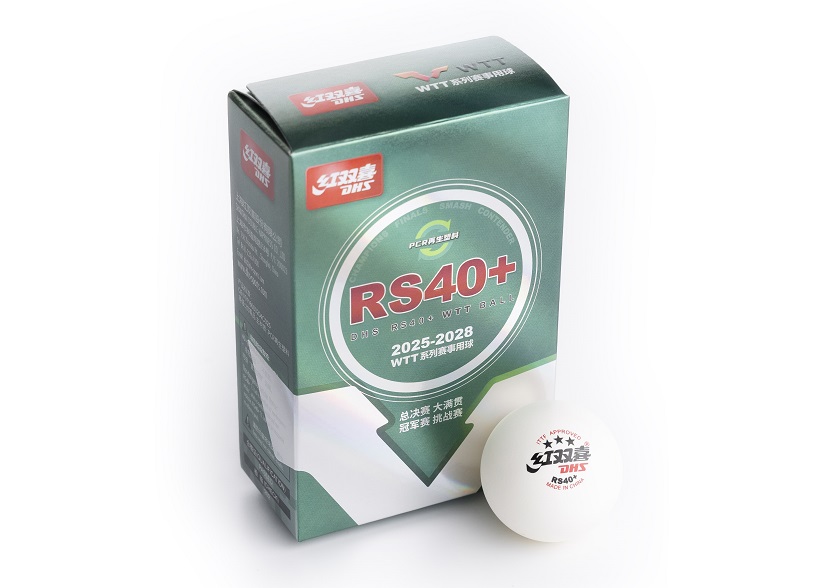
Testing the DHS RS40+ ball.
I recently tested four types of 3-star 40+ balls used on the World Table Tennis (WTT) tour: the seamed Double Fish V40+ 3*** WTT ITTF (V40+), DHS DJ40+ 3*** WTT ITTF (DJ40+), and Yinhe H40+ 3*** WTT ITTF (H40+) balls, as well as the seamless 729 S40+ 3*** WTT (S40+) balls. I found all these balls to be excellent. Their dimensions and weights fall within narrow distributions. The seamed balls had very similar playing properties and felt harder, heavier, and slower than the seamless S40+, which encouraged a more physical playing style.
In this follow-up test, I am evaluating the DHS RS40+ 3*** star ball (RS40+), which is primarily made of post-consumer recycled plastic, and comparing it to the DJ40+ and our usual training balls, the seamed Neottec Neoplast Pro 40+ (NP40+).
The DHS RS40+ balls arrive in a shiny, mostly green-and-silver box — presumably to indicate the environmentally friendly aspect — that features an illustration of the ball on one side and the name of the ball on both the front and back. The sides of the box list major milestones (in Chinese), the quality-control steps the balls have passed, and DHS’s contact information.

The RS40+ balls are off-white, appearing slightly whiter than the DJ40+. They feature a DHS logo in mostly black with some red text. The opposite side shows a large red WTT logo, a significant departure from the small black WTT logo on the DJ40+. The surface of the RS40+ has a slight roughness, similar to that of the DJ40+.
I measured the diameter of six RS40+ balls using calipers. All diameters were within the measurement error (estimated at ±0.1 mm), with the RS40+ balls averaging approximately 40.02 mm, very close to the DJ40+ balls (~40.05 mm).
I weighed the six RS40+ balls using a high-precision balance and found them to weigh 2.755 g ± 0.006 g. For comparison: Neottec NP40+ (2.576 g ± 0.014 g), Double Fish V40+ (2.738 g ± 0.011 g), YinHe H40+ (2.743 g ± 0.007 g), 729 S40+ (2.749 g ± 0.004 g), and DHS DJ40+ (2.759 g ± 0.005 g) (± denotes standard deviation). In other words, the RS40+ balls have a tight distribution and are among the heavier WTT balls.
I also bounced randomly selected balls of each type against one another to compare bounce height. The difference in bounce height between the DJ40+ (which was the lowest bouncing ball in the original test) and the RS40+ balls was minimal, with the latter possibly having a marginally higher bounce.
I also evaluated the roundness of the balls by spinning six balls of each type around their axis. As one should hope – and similar to my observations with the other WTT balls – the RS40+ balls seemed to be perfectly round.
Playing properties.
As noted in my original test, the reference DHS DJ40+ is very clearly an ABS ball: quite hard, heavy, and slow (though slightly less so than the Double Fish V40+). The DJ40+ ball produces a very crisp bounce sound. In comparison, the RS40+ sounds and feels slightly softer, lighter, and faster.
The RS40+ also seemed to generate marginally more spin, reducing the extreme “ABS feel.” Backspin serves and pushes traveled a little longer and bounced a little lower than with the DJ40+, making it slightly harder for my practice partner to execute third-ball attacks.
Topspin rallies with the RS40+ felt slightly more celluloid-like, requiring less physical effort. The shot trajectory was perfectly predictable, with no sign of any ball imperfections. Unlike the DJ40+, the larger logo on the RS40+ made it easier to see the label and thus read the spin. Finally, I observed more color transfer from black rubbers onto the RS40+ balls than with the DJ40+ balls, though there was little powder transfer to the rubbers. This may support the subjective impression of slightly greater spin.
Conclusion:
The seamed DHS RS40+, which incorporates recycled plastic and can therefore be viewed as a more environmentally friendly alternative, is an excellent ball. Like the other 3-star WTT balls I have tested, the RS40+ shows tightly defined dimensions and weight. Its playing properties closely resemble those of other seamed WTT balls, but are closest to the Yinhe H40+: slightly softer and faster. As one would hope, this is a ball worthy of high-profile tournaments.
About the Reviewer

Patrick 'Pong Professor' Hrdlicka is a table tennis enthusiast with a Ph.D. in chemistry who combines his analytical and experimental skills with his love of table tennis in order to test and review a wide range of table tennis equipment.