We use cookies to make your experience better. To comply with the new e-Privacy directive, we need to ask for your consent to set the cookies. Learn more.

Testing Antispin Rubbers

Testing Antispin Rubbers
Here is something I didn’t have on my “TableTennis11 testing bingo card”….testing antispin rubbers! Throughout my table tennis life, I have either used regular inverted rubbers (as a kid and again when I returned to the sport) or short pips (past ~10 years) in my backhand. Inspired by the female German player Sabine Winther’s recent successful switch from regular inverted BH rubbers to antispin (she reached the semifinals of the Euro Top 16), I decided to try out a couple of antispin rubbers for fun during the off-season.
Antispin rubbers are designed to neutralize incoming spin. In addition, antispin rubbers are typically very slow. The reduced spin and speed are meant to disrupt the rhythm and confuse your opponent. The confusion is maximized if antispin rubbers are paired with regular, spinny, inverted rubbers, especially for players mastering tactical twiddling, i.e., the process of flipping the blade mid-rally and changing between the antispin and spinny rubbers in the BH. Having played against numerous antispin players, I know firsthand that it is necessary to adapt and be patient, as it otherwise is extremely easy to overshoot the table when looping or popping the ball way up when pushing. Personally, I don’t find it particularly difficult to play against antispin players as this style has inherent weaknesses. Thus, antispin players typically struggle with long no-spin or slightly backspin serves played into the antispin side, and hard flat hits into the antispin rubber. Also, antispin players can be brought out of balance by varying the length of the shots (e.g., short pushes into FH, followed by long pushes/smashes into the BH). Either way, I was excited to see whether I could figure them out.
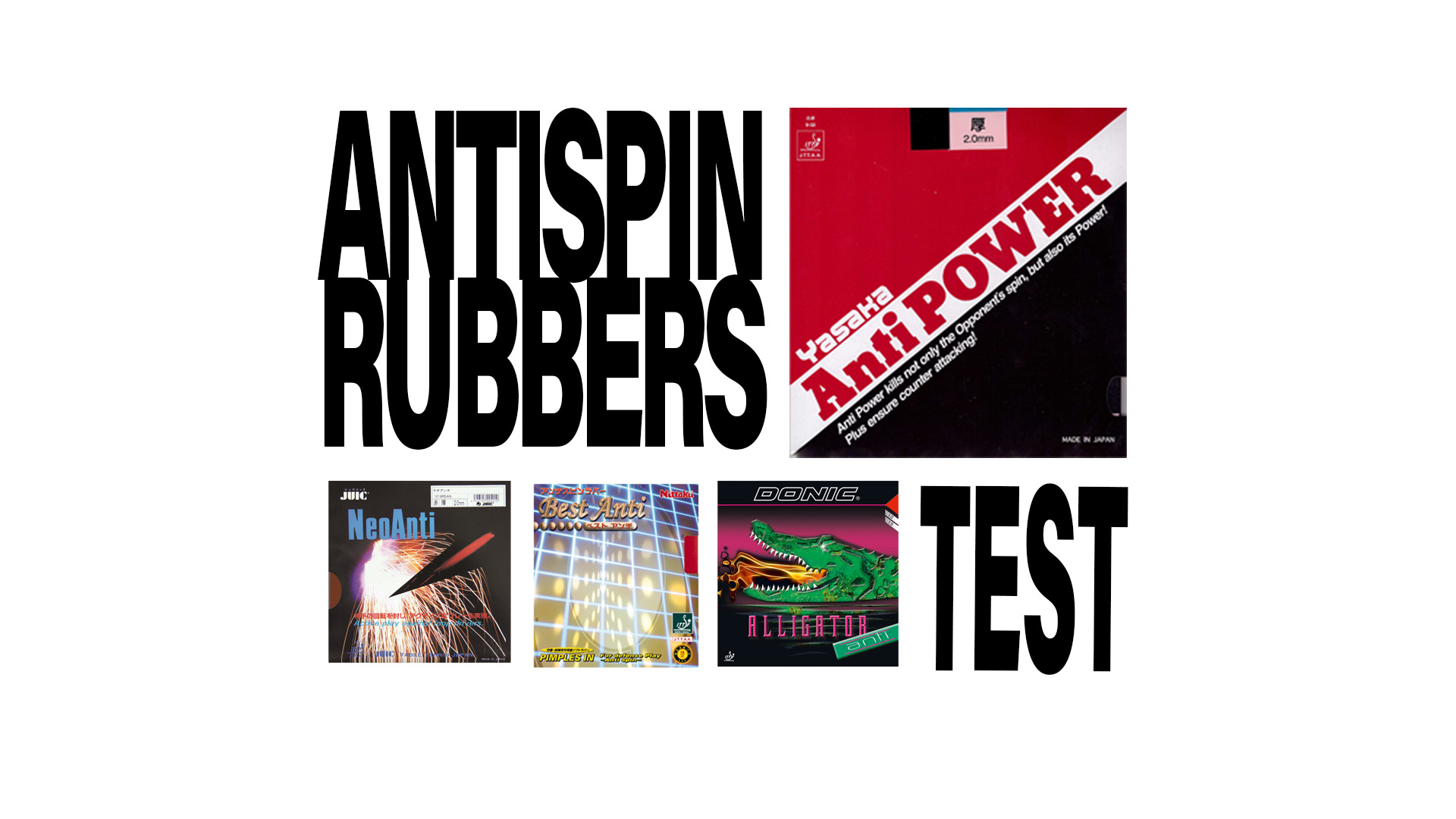
I tested four antispin rubbers – in this order: Yasaka Anti Power (YAP), Nittaku Best Anti (NBA), Juic Neo Anti (JNA), and Donic Alligator Anti (DAA).
Testing Protocol
I tested the antispin rubbers using the Tibhar Szocs Signature 1 7-ply all-wood blade with a well-used sheet of DHS Hurricane 3 (black, 2.15 mm, 40-degree) in my FH. I attached the brand-new rubbers onto the blade using two layers of the Revolution 3 normal viscosity glue. I tested each rubber over 2-3 sessions, playing the usual mix of regular and match-like drills against my high-level practice partner (two-winged looper) and practice matches against intermediate-level clubmates, using Neottec Neoplast Pro 40+ training balls.
Disclaimer: I am not an expert antispin player, but rather an experienced BH short pip player who can capably execute flat hits and active blocks, as well as passive blocks, chop blocks, and dropshots that require a lot of feeling. I basically used the antispin rubbers like I would a regular short pip, except for playing a slightly higher proportion of passive touch shots.
Yasaka AntiPower (black, 1.5 mm)
An Easy-to-Use Disruptive Antispin Rubber That Enables Controlled Attacks
The Yasaka AntiPower (YAP) is described as an antispin rubber that neutralizes incoming spin and provides exceptional control for defensive players. The soft 27.5-degree sponge is asserted to further enhance control and stability during play. Yasaka recommends the YAP for players employing a strategic, control-oriented game, aiming to disrupt opponents’ rhythm and induce errors. Yasaka gives the YAP speed, spin, and control ratings of 38, 11, and 70 (on a 0-to-100 scale), as compared to corresponding ratings of 87/88/63 and 80/53/63 for the Yasaka Rakza 7 (inverted rubber) and Yasaka Rakza PO (short pimpled rubber), respectively.
The YAP is packaged in a red, white, and black cardboard wrapper that features the rubber’s name and the text “Anti Power kills not only the Opponent’s spin, but also its Power! Plus ensure counter attacking!”. The reverse side of the wrapper describes the playing characteristics of the YAP in two languages.

Inside the wrapper, you will find the YAP, which is made in Japan, covered by a paper sheet. The YAP is rather pliable. The topsheet is smooth with a level of grippiness akin to the JNA. The pimples are visible below the dark-red topsheet. The pale mustard-yellow sponge, which has a rubbery smell, has no discernible pores. The sheet weighed 51 grams uncut (height x width: 173 mm x 173 mm) and 36 grams cut to the 158 mm x 151 mm test blade, rendering it the heaviest of the four rubbers tested in this series.
Playing Impressions
To my surprise, I found that I could use my BH short-pip techniques without much adjustment when playing with the YAP. Whilst the YAP – obviously – is much slower than my usual Spinlord Waran II (W2) short pips, I could use the same motion to play BH drives - flat hitting with an open bat angle. And since the YAP is much slower than the W2 (but substantially faster than, e.g., the NBA), I was able to use a much more aggressive motion to produce BH drives that were very flat and faster than expected, which gave my playing partner all sorts of problems.
Predictably, passive blocking against high-powered loops produced slow and flat shots. However, at times, I still struggled to keep the shots on the table, as there is no spin on the block, and the ball continues in a straight path. Active blocks, on the other hand, were much more controllable and dangerous. A small flick of the wrist and tightening of the forearm made all the difference as it gave the ball a subtle arc, helping it to reliably dip down before the end line. The blocks were fast and spinless enough to confuse my practice partner, leading him to substantially overshoot the subsequent loop on most occasions. Conversely, flicking the wrist without tightening the forearm resulted in ultra-short dropshots that stop before the endline and substantially break your opponent’s rhythm.
Perhaps somewhat atypically for antispin players, I tried using the YAP for BH third-ball attacks against long pushes. To my amazement, I found the YAP to be very capable. Due to the minimal grip, I obviously had to use a flat, quite short, pip-like stroke. Not only did the ball get on my opponent’s side in a reliable manner, but the BH attacks were also reasonably fast and very difficult to deal with due to the flat trajectory and lack of spin. I was even able to make BH flat hits, being 2-3 steps behind the table. Any further than that, though, the YAP was too slow.
I also tried to BH flick with the YAP against short pushes. Obviously, given the minimal grip, it is necessary to hit the ball in its zenith with a flat stroke. However, that proved easier than I feared and resulted in BH pancake-type flicks that were controlled and reasonably fast, though one needs to be ready for the following return.
Unquestionably, the biggest adjustment came when using the YAP (or any of the antispin rubbers) for pushes. The lack of grip means that the ball pops up if you contact the ball in the 4 to 6 o’clock position, like with an inverted or short pimpled rubber. To prevent this, it is necessary to use a far more forward-oriented stroke where the ball is contacted in the 3 o’clock position. This results in a floating, slow shot that can disrupt your opponent’s rhythm but also, if they are alert and patient, result in a flat hit kill-shot. I am confident that with more practice, it is possible to execute aggressive slapping FH pushes that make life uncomfortable for your opponent.
Lastly, I asked my practice partner to serve a variety of long serves into my antispin BH. Unsurprisingly, given the characteristics of antispin rubbers, the main serve return option is to make a relatively aggressive BH attack with some wrist whip. The deeper the serve, the more difficult the shot becomes. However, I felt that the YAP performed admirably. Needless to say, the spin type had very little impact on these spin returns.
Conclusion
I would recommend the Yasaka AntiPower to anyone wanting to switch from inverted or short pimpled rubbers to antispin rubbers, as it has the traditional antispin characteristics, whilst still enabling controlled attacks to be executed. Those seeking a truly dead antispin rubber will probably find the YAP slightly too fast.
Nittaku Best Anti (red 1.8 mm)
A More Traditional Antispin Rubber?
The Nittaku Best Anti (NBA) is described as a rubber that is insensitive to incoming spin, yet capable of aggressive attacks due to the slightly grippy surface, which also allows for spin-inverted shots. Nittaku gives this Made in Japan rubber speed and spin ratings of 4.0 and 3.0, respectively. For comparison, the Nittaku Fastarc G-1 (an inverted rubber) and the Nittaku Moristo SP (a short pimpled rubber) have speed/spin ratings of 15.00/12.50 and 12.50/7.50, which gives you an idea of just how slow and non-spinny the NBA just is.

The NBA is delivered in a cardboard wrapper that features a light-blue grid pattern against an olive-green complex background. The reverse side provides a brief description of the rubber’s characteristics and some handling guidelines. Inside the wrapper, the rubber is covered by a paper sheet. The sheet, which has a weak rubber smell, is somewhat more rigid than a prototypical inverted rubber, presumably due to a stiffer topsheet. As expected, the bright red topsheet is quite smooth with very low grip. The cylindrical pimples are not visible through the topsheet and appear to be widely separated. The white 30-degree sponge (20 degrees on Nittaku’s scale) has a high density of tiny pores. The sheet weighed 48 grams uncut (height x width: 174 mm x 170 mm) and 34 grams cut to the 158 mm x 151 mm test blade.
Playing Impressions
BH drives played with the NBA are noticeably slower than with the YAP and with even flatter trajectories. Therefore, a greater proportion of my BH drives tended to float past the endline unless I got the bat angle perfect, since that ball doesn’t really dip. The use of a wristier motion alleviated this partially, but my control on BH drives was lower than with the YAP.
Along similar lines, successful passive BH blocking against high-powered loops was also dependent on having the correct bat angle and a very relaxed forearm. Whenever I got these things right, the shots produced were slow and ridiculously flat, with minimal bounce on my opponent’s side. As with the YAP, active blocking resulted in improved consistency. However, the resulting BH blocks were slower than with the YAP, giving my practice partner more time to position himself and execute effective attacks in hard-to-reach places for me. When flicking my wrist without tightening the forearm, the NBA could produce truly disruptive ultra-short block dropshots.
BH third-ball attacks against long pushes, whilst still possible and relatively dangerous, were less reliable with the NBA than with the YAP due to the even lower spin values. This occasionally led to completely flat shots that just floated beyond the endline. Once again, it seemed that my practice partner had more time to get into position and chase me around on the subsequent shot. Unlike the YAP, the NBA was too slow and frictionless to be effective on BH fishing shots further from the table.
BH flicking against short pushes with the NBA proved trickier than with the YAP due to the even lower grip level. The timing has to be absolutely perfect, as the ball otherwise will sail past the end line. The resulting BH flick is very uncomfortable if you get the timing right, as the trajectory is ridiculously flat.
As with YAP and most of the other antispin rubbers in this test, one has to adjust the BH pushing technique (i.e., hitting the ball more directly). The resulting pushes are floating and very slow, and were clearly disruptive for my practice partner.
The NBA is almost completely insensitive to incoming spin. Deep serves into the antispin backhand were more challenging to return than with the YAP, due to the even lower grip and speed. Once again, successful serve returns required a wristy BH attack motion, which was a little bit less reliable due to the NBA’s glass-like surface.
Conclusion
The Nittaku Best Anti plays like what I imagine a classic antispin should: very slow and disruptive, and less suited for attacking. I imagine this is best suited for seasoned antispin specialists whose primary goal is to disrupt the opponent’s rhythm and set up FH kill shots.
Juic Neo Anti (black, 1.5 mm)
An Even Easier-to-Use Antispin Rubber for Newcomers
The Juic Neo Anti (JNA) is described as an antispin rubber that does more than simply passively send a disruptive ball back to your opponent. Supposedly, the JNA also allows for active play against loop drives and some spin generation, a feature that Juic deems critical for modern antispin players. This is accomplished in three ways: the use of an extremely elastic antispin topsheet, a special sponge, and a new “Power-Add-On formula”. Juic gives the JNA speed and spin ratings of 4 and 3, respectively. In contrast, the Juic Neo Galaxia inverted rubber is rated at 16.5 and 18 in these categories, respectively, again highlighting just how slow and non-spinny the JNA really is.

This “Made in Japan” rubber is delivered in a larger-than-usual cardboard wrapper. I couldn’t fully make out the graphics on the front, but it seems to feature a needle against a background of electric sparks. An extensive description of the JNA’s characteristics is provided on the back of the wrapper in five languages. Inside the wrapper, you will find the JNA protected by a green (possibly waxed) paper sheet that Juic recommends be used to protect the rubber from oil and dust after play. The sheet, which has a faint rubbery scent, is almost as pliable as regular inverted sheets. The pimples are visible below the topsheet, which is smooth but slightly less so than the NBA. The soft white sponge has a high density of tiny pores. The sheet weighed 48 grams uncut (height x width: 173 mm x 174 mm) and 33 grams cut to the 158 mm x 151 mm test blade, rendering it the lightest of the four rubbers.
Playing Impressions
Following a more challenging stint with the Nittaku Best Anti, I was pleased to discover that the JNA is much easier to use for a BH short-pip player. Akin to my observations with the Yasaka Anti Power, I only had to make relatively minor adjustments to my strokes when using the JNA. Thus, I found BH drives relatively easy to execute if using a flat hitting technique with an almost open bat angle. The bat angle was slightly more closed than with the YAP, presumably because the JNA grips the ball slightly more. The JNA is noticeably faster than the NBA, and slightly faster than the YAP, resulting in decently paced shots. The trajectory is flat, but less disruptive than with the YAP and – especially – the NBA. The consistency of my BH drives was good.
As with the YAP, passive blocking against high-powered loops produced flat shots. However, a greater proportion of the passive blocks floated past the table and were difficult to control. As before, it turned out that more active blocking was the winning ticket. Thus, it is very important to meet every incoming topspin with an active stroke using a wrist flick, as this produces a slightly arching shot that dips before the end of the table. The blocks were of a similar pace as those from the YAP, but the blocks seemed to confuse my practice partner a little less, as he was able to return a greater proportion of them. Again, the tension in the forearm can be used to control the pace of the block. A tense arm results in faster, more direct shots, whereas a soft hand can produce ridiculously short blocks that bounce twice or more.
Considering it is an antispin rubber, the JNA works really well for BH third-ball attacks against long pushes. As with the YAP, I used flat strokes that worked to reliably propel the ball over the net. There is just enough clearance over the net, and the dipping trajectory renders it an uncomfortable shot to return, even though it is less disruptive than with the YAP and – especially – the NBA. BH flat hits from 2-3 steps behind the table, however, were challenging to land as the ball tended to continue in a straight line.
I am amazed how well the JNA works on BH flicks against short pushes. Naturally, given the lack of grip, I had to use a flat stroke. Whenever I contacted the ball near its high point, I was able to land the flick, which had a flat, uncomfortable trajectory. I genuinely enjoyed better consistency than with my regular short pips, presumably since the JNA has a more moderate pace.
I found the JNA easier to use for long pushes than the YAP or – especially – the NBA. The ball does not pop up as high and actually has a comparatively flat trajectory and even slight amounts of backspin. Although the pushes float less, the radical change in speed is disruptive. While faster than the NBA, it is still very much possible to make very slow drop shots and pushes with the JNA.
Returning various long backspin, no spin, or topspin serves played into the antispin BH was relatively easy, although it required an aggressive BH stroke with considerable wrist whipping. Interestingly, essentially the same stroke works regardless of spin type. Pushing, however, does not work well, as the ball pops up with little spin. I view this as an advantage as it simplifies service returns.
Conclusion
The Juic Neo Anti is arguably the most newcomer-friendly antispin rubber in this series. It maintains the disruptive qualities associated with antispin while offering greater ease of use, especially for players transitioning from inverted or short pips. It excels in controlled attacks against long pushes, pancake-style BH flicks, reliable active blocking, and short touch shots that disrupt your opponent’s rhythm. While slightly less disruptive than the NBA or YAP, the JNA’s balanced pace and forgiving feel make it an ideal stepping stone into the antispin world.
Donic Alligator Anti (red, 1.5 mm)
A Highly Disruptive Antispin Rubber
The Donic Alligator Anti (DAA) is described as a very direct antispin rubber with a taut topsheet and hard sponge that enables a variable game style with short drop shots as well as fast counter-attacks. Donic gives the DAA speed, spin, and control ratings of 4+, 1+, and 9+, as compared to corresponding ratings for the Donic BlueGrip C2 (an inverted rubber) of 10+, 11++, and 6-.

The DAA is delivered inside a cardboard wrapper that features a green fire-spewing alligator against a black and pink background. The reverse side of the wrapper lists the above-mentioned ratings along with a description of the playing characteristics of the DAA in three languages.
Inside the wrapper, the DAA is covered by a paper sheet. The DAA is an extremely rigid rubber - when held in one corner, the sheet barely bends - presumably due to the extremely stiff topsheet. The topsheet is smooth, but the grippiest of the four antispin rubbers. The pimples, which seem to be broader and shorter than in the other antispin rubbers, are not visible below the exceptionally matte red topsheet. The soft lemon-yellow sponge has a high density of very tiny pores. The sheet weighed 48 grams uncut (height x width: 169 mm x 170 mm) and 35 grams cut to the 158 mm x 151 mm test blade, leaving it as the second heaviest of the tested rubbers.
Playing Impressions
The first thing you’ll notice when playing with the DAA is the sound when hitting the ball. It is a very dull, almost cardboard-like sound. BH drives with the DAA proved to be more challenging and timing-dependent than with the YAP or JNA, and more akin to my observations with the NBA. I attribute this to the exceptionally firm topsheet. In fact, the topsheet is so hard that you could almost cut your finger on its edge. Anyways, when hit with perfect timing and open bat angle, the BH drive produces an extremely flat trajectory. The ball has minimal bounce and is, accordingly, difficult to return. Conversely, if you mistime the shot, the BH drive goes way too long. For the same reason, I found it very challenging to play BH fishing shots a couple of steps away from the table.
As with the other antispin rubbers, it is critically important to use an active wrist flick when blocking against high-powered loops, as passive blocks resulted in uncontrollable returns. Active blocking produces shots with uncomfortably flat trajectories that my practice partner struggled to return. The BH blocks were significantly slower than with the YAP or JNA and seemed to be more disruptive because of that. I struggled to produce fast blocks as the shots would overshoot the table, likely again due to the rubber’s extremely firm nature. The DAA works incredibly well for chop blocks. The topsheet is completely spin-insensitive, and the firm and very slow nature of the rubber meant that the chop blocks made it over the net in a fairly reliable fashion.
As with several of the other antispin rubbers, I found it quite easy to use the DAA for BH third-ball attacks against long pushes, although it is a little less controllable and more timing-dependent due to the aforementioned nature of the topsheet. Nonetheless, the BH attacks were viciously deceptive and difficult to return due to their super flat trajectory and the minimal bounce.
Long BH pushes against short backspin serves had a tendency to pop up more than with the JNA, but this was manageable. The nature of the DAA is such that I was compelled to BH chop with it away from the table, and I was surprised how effective it is in that role. A large, aggressive stroke can (and must) be used since the rubber is very slow. The chops sail over the net with a flat trajectory, and the spin reversal renders it challenging for your opponent to produce a high-quality follow-up shot.
Of the four antispin rubbers tested, I would say that the DAA allows for the strongest disruption in playing rhythm. Nowhere did this become more obvious than when playing short pushes and touch shots. If you have good feeling in your hands, the shots can be played ridiculously short, bouncing multiple times on the table and frustrating your opponent.
Once again, I was shocked how well antispin rubbers work for BH flicks, and the DAA is no exception. Using a flat stroke and hitting short pushes at the top of their bounce, I was able to BH flick with outstanding consistency. And, because the shots have a very flat trajectory, they become challenging to return.
Returning different long serves played into the antispin BH was easier than I thought it would be, given the hard topsheet. Once again, it is key to use an active but relaxed BH stroke with considerable wrist whip. The slower speed of the DAA resulted in consistent returns, provided I timed the stroke correctly. Pushing, on the other hand, is generally not an advisable strategy.
Conclusion
The Donic Alligator Anti is a little more difficult to use with aggressive strategies than the Juic Neo Anti or Yasaka AntiPower due to its extremely hard topsheet. However, it offers more disruption than either of those antispin rubbers, both with respect to trajectory and speed. Of the four rubbers tested, it is probably the one that is best suited for classic antispin defensive strategies and chopping away from the table.
Final general thoughts on antispin rubbers: As a BH short pips player, I found the antispin rubbers surprisingly easy to adapt to. The Yasaka AntiPower and Juic Neo Anti rubbers, in particular, allow controlled attacks and flicks using stroke mechanics that are not too dissimilar from short pip strokes. Now, I am not saying that antispin rubbers play like short pimpled rubbers. Of course they don’t. But I found them much easier to play with than, e.g., long pimpled rubbers. The big question is, do antispin rubbers, on the whole, offer advantages over short pips or – as in Sabine Winther’s case – inverted rubbers? It is tough to say with certainty. I still believe the disadvantages of antispin rubbers (e.g., compromised pushing; challenging to return long no-spin or backspin serves and hard flat hits; compromised mid-/long-distance game; having to protect the BH side) likely outweigh the advantages (e.g., rhythm disruption; uncomfortable shot trajectories; greater variability in shot length; ease in returning short and medium long serves), especially against opponents who know how to play against antispin rubbers. Nominally, I am a 2200 USATT-rated player. Compared to playing with BH short pips, I think I would be able to win matches against (impatient) 2300-2400 rated players using a BH antispin rubber. However, I also think I might lose more matches against the “wrong” type of lower-rated players than presently, which would result in a net drop in rating. Either way, it has been fun to try out these antispin rubbers.
About the Reviewer
Patrick 'Pong Professor' Hrdlicka is a table tennis enthusiast with a Ph.D. in chemistry who combines his analytical and experimental skills with his love of table tennis in order to test and review a wide range of table tennis equipment.
