We use cookies to make your experience better. To comply with the new e-Privacy directive, we need to ask for your consent to set the cookies. Learn more.

A Closer Look at Two Xiom Hayabusa Blades

A Closer Look at Two Xiom Hayabusa Blades
Hello again, TT enthusiasts!
This time, I’m reviewing two blades from XIOM’s affordable Hayabusa range, i.e., the 5+2 ply composite XIOM Hayabusa ARX and XIOM Hayabusa ZLX blades.
Like the rest of the Hayabusa series, the ARX and ZLX blades are made in China. The design philosophy behind the Hayabusa blades focuses on extending dwell times on high-impact shots and redirecting incoming energy with a strong catapult. Both blades feature an outer fiber construction. The ARX is an Aramid Carbon blade that XIOM describes as absorbing incoming energy, dampening vibrations, and enabling topspin shots. The ZLX, which features a Zephylium Carbon weave, is described as a blade having a “rich hit-feel sensation”, a sensible character, and strong resilience.

XIOM provides the following ratings for the ARX and ZLX in catapult, ball grab, repulsion, and precision categories: 9.1/7.6/7.5/8.0 and 8.8/8.2/8.1/8.2, respectively. The corresponding ratings for the Hugo Calderano HAL, Ice Cream AZX, and An Jaehyun TMXi blades from XIOM’s range are 8.7/7.5/7.7/9.1, 9.7/8.5/8.5/7.7, and 9.4/7.9/8.2/9.1, respectively. In other words, the ARX and ZLX are expected to have catapult, ball grab, and repulsion characteristics that place them between the HAL and AZX/TMXi, while offering greater precision than the AZX but less than the HAL and TMXi. Additionally, XIOM classifies the ZLX as an OFF+ blade, capable of producing spin levels of 5-6 on a 7-scale, with a control rating of “easy”, whereas the ARX is classified as an OFF blade, capable of producing similar spin levels as the ZLX, with a control rating between “easiest” and “easy”.
The two blades are delivered in the same slim box. The box’s design and color pattern are …interesting. I would describe it as 1970s-inspired psychedelic V-shaped patterns in all sorts of colors. The Omni logo, a series of concentric rings with differentially shaded areas, is embossed on the box (Omni is one of XIOM’s sub-brands). No descriptive text is provided on the boxes, except for a sticker on the front lip that lists the blade name and grip type.
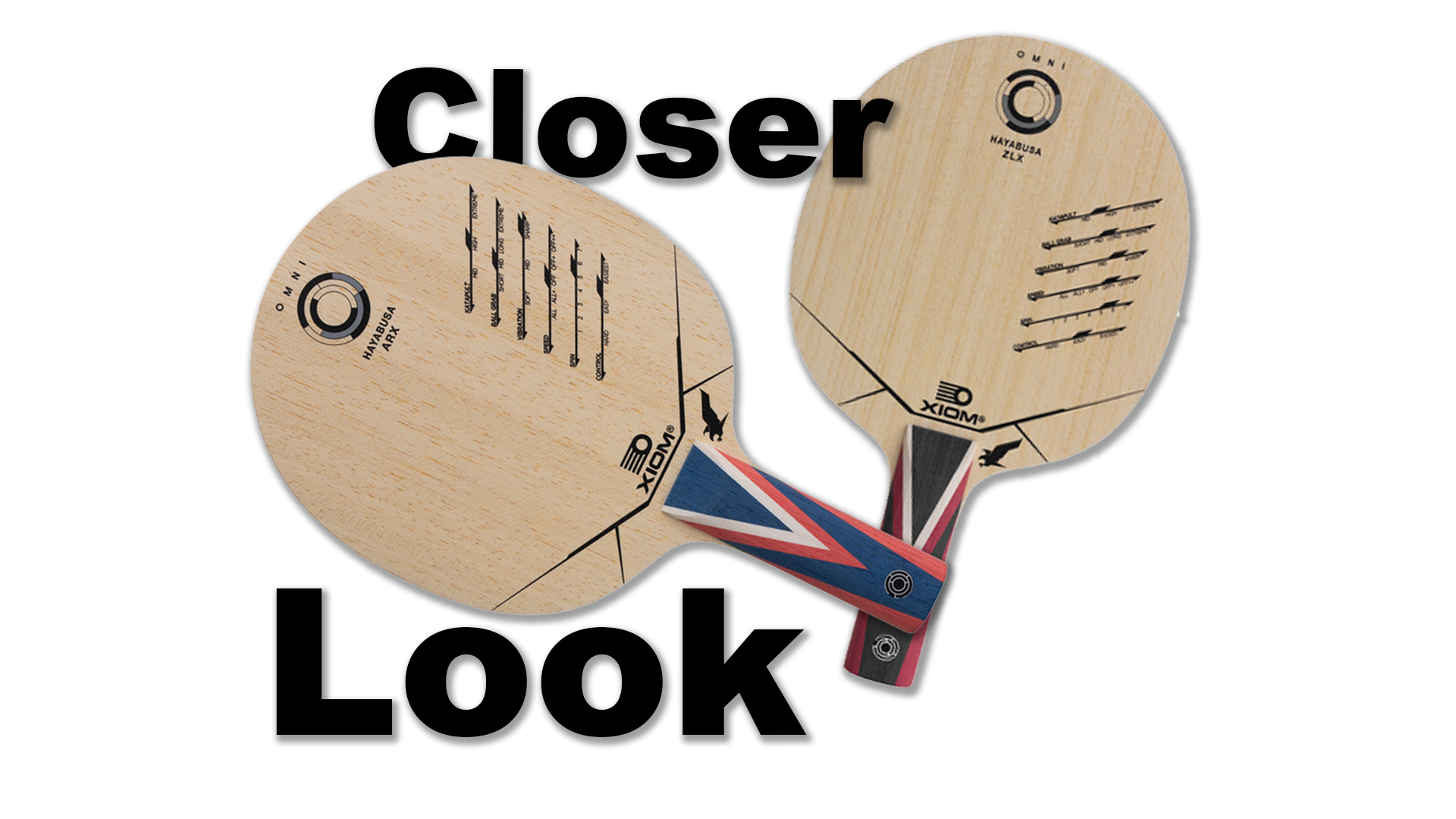
The blades also share a similar design. Thus, the playing surface on the FH side features several design elements, including the Omni logo, the blade name, the XIOM logo, a Hayabusa (i.e., a peregrine or falcon) about to land on the handle, and diagonal stripes near the handle area that probably are meant to mimic a Hayabusa in flight. Also listed on the FH side are charts indicating blade characteristics (Catapult, Ball Grab, Vibration, Speed, Spin, Control). The playing surface on the BH side also features the XIOM logo and the “Hayabusa in flight” design feature, the name and logo of the composite material used, and text describing how rubbers “modify the rectilinear kinetic energy produced by the blade” into “curvilinear synchronized dynamics” to “achieve new equilibrium quality”. In other words, the playing surfaces are quite busy.
The handles have a three-color V-shaped design scheme on both the FH and BH sides (ARX: royal blue, salmon red, and white; ZLX: dark grey, burgundy, and white). The FH side of the handle features a small, silver-colored, metal Omni logo, whereas the BH side features a similarly sized and shaped metal tag listing the three-letter abbreviation. The handle butts feature a golden “Hayabusa, XIOM, OMNI” tag.
Both blades have straw-colored playing surfaces. The ZLX surface is slightly paler and has a prominent fish scale pattern, indicating that koto wood is used as the outer veneer, whereas the surface veneer of the ARX is slightly darker. The blades look quite modern and appear to be well-made, although the wings have not been sanded. Both blades are ok to hold, but the ZLX’s handle felt thinner, and the butt of the handle burrowed into my palm during gameplay.
The ZLX has a relatively thick core (presumably kiri), a thin intermediate ply (presumably ayous), a very thin weave of Zephylium Carbon, and a very thin outer veneer of koto. The ARX appears to have a very similar ply construction, except that a very thin weave of Aramid Carbon is placed below the very thin outer veneer. I am not 100% certain if the outer ply is limba or koto.
Both blades have playing surfaces of 158 mm x 151 mm (height x width). The ZLX has a thickness of 5.6 mm, whereas the ARX has a mid-blade thickness of 5.7 mm. Somewhat unusually, the ARX blade seems to be 0.1-0.2 mm thicker towards the top of the head, according to my measurements. The FL handle of the ZLX has the following dimensions for length, width, and height: 100.7 mm, 25.5-32.3 mm, and 23.3-24.8 mm, respectively. The ARX FL handle is minimally larger with length, width, and height dimensions of 100.9 mm, 26.0-32.8 mm, and 23.5-25.4 mm, respectively. The blades weighed 83 grams (ZLX) and 86 grams (ARX). Bouncing a ball on the bare blade produced resonance frequencies of 1550-1570 Hz (ZLX) and 1523 Hz (ARX), suggesting that both Hayabusa blades are very fast and/or stiff. The centers of gravity for the two blades are approximately 2.7 cm (ZLX) and 3.0 cm (ARX) from the top of the handle.
Testing Procedure
I evaluated the ARX and ZLX blades using well-used sheets of DHS Hurricane 3 (black, 2.15 mm, 40-degree) and Spinlord Waran 2 (red, 2.0 mm) short pips as my FH and BH rubbers, respectively. I attached the rubbers to the blades using one layer of the Revolution 3 normal viscosity glue on the rubber and the blade. I tested the setups over several sessions each, playing a mix of regular and match-like drills against my regular high-level practice partner (two-winged looper) and practice matches against intermediate level club members, using Neottec Neoplast Pro 40+ training balls throughout this test.

Playing impressions ARX
Driving
The feeling upon striking the ball with the ARX is exceptionally rigid and metallic. This was surprising to me as I was expecting a feeling more akin to the classic Butterfly Viscaria blade (which feels far less rigid). Very few vibrations travel into the hand, which produces a very stiff and somewhat empty sensation. The ARX is a very fast blade with a short dwell time in the low-to-mid OFF+ category. As a result, my FH and BH drives were very flat, with long trajectories leaving a small, but sufficient margin over the net. The sweet spot is huge. The rigid feeling persists, irrespective of where you hit the ball on the blade.
Looping
The ARX also felt very rigid on FH loops. Spin production is quite modest since the dwell time is short - there simply isn’t sufficient contact time to impart heavy spin on the ball, even when using H3 as a FH rubber. The ball trajectory is therefore very flat as the ball doesn’t dip very strongly. My FH warm-up loops were fast but easy to return for my practice partner. It is possible to maintain an excellent consistency if one has good hand feeling. When practicing 3rd ball attacks, I focused on speed and ball placement rather than spin. Thus, it is possible to produce blisteringly fast shots. However, any FH loop that isn’t outside of your opponent’s reach will be easy to return for them, as the spin levels are low. While the blade is fast, I didn’t feel much in terms of catapult.
The ARX has plenty of power reserves to facilitate FH-to-FH loop rallies away from the table. As before, the trajectory is quite flat, and the margin for error is lower than with higher arcing blades. I particularly enjoyed the rigid nature and high speed of the ARX on BH short pip topspin/fishing shots far from the table. The cracking sensation gave me the confidence to use very aggressive stroke mechanics and still land the shots.
Third-ball BH openers against long pushes were fast, long, and dangerous. The stiff nature of the ARX pairs quite well with short pips and led to good levels of spin inversion.
Blocking
The ARX is an all-or-nothing blade when it comes to blocking. Due to its rigidity and high speed, the margin for error is quite low when blocking close to the table. It’s essential to use the correct bat angle, as the block otherwise will fly past the table or into the net. With the correct bat angle, FH and BH blocks are propelled quickly over the net, often resulting in outright winners. Stepping 1-2 steps away from the table improved the consistency of my FH/BH blocks and seems to be the optimal distance for this blade.

Smashing
The ARX is preeminently suited for flat hitting and smashing due to its high speed and rigid nature. I was able to exert a high level of pressure on my practice partner using these shot types, especially with my BH short pips.
Flicking
The rigid nature of the ARX renders it well-suited for all types of flicks, particularly BH short pip pancake type flicks.
Pushing
The short dwell time of the ARX means that pushes are fast and flat but low on spin. If your opponent is in a position to attack the push, they will have a rather easy time. The key is to produce aggressive pushes that bring your opponent out of position.
The fast nature of the ARX blade means that good hand feeling is needed to produce good-quality short pushes. That said, the lack of a strong catapult does help to get the length of the shots right.
Serving
The ARX works very well for long, fast serves of all types of spin due to its fast nature. Spin levels are only moderate, so surprising your opponent with speed and ball placement is critical. The rigid, non-bouncy nature of the blade also means that it is possible to execute short, flat backspin serves with good consistency, albeit with relatively low spin levels.
Conclusion
My initial impression of the Hayabusa ARX blade was not great. It felt very metallic and “empty”. However, I learned to appreciate the blade more and more as the test progressed. It is a fast, rigid blade that encourages a direct and aggressive style where the focus is on speed over spin. If your style emphasizes flat hits, loop drives, and flicks, then this is a blade for you. The ARX works from all distances due to its high speed, but is probably best suited for mid-distance play. This is not a blade for beginners or intermediate-level players, but rather for uncompromising advanced players.
Other blade(s) this reminds me of: Stiga Carbonado 290.

Playing Impressions ZLX
Driving
Surprisingly, the ZLX feels very different from the ARX. Thus, while the ARX is rigid and metallic, the ZLX feels soft, empty, and disengaged when striking the ball. Very few vibrations travel to the hand, which meant that I struggled to develop a good feeling for the ball. Contrary to XIOM’s description, the ZLX feels noticeably slower than the ARX, though it is slightly bouncier. In fact, I found XIOM’s descriptions of the blades to be quite inaccurate. I see the ZLX as a blade in the low OFF category. My FH and BH drives had medium-long trajectories, with slightly greater clearance over the net than the ARX. The ZLX has a far smaller sweet spot than the ARX.
Looping
The ZLX’s disengaged, soft feeling also applies to FH loops. Spin production is marginally higher than with the ARX due to the slightly longer dwell time, but it is still lower than with other composite blades that I have tested recently. The trajectories of my FH loops remained quite flat as the ball didn’t dip very strongly. My FH warm-up loops were clearly slower than with the ARX but not a whole lot spinnier, which meant my practice partner had a relatively easy time returning the shots. I never managed to develop a good feeling for the ball using the ZLX. Thus, when practicing 3rd-ball attacks, I lacked the ARX’s speed and ability to place the shot, and didn’t gain much in terms of spin. Accordingly, I struggled to put my high-quality practice partner under pressure.
The ZLX has sufficient power to enable FH-to-FH loop rallies away from the table, but its slower and softer nature meant that my shots had less penetrating power and were less consistent. The softer and slower nature of the ZLX also affected my BH short pip topspin/fishing shots far from the table, which had otherwise been a highlight in recent weeks. Since the blade gave me less feedback, I didn’t have the same level of confidence as with the ARX.
My 3rd-ball BH openers with the short pips against long pushes were medium-fast and medium-long with decent but not fantastic levels of consistency. Once again, the ZLX’s softer feeling meant that I was less confident about attacking the ball aggressively.
Blocking
FH blocking with the ZLX was solid but unspectacular. The ZLX absorbs incoming energy decently enough, but the soft and disengaged feeling that the blade produces renders the shots a little…boring. The blade’s lower speed meant I was rarely able to overpower my practice partner, and instead, I had to place the FH blocks in hard-to-reach places. At times, the ZLX’s longer dwell time and bouncier nature meant that my H3 rubber had a longer time to react to the incoming spin, resulting in less controlled FH blocks. My BH blocks were similarly unexciting, feeling soft with moderate pace but without a commensurate increase in control relative to the ARX.

Smashing
The ZLX’s slightly longer dwell time gave the impression that my H3 FH rubber was more sensitive to incoming spin, which, to some extent, together with the blade’s more moderate speed, impacted my ability to generate truly powerful smashes. My BH smashes, executed with the softer W2, were reasonably effective.
Flicking
I struggled to develop a good feeling for FH flicks with the ZLX due to its softer nature. Particularly, my pancake flicks were very hit or miss, whereas I enjoyed better consistency when attempting classic mini-loop-type flicks. My feeling for BH flicks with my softer W2 short pips was slightly better, but not as good as with the ARX.
Pushing
Compared to the ARX, the ZLX was able to produce spinnier long pushes, which in turn required greater physical commitment from my practice partner, for him to return - and maintain initiative on - his 3rd-ball attacks. The ZLX’s moderate speed and lack of a strong catapult meant I was able to produce reasonably good quality touch shots and short pushes.
Serving
The ZLX worked ok but unspectacularly on short backspin serves. The disengaged feeling that I have been speaking about meant that I couldn’t really feel the ball bite into the H3 rubber. The serves seemed spinny enough, though. The quality of my long side/topspin serves was fine but unspectacular, with spin and speed levels at “meh” levels.
Conclusion
The XIOM Hayabusa ZLX is a low OFF-level composite blade that feels soft and disengaged. This is one of those blades that is okay but doesn’t stand out in any shot category. It is too slow to be a hard-hitter’s blade, yet doesn’t produce enough spin and control to be a blade of choice for two-winged loopers or spin-offensive players using hard rubbers. In fact, the ZLX might pair significantly better with softer European/Japanese rubbers.
Other blade(s) this reminds me of: A less refined version of the Tibhar Alexis Lebrun Krypto Carbon.
Final Thoughts on the ZLX and ARX Blades
The ultra-aggressive and stiff XIOM Hayabusa ARX is a fun blade to play with, as it allows you to feel and pound the ball. The XIOM Hayabusa ZLX, on the other hand, is too soft and disengaged for my liking when using H3 and W2. While it is considerably slower than the ARX, it does not produce commensurate increases in spin or control.
About the Reviewer
Patrick 'Pong Professor' Hrdlicka is a table tennis enthusiast with a Ph.D. in chemistry who combines his analytical and experimental skills with his love of table tennis in order to test and review a wide range of table tennis equipment.
