We use cookies to make your experience better. To comply with the new e-Privacy directive, we need to ask for your consent to set the cookies. Learn more.

Rubber Review: Xiom Omega VIII Rubbers

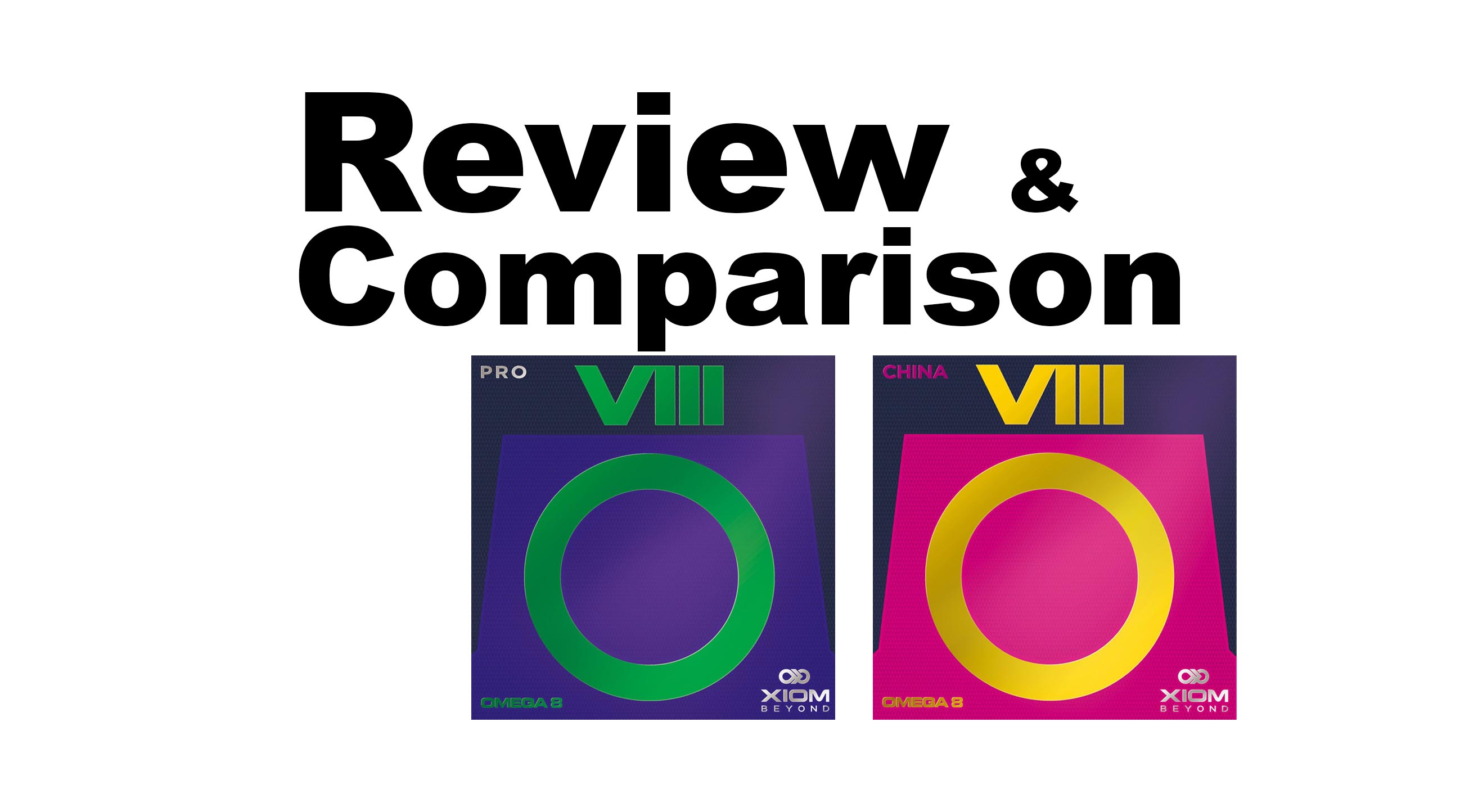
Xiom Omega VIII Rubbers
This test report is on two members from Xiom’s recently released Omega VIII series, i.e., the Xiom Omega VIII Pro (O8P) and Xiom Omega VIII China (O8C).
Xiom recently introduced the AI-developed “X-factor” concept to address a common problem that table tennis players face, i.e., tension-free sticky Chinese rubbers provide exquisite control in the short game but lack power away from the table unless illegally boosted, whereas standard high-tension rubbers on soft sponges provide excellent power away from the table but are difficult to control in the short game. According to Xiom, the X-factor concept provides high-tension power away from the table but remains in a controllable low-tension state on low-impact strokes close to the table. Xiom first introduced the X-factor concept with the Jekyll and Hyde rubber series, which featured a thicker topsheet, shorter and more densely arranged pimples, and an improved integration between the topsheet and the so-called epsilon sponge, which has a high density of uniformly distributed tiny pores.
The Omega VIII rubbers, which are made in Germany, feature the same X-factor technology as the Jekyll and Hyde rubbers but are lighter due to the use of a so-called NIF sponge, which has ultralow elasticity. According to Xiom, national-level players often prefer heavier and stronger rubbers for increased balance and stability at high swing speeds. However, players who are not at this level might benefit from using lighter equipment, especially in close-to-the-table play.
The 47.5-degree O8P is described as having a powerful catapult for aggressive topspins, whereas the 52.5-degree O8C is described as a Chinese sticky FH rubber with a stabilizing quality, powerful performance, and lower weight than the Jekyll & Hyde C-series. Xiom gives the O8P and O8C ratings of 8.9/9.2/9.5 and 8.5/9.6/8.9 in the speed/spin/precision categories, respectively, whereas it rates the Jekyll & Hyde C55 and Omega VII Guang China (O7GC) rubbers at 8.4/9.8/8.9 and 9.0/9.0/9.5. These ratings suggest that the O8P and O8C rubbers are faster but less spinny than the C55, but more spinny than the O7GC.

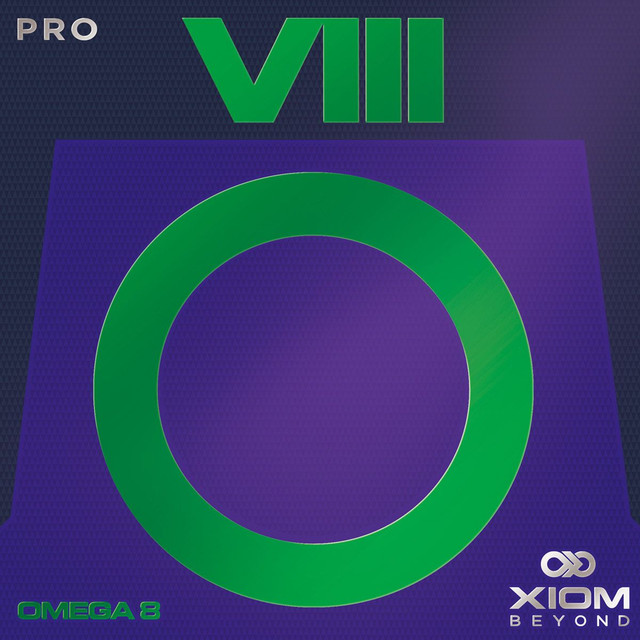
The O8P and O8C rubbers are delivered in similar cardboard two-fold wrappers. The front flap features a big green “O” against a purple metallic fish scale background (O8P) or a big golden “O” against a pink metallic fish scale background (O8C). The inside flap features a large matte black circle with the text “2in1” against a metallic purple fish scale background. The name of the rubber is listed on top in silver and green (O8P) or pink and gold (O8C). The reverse side of the wrapper lists technical information such as the sponge hardness, descriptions of Xiom’s C, H, P, and E-series, and philosophy behind the “2-in-1” concept.
Inside the wrapper, the O8P and O8C rubbers are covered by a simple paper and a non-adhesive opaque plastic sheet, respectively. The O8P has a strong sweet scent, whereas the O8C has a weaker sweet scent.
The topsheet of the O8P is slightly sparkly and in a paler shade of red. It is grippy but entirely non-tacky. The pimples, which are short and cylindrical, are seen below the topsheet. The O8P’s black sponge has a high density of small pores. The topsheet of the O8C is a brighter shade of red, shinier, and also sparkly. It is very grippy and only minimally tacky. The short pimples are not visible below the topsheet. The O8C’s black sponge has a high density of small pores.
The O8P and O8C (red, max, which is only 1.9 mm) weighed ~67 grams and ~72 grams uncut (170 mm x 170 mm, width x height) as compared to the Jekyll and Hyde C55, which weighed 73 grams uncut. The O8P and O8C weighed ~48 grams and ~51 grams when cut to the 158 mm x 151 mm test blade, which are fairly average for rubbers of these hardness levels.
Playing Impressions – O8P
Drives
It didn’t take many warm-up FH drives to realize that the O8P is a rather soft and bouncy rubber. The O8P is relatively docile on medium-impact FH drives, with a medium catapult and mid OFF- speed level. A fairly prominent clicking sound is produced when striking the ball. More aggressive FH drives, executed with a more closed bat angle, result in an even more prominent click and activate a stronger catapult that lengthens the shot trajectory considerably, giving the impression that the O8P is a very fast rubber, even though it really isn’t. The O8P generally felt more predictable and crisper whenever I used a more closed bat angle, whereas it felt soft, spongy, and bland when using a neutral bat angle. The transition from moderate to prominent catapult is quite sharp, which requires focus as the FH drives; otherwise might overshoot the table.
Loops
FH warm-up loops are effortless and predictable with the O8P. However, judging from my partner’s blocking, the shots seemed to lack power compared to other top-end rubbers that I have recently tested. Spin levels seemed to be moderate and less than with the Victas V>15 Sticky that I recently tested. And the FH loops also weren’t spectacularly fast. Whenever I tried to loop with greater effort, the strong catapult activated, causing me to overshoot the table at a higher frequency than normal. Somewhat counterintuitive considering the relatively soft sponge, the throw angle seemed to be rather flat on FH loops, leading me to use a more upward motion.
My 3rd ball FH attacks against long pushes further underscored these observations. I felt that the FH loops - while easy to execute due to the grippy rubber – lacked power and were not always easy to predict due to the sudden onset of the catapult. I resorted to playing 3rd ball attacks with 60-70% of my max power and used feeling and creative angles to place the FH loops in difficult-to-reach places. This approach worked quite well, but it necessitates excellent ball feeling.
The bouncy nature of the O8P means that it was easy for me to play FH loop-to-loop rallies. Once again, I found it important not to be too aggressive, as my shots otherwise had a tendency to sail long. Instead, I tried to use the bounciness of the O8P to my advantage and just let the rubber do its thing. Doing so, I was able to engage in effective and controlled rallies.
Blocks
The feeling on FH warm-up blocks is relatively crisp with the O8P. Akin to my observations with the C55, the use of neutral bat angle when blocking sometimes resulted in bouncy, high-throwing shots that went long. There is no doubt in my mind that the O8P is a rubber that needs to be closed with a more closed angle on all topspin shots. Thus, just like the C55, it provided more effective counterdrives, resulting in fast and very flat shots that were challenging for my practice partner to return. However, compared to the C55, it is easier to hit deeply into the sponge with the O8P, which renders top-quality counterdrives less predictable.
Smashes
The O8P works ok on FH smashes, but the relatively soft sponge limits the maximal power transfer between the player, paddle, and ball. Thus, my smashes, while fast enough to finish most points, lacked a little top-end power.
Flicks
The feeling on flicks was surprisingly muted considering the O8P’s soft sponge. My mini-loop type FH flicks were controlled and consistent, as the catapult effect didn’t kick in on these low-input-power shots. Pancake-type FH flicks were underwhelming since the O8P, as asserted by Xiom, felt relatively slow on these shots. All-in-all, the O8P allows for controlled flicks to be executed with sufficient clearance over the net.
Pushes
FH pushes against short backspin serves were surprisingly spinny, considering my other observations. The topsheet grips the ball quite well, and the lack of a prominent catapult meant that I was able to slice the ball with good feeling and depth. More aggressive pushes, however, did seem to activate the catapult, leading to some of my FH pushes going long. The take-home message is that it is possible to produce excellent FH pushes provided one moderates the amount of input power.
The O8P felt quite slow on short FH pushes against short backspin serves, allowing me to produce very high-quality pushes. Once again, these seem to affirm Xiom’s assertions regarding their “X-factor technology”.
Serves
I tried a variety of serves against my practice partner. The spin level on the serves was fine, but nothing special. The bouncy nature of the O8P, at times, led me to overshoot the table on long top-/sidespin serves.
Conclusion
Xiom Omega VIII Pro is a relatively soft rubber that is relatively slow on low input power shots (pushes, flicks) and very bouncy on higher input power shots (loops, counter-drives). It is a rubber that performs best on shots executed with closed bat angles (flicks, loops), and less well on neutral bat angles (e.g., passive blocking, flat hitting). The rubber’s dual nature does necessitate some getting used to, and players with good feeling in their hands will be able to use this rubber effectively. The O8P is probably too soft as a FH rubber for most advanced players and might be better suited as a BH rubber.
Playing Impressions – O8C
Drives
The first couple of FH drives immediately revealed that the O8P and O8C rubbers are astonishingly different, despite being members of the same series. The O8C is a far more reliable and predictable rubber, with more linear performance characteristics. A prominent clicking sound is produced when the ball is struck, and the resulting shot has a medium-high and relatively long trajectory. The O8C is faster than the O8P (~low-to-mid OFF), even though some perceive it as being slower due to the weaker and more consistent catapult effect. Be it as it may, I enjoyed the outstanding consistency of my warm-up FH drives.
Loops
FH warm-up looping is effortless and very reliable with the O8C. The topsheet grips the ball with near-Hurricane-like efficiency, even though the spin levels produced aren’t quite at that level. The resulting shots are fast with long trajectories. Compared to the O8P, far fewer of my FH loops overshot the table.
My 3rd ball FH attacks against long pushes were very consistent and clearly more dangerous than with the O8P. Whilst the spin levels produced are a step below Hurricane 3, they are on par with the very best hybrid rubbers such as Tibhar K3 Hybrid, Victas V > 15 Extra Sticky, or Butterfly Dignics 09C. The harder sponge of the O8C ensured more efficient power coupling between player, paddle, and ball, enabling fast and reliable 3rd ball attacks that often set me up for winning the point outright or on the following shot.
The O8C’s linear and relatively moderate catapult, coupled with the firm nature of the sponge and prominent clicking sound produced, gave me a lot of confidence in FH loop-to-loop rallies. I was able to hit quite hard through the ball without having to worry about overshooting the table. And, the relatively high throw angle afforded me the net clearance that was needed.
Blocks
The O8C is clearly capable of absorbing more incoming kinetic energy than the O8P due to the harder sponge. Thus, FH warm-up blocking was crisp and reliable with the O8P. During match-play, however, I found that the use of a neutral bat angle at times resulted in unusually high-throwing blocks that overshot the table. Akin to my observations with the O8P and C55, I found that the O8C shines in aggressive, modern blocking where a more closed bat angle is used. Thus, I found the O8C to be exceptionally effective for counterdrives, which were lightning fast and near-impossible to return.
Smashes
The O8C works well for FH flat hitting. That said, there are other hybrid rubbers on the market with a similar sponge hardness that can produce faster FH smashes due to a stronger catapult effect. However, the speed produced by the O8C is more than sufficient to put away any balls that sit up.
Flicks
Like my observations with the O8P, I found the feeling on flicks to be surprisingly muted, considering the crisp feeling on drives, loops, and blocks. Accordingly, my FH flicks were solid and reliable but unspectacular. Mini-loop type FH flicks were controlled and benefited from the strong grip of the topsheet. My pancake-type FH flicks were only moderately fast.
Pushes
My FH pushes against backspin serves were more consistent with the O8C than with the O8P due to a more linear and moderate catapult effect. Once again, the topsheet gripped the ball very well, allowing me to produce very spinny and flat pushes that proved challenging for my practice partner to attack.
For similar reasons, I found it easy to execute short pushes against short backspin serves with good consistency. If anything, I almost wished the O8C was a little faster, as some of my pushes were too short.
Serves
The O8C seemed to be able to produce very respectable spin levels on short backspin serves, but did not quite reach Hurricane-like levels on longer side-/top-spin serves. However, for a non-Hurricane rubber, the spin levels were very good.
Conclusion
The Xiom Omega VIII China is a top-notch, semi-hard, hybrid rubber that produces a crisp feeling on drives, loops, and blocks, and excels on counterdrives. The topsheet is very grippy, and the sponge provides excellent resistance, allowing advanced players to rip through the ball with confidence. It is a fast (but not insanely fast) rubber, with a linear and relatively moderate catapult, which enables good shot consistency. These qualities will also render it suitable for a surprisingly wide range of players, ranging from intermediate to professional level players, both as a FH and BH rubber. In my opinion, the O8C is one of the best non-Hurricane rubbers on the market.
About the Reviewer
Patrick 'Pong Professor' Hrdlicka is a table tennis enthusiast with a Ph.D. in chemistry who combines his analytical and experimental skills with his love of table tennis in order to test and review a wide range of table tennis equipment.
