We use cookies to make your experience better. To comply with the new e-Privacy directive, we need to ask for your consent to set the cookies. Learn more.

Nittaku Hina Hayata H2

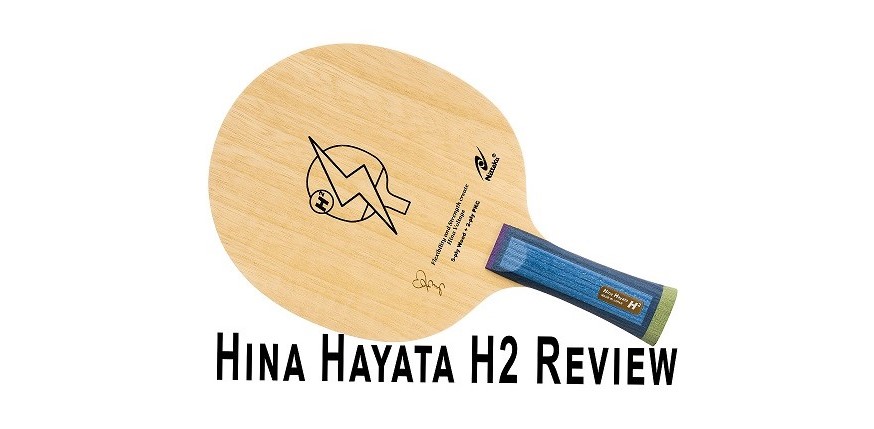
Nittaku Hina Hayata H2
A Well-Balanced Composite Blade for Modern Spin-Offensive Strategies
Welcome to my test report of the Nittaku Hina Hayata H2 (HH) blade. Named after – and used by – the Japanese female star player (bronze medalist in Women’s Singles at the 2023 World Championships; five-time medalist in doubles events at World Championships), this Japanese-made 5+2 inner construction composite blade is tailored to players who block and counter aggressively close to the table, while still being flexible enough to handle topspins and blocks from mid-distance. According to Nittaku, the blade’s outer limba ply renders it easy to feel the ball impact and facilitates delicate touch play.

Nittaku rates the speed and shot feeling of the HH as 4 and 3, respectively, on a 5-point scale. For comparison, the Nittaku So-Ten, Mima Ito Carbon, and Gyo-En composite blades are given corresponding ratings of 4 and 3, 4 and 5, and 4 and 5, respectively. In other words, we should expect the HH to be a reasonably fast blade with a soft feeling.
The HH arrives in a blade-specific box that provides adequate protection during transport and features a white, purple, and green color scheme. A sticker on the front lip lists the blade’s name and technical information in Japanese. The back of the box lists what appears to be blade-specific information in Japanese.

The blade has a modern appearance. The FH side of the straw-colored playing surface features the unique blade logo - i.e., a paddle with a lightning bolt and an H2 ball – along with the Nittaku logo, an outline of the ply composition (“5-ply wood + 2-ply PKC”), a description of the HH’s characteristics (“Flexibility and Strength create Hina Voltage”) and Hina’s signature. The BH playing surface is without text. The handle has a two-toned blue color scheme with a thin purple horizontal stripe near the top and a thicker mint-green horizontal stripe at the bottom. A medium-sized, rectangular, olive-green metallic tag listing the blade name is embedded on the FH side of the handle, while the BH side only features a small, plastic circular lens with silver “H2“ text against a red and black background. A rectangular, golden, holographic Nittaku tag is placed on the bottom of the handle. Although the blade appears to be well-constructed, neither the wings, edges, nor handle are sanded and accordingly feel slightly sharp to the touch.
The HH has a medium-thick ayous (?) core that is surrounded by the new “PKC” composite weave, which combines highly elastic Kevlar and carbon fibers, followed by a thin intermediate ply (looks like ayous or limba) and a very thin limba outer ply. The playing surface has the following dimensions (height x width x thickness): 157 mm x 152 mm x 5.8 mm. The FL handle has the following length, width, and height: 101.0 mm x 26.3-34.0 mm x 22.5-24.1 mm, respectively. Bouncing a ball on the naked blade produced a resonance frequency of 1359 Hz, indicating that the HH is in the high OFF- to low OFF range. My HH sample weighed 90 grams.
Testing Procedure
I evaluated the HH blade using well-used sheets of DHS Skyline 3 (black, 2.1 mm, 40-degree, blue sponge, provincial version) and Spinlord Waran II (red, 2.0 mm) short pips as my FH and BH rubbers, respectively. I attached the rubbers to the blade using one layer of the Revolution 3 normal viscosity glue on each of the rubber and the blade. I tested the set-up over five sessions, playing a mix of regular and match-like drills against my usual high-level practice partner (two-winged looper), using Neottec Neoplast Pro 40+ training balls throughout this test.
Playing Impressions HH
Initial Impressions
The HH felt surprisingly nimble and well-balanced considering its above-average weight (90 g). The balance point is tilted slightly towards the head. The handle of the HH is relatively narrow but not disturbingly so. In fact, the style of the handle and neck encouraged a slightly looser grip, which I prefer.
Driving
The feeling upon striking the ball whilst playing warm-up FH drives with the HH/Skyline 3 combination is characteristically limba soft. Yet, at the same time, I could detect a certain stiffness from the PKC weave. The soft/stiff characteristics combine to produce a very pleasant feeling that is quite woody yet snappy. The HH is not a particularly bouncy blade but produces FH drives with a surprisingly long trajectory with a medium to medium-high throw angle. I would categorize the HH as a high OFF- blade. My Waran II short pip BH drives felt crisper, and a more cracking sound was produced. In a blind test, I would have been hard-pressed to distinguish between the HH and a thinner limba-based 7-ply all-wood blade, such is the relatively soft and crisp feeling of the HH. The consistency of my FH/BH drives was sky-high, which proved to be a recurring observation throughout this test.
Looping
FH looping with the HH/Skyline 3 combination generates a relatively soft feeling on ball impact and trajectories with a medium-high and relatively long trajectory. My FH loops had plenty of clearance over the net, were very consistent, and had excellent spin. As a matter of fact, the HH gave me heaps of confidence to execute FH loops down-the-line, inside-out or with extreme diagonal angles, without being worried about overshooting the table. And while the HH is not a speed demon for outright 3rd ball attack winners, it does have the right mix of characteristics to enable relatively fast and spinny shots to be executed with excellent control, which won me an above-average amount of points. My 3rd ball BH attacks against long pushes with the Waran II short pips benefited from the slightly stiff nature and medium/medium-high throw angle of the HH. I was able to hit flat through the spin and land reasonably dangerous shots with good consistency.
The HH also felt great in FH loop-to-loop rallies away from the table. It is sufficiently fast and has plenty of arc to securely land shots on your opponent’s side. Once again, I enjoyed excellent control and rarely overshot the table. Similarly, the crisp feeling produced by the HH, coupled with its low OFF and relatively high-throwing characteristics, also allowed me to play aggressive BH short pip fishing shots far from the table with good consistency.
Blocking
The medium-stiff, moderately fast, and relatively linear nature of the HH works very well for blocking. The blade seems to absorb the incoming energy from high-quality loops well and allows for predictable redirection of the energy into hard-to-reach places without having to worry about overshooting the table, as there is no strong catapult. For sure, I scored many direct points on FH blocks in this manner. BH blocking was a little livelier and crisper due to the softer sponge of the Waran II, but I still enjoyed excellent control on my shots.
Smashing
While the HH is no rocket, it still is fast enough to put away any shots that sit up.
Flicking
I found FH flicks to be the weakest shot category of the HH, as it felt too soft and slow in my hands to facilitate dangerous pancake-type flicks. However, I was able to execute mini-loop type FH flicks with good consistency, aided by the blade’s medium-high throw angle.
Pushing
In my opinion, the HH/Skyline 3 combination worked supremely well for long FH pushes, as the dwell time was extended, enabling me to impart high spin levels on the pushes. Moreover, the predictable nature of the blade, i.e., the lack of a strong catapult, generally meant that I was able to place the ball in the intended locations with excellent consistency.
The HH feels relatively slow on low-impact shots, which allowed me to produce high-quality short pushes and ultra-short drop shots during gameplay. I was surprised by the high amount of feeling that this composite blade was able to provide me.
Serving
The HH/Skyline 3 combination gave the impression of an extended dwell time, which in turn allowed for the generation of high spin levels on serves. The blade gave me the feedback I needed to execute high-quality serves.
Conclusion
I thoroughly enjoyed the Nittaku Hina Hayata H2 blade. In fact, I would rank it among my top 3 composite blades. Combined with an inverted rubber, the blade facilitates a spin-offensive game style and offers a high degree of control relative to its speed levels. It allows for controlled blocking, great feeling in the short game, and spinny serves. Combined with a short, pimpled rubber, the HH allows for crisp blocking off the bounce and an aggressive over-the-table game style. In my opinion, this blade can be used by many different types of players due to its controlled yet relatively fast nature. Only outright flat hitters might find the blade too slow.
About the Reviewer
Patrick 'Pong Professor' Hrdlicka is a table tennis enthusiast with a Ph.D. in chemistry who combines his analytical and experimental skills with his love of table tennis in order to test and review a wide range of table tennis equipment.
