We use cookies to make your experience better. To comply with the new e-Privacy directive, we need to ask for your consent to set the cookies. Learn more.

Nittaku GeneXTion vs Donic Bluestar A1: The Battle of Recently Introduced 52.5-Degree Rubbers

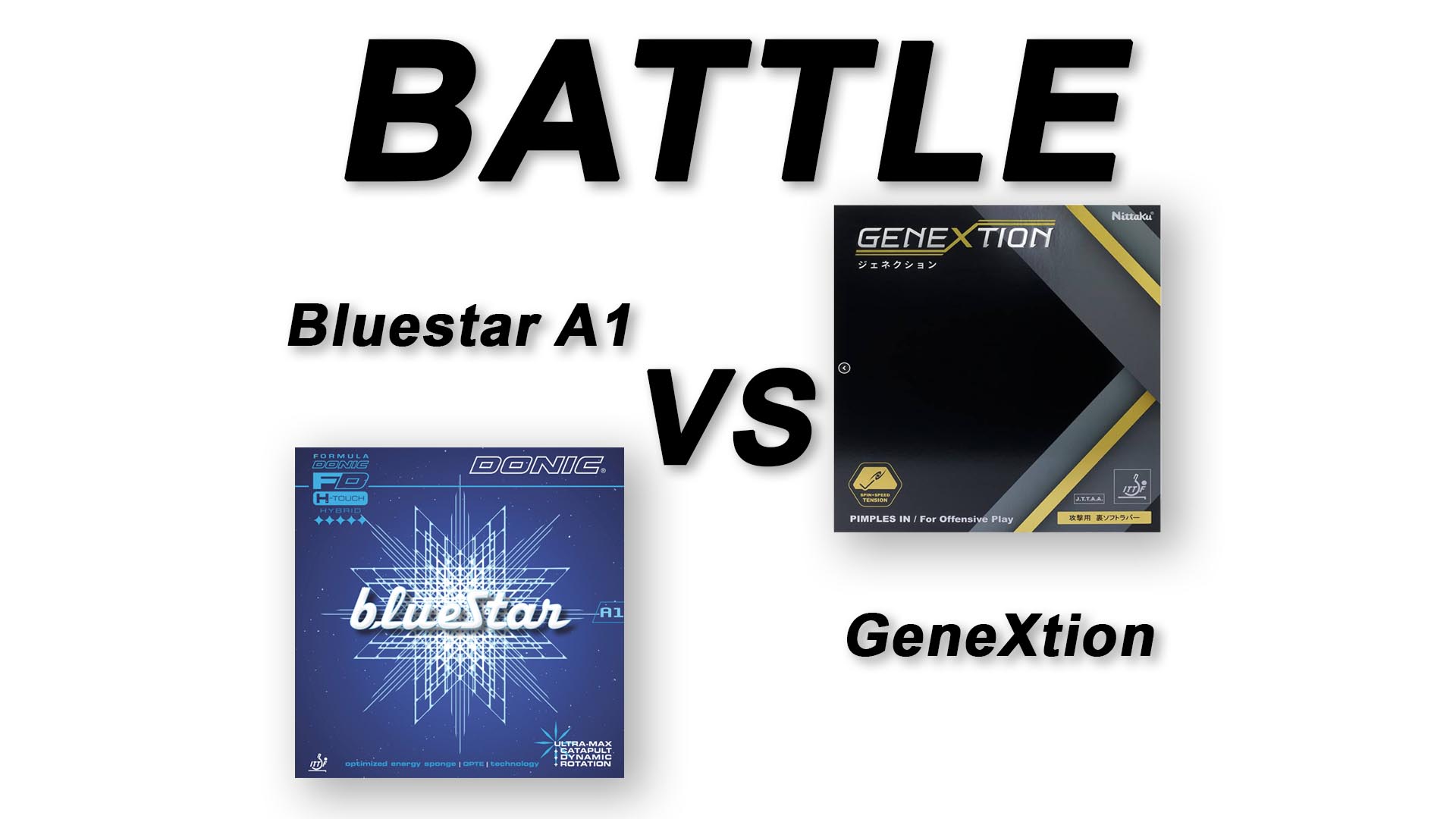
Nittaku GeneXTion vs Donic Bluestar A1: The Battle of Recently Introduced 52.5-Degree Rubbers
The Nittaku GeneXTion (GXT) is described as a rubber that facilitates intense rallies due to its hard sponge and excellent power transfer, while still providing exceptional softness for touch play. Nittaku credits this to their newly developed “Dual Sponge” and asserts that this renders the GXT ideal for modern offensive table tennis styles.
The German-made GXT from Nittaku is rated at 16.50 for speed and 13.50 for spin, making it the fastest rubber in their lineup. By contrast, the popular Nittaku FastArc G-1 has ratings of 15.00 for speed and 12.50 for spin, and the Nittaku Hurricane Pro III Turbo Orange is rated at 14.75 and 15.00. On the surface, the GXT appears to be an enhancement of the FastArc G-1.

I received a red “super-thick” (~2.0 mm) pre-release version of the GXT, which came in an all-white cardboard wrapper. According to online photographs, the production wrapper features black with gray and golden diagonal stripes, resembling the left half of an “X”.
The GXT features a thick, non-translucent, pale-red topsheet that is sparkly and grippy but completely non-tacky. The pimples seem to be relatively tall and broad, with small gaps between them. The cream-colored sponge is firm (rated at 52.5 degrees on the ESN scale) and has tiny pores. The GXT has a sweet booster smell and weighs 72 grams uncut (width x height: 170 mm x 169 mm) and 50 grams when cut to the 158 mm x 151 mm test blade (testing protocol detailed towards the end of this article).
Testing Procedure
I evaluated the GXT (red, 2.0 mm) and XXX (red, max) rubbers using one of my standard reference blades, i.e., the popular Tibhar Samsonov Force Pro Black Edition 7-ply all-wood blade with Spinlord Waran II short pips in my BH. I attached the brand-new rubbers to the blade as received using two layers of the Revolution 3 normal viscosity glue. I tested the setups over several sessions each, playing a mix of regular and match-like drills against my regular high-level practice partner (two-winged looper) and practice matches against intermediate-level club members, using Neottec Neoplast Pro 40+ training balls throughout this test.
Nittaku GeneXTion

Playing Impressions
Driving
Initial FH drives with the GXT revealed that it is a fast (high OFF, if not OFF+), catapulty, and soft-feeling rubber. A very pronounced clicking sound is produced on ball impact. The shot trajectories are long, with sufficient clearance over the net. Did I mention the rubber feels soft? It is astonishing how soft the GXT feels considering its 52.5-degree hardness rating. I could literally feel the ball sink into the rubber on FH drives.
Looping
My diagonal warm-up FH loops were fast, long, and quite consistent, and accompanied by a prominent clicking sound. However, the FH loops lacked significant spin, as evidenced by how easily my practice partner was blocking the shots. Down-the-line warm-up FH loops tended to go too long due to the GXT’s aggressive catapult effect. Additionally, the GXT’s soft nature sometimes made it feel like the ball had an especially extended dwell time, resulting in an exaggerated throw angle and shot trajectory.
Despite the previous observations, I found it challenging to execute third-ball FH loops against long pushes, which often lacked power and clipped the edge of the net. It almost seemed as though the rubber sort of collapsed when striking the ball when I used forceful stroke mechanics, leading to a significantly flattened throw angle. Being used to Hurricane 3, my fast acceleration through the ball likely caused me to hit through the GXT’s sponge. My practice partner overhit his blocks only on rare occasions, indicating that the spin levels on the FH loops were only moderate.
The GXT was effective in FH loop-to-loop rallies when I let the rubber handle the workload instead of using brute force. Said differently, the catapult effect carries the ball across the net, but if I used excessive power, the ball seemed to sink too deeply into the sponge, resulting in an inadequate power coupling between player, paddle, and ball.
Blocking
My FH warm-up blocks felt comfortable and had sufficient clearance over the net, resulting in good consistency. However, my passive FH blocks in actual match play became increasingly erratic. I credit this to the soft, bouncy nature of the GXT, which seems to lead to insufficient compressibility characteristics against very high-quality topspin. Instead, I found it more advantageous to close the bat angle and aggressively counterloop incoming topspin balls, as this yielded shots that were both more predictable and dangerous.
Smashing
The GXT performs admirably on flat hits, yet its soft nature imposes a limitation on the power transfer from the player to the ball via the paddle. Nevertheless, smashes maintain sufficient speed and lethality.
Flicking
FH flicks surprisingly emerged as my standout shot with the GXT, defying my usual weaknesses. The GXT’s catapult effect not only enabled me to lift the ball comfortably over the net when using the mini-loop technique, but also resulted in relatively dangerous shots given their long trajectory. Pancake-style flicks fared even better, resulting in rapid shots accompanied by a satisfying clicking sound. I give the GXT top marks in this shot category.
Pushing
Short FH pushes proved challenging for me. When pushing short against half-long backspin serves, I struggled to gauge the push length accurately, often being overly cautious to avoid activating the rubber's strong catapult effect, which meant that many shots hit the net. Against short backspin serves, my pushes tended to pop up high, making it easy for my practice partner to kill off the point.
On the other hand, the quality of my long pushes against backspin serves was good with respectable spin levels, provided I contacted the ball right off the bounce with soft hands. However, missing the timing even by a little led to my FH pushes sailing past the table due to the rubber's inherently fast nature and strong catapult, which is particularly evident on low and medium impact strokes.
Serving
My short backspin serves were low and carried an average amount of spin. As for long side/top-spin serves, they were long and fast, making them dangerous, although spin levels were merely moderate.
Conclusion
Contrary to Nittaku’s claims, I would not classify the GXT as a hard-sponged rubber. It feels like a bouncy medium-soft rubber. Consequently, it is very fast on slow and medium impact strokes such as flicks, drives, and counter-loops. However, I felt there was an incomplete power transfer on high-impact strokes such as loops and smashes, imposing an upper limit on power imparted to the ball. While these characteristics aren't inherently 'bad,' they may not suit all players' preferences. The GXT caters to advanced offensive players who favor fast, bouncy, and soft rubbers that facilitate effortless play. I see particular value in the GXT as a BH rubber, as most players generally prefer a bouncier rubber to compensate for the lower amount of power that one can generate from the BH side.
Donic Bluestar A1

Donic touts the BlueStar A1 (BSA1) as having the potential to “become the new star” in its rubber range, due to its innovative "Optimised Energy Sponge" (OPTE). This small-pored sponge is said to set “new standards in terms of elasticity and dampening”. Donic claims the BSA1 boasts fantastic catapult and speed characteristics, coupled with an extremely grippy topsheet that ensures precise attacking strokes with substantial rotation and enormous dynamics. The BSA1 is recommended for ambitious, uncompromising offensive table tennis players who practice intensively, and it is categorized as an OFF/OFF+ hard-sponged rubber. The BSA1 is rated 11++ for speed, 11++ for spin, and 5+ for control, compared to the Bluestorm Pro’s 11+/11/5+, the BlueGrip C1’s 11/11++/5, and the BlueGrip C2’s 10+/11++/6-. In other words, the BSA1 is expected to be faster than these reference rubbers, as spinny as the BlueGrip rubbers, and with comparable or better control.
Packaged in a silver-on-blue cardboard wrapper, the BSA1 lists its speed/spin/control values and additional information on the back. The inside cover describes the Lifetime PLUS, Catapult PLUS, and Tension PLUS technologies, which should yield a 50% increase in playing hours, enhanced precision due to the catapult effect, and improved inner tension for a speed glue-like feeling. The deep red topsheet is covered by an opaque non-sticky sheet and features a thin, non-translucent, sparkly surface that feels grippy but non-tacky. The pimples are short and thin, with wide gaps between them. The blue sponge is rated at 52.5 degrees of hardness and has a high density of tiny pores. Even though both the BSA1 and GXT have the same hardness rating, the BSA1 feels firmer. The BSA1 sheet has a rubbery smell and weighs 74 grams uncut (width x height: 169 mm x 170 mm) and 52 grams when cut to the 158 mm x 151 mm test blade.

Playing Impressions
Driving
From the first few FH drives, it was clear that the BSA1 is significantly different from the GXT, offering a firmer feel and better power transfer. My FH drives felt crisp and produced a prominent clicking sound. The BSA1 is a low-to-mid OFF-level rubber with a moderate catapult effect, much less pronounced than that of the GXT. The BSA1 has a relatively low throw angle, being somewhere between medium-low and medium. Despite this, my FH drives consistently cleared the net and felt more reliable compared to those with the GXT. These characteristics encouraged me to use more aggressive stroke mechanics, resulting in faster FH drives with longer trajectories.
Looping
FH warm-up loops with the BSA1 were consistent and satisfying, with crisp ball contact and long, deep trajectories. The loops were fast, but the spin levels were only moderate, making it easy for my practice partner to block my shots. My attempts to add more spin by using a more upward motion did not affect my practice partner’s blocks much.
The BSA1's relatively flat throw angle rendered 3rd ball FH loops against long pushes challenging, as many of my shots hit the net or failed to dip in time, likely due to the average spin levels. With the right timing, I managed fast but not particularly spinny 3rd ball attacks, which required me to be ready for a follow-up 5th ball. Interestingly, loops against topspin worked better than those against backspin with both the BSA1 and GXT, indicating a trend towards rubbers geared for more open gameplay.
Reinforcing this observation, the BSA1 was effective in FH loop-to-loop rallies far from the table. The rubber felt stable and enabled efficient power transfer, allowing shots to consistently clear the net, though with slightly less spin power.
Blocking
Using the BSA1 for passive FH blocking felt crisp and reliable, with the rubber absorbing the energy from high-quality loops, resulting in greater consistency compared to the GXT. This is likely due to the harder sponge and reduced catapult effect. Active blocks, executed with short wristy motions, stood out with the BSA1, generating lightning-fast shots with flat trajectories that were hard to return. This reinforces the BSA1's suitability for open gameplay.
Smashing
Flat hits and smashes are highly effective with the BSA1, thanks to its inherent speed and excellent power transfer. This allowed me to close out points effortlessly when given the chance.
Flicking
Mini-loop type FH flicks with the BSA1 are fairly effective, although they demand better timing than the GXT, due to the harder and less bouncy sponge. Despite this, I successfully landed more shots than usual, owing to the high grip of the topsheet. Pancake-type flicks were especially delightful to play and difficult for my partner to counter, as the shots were rather fast.
Pushing
Thanks to the firm nature of the BSA1 and its grippy topsheet, I could execute consistent and decently spinny long pushes against short backspin serves. The BSA1's predictability, compared to the GXT, allowed me to lean into shots aggressively, making the pushes more challenging to attack. However, care is needed when pushing against dead serves, as the BSA1's speed can lead to overshooting the table.
While the BSA1 is more reliable for short pushes than the GXT due to its weaker catapult effect, I still found it difficult to keep the ball low over the net.
Serving
With the BSA1, I achieved respectable spin levels on short backspin pendulum serves, as the ball gripped the topsheet well and allowed for a more aggressive wristy motion than the GXT. Long side/top-spin serves also seemed to have a notable amount of spin but were perhaps a tad slower.
Conclusion
The BSA1 bears a striking resemblance to a slightly less spinny, yet considerably more affordable alternative to the Butterfly Dignics 09C. It's a compliant and well-rounded rubber designed for offensive players who favor a topspin-oriented gameplay, with particular emphasis on loop-driving, counter-looping, and blocking. However, it may not be as suitable for spin-offensive players seeking to generate maximum spin on every loop. With its reliable nature, the BSA1 caters to a broader range of players, from intermediate to highly advanced skill levels.
Final Thoughts
I prefer the BSA1 as an FH rubber for its enhanced predictability, better compressibility properties, and more effective power coupling. Said differently, I had a better idea of how the BSA1 would react to the different stroke types than the GXT. Advanced players, with excellent timing and refined stroke mechanics, can harness the BSA1 to produce more powerful shots, whereas the GXT can generate more power on low and medium-impact shots, which may favor its use as a BH rubber.
About the Reviewer
Patrick 'Pong Professor' Hrdlicka is a table tennis enthusiast with a Ph.D. in chemistry who combines his analytical and experimental skills with his love of table tennis in order to test and review a wide range of table tennis equipment.
