We use cookies to make your experience better. To comply with the new e-Privacy directive, we need to ask for your consent to set the cookies. Learn more.

Nittaku GeneXTion V2C – An improvement relative to its predecessor

Nittaku GeneXTion V2C – An improvement relative to its predecessor
Hello again, TT11 blog readers!
This time I am testing the Nittaku GeneXTion V2C rubber (GXTV2), i.e., the successor to the original Nittaku GeneXTion (GXT), which I reviewed earlier. I found the GXT to play like a bouncy, medium-soft rubber that is very fast on low- and medium-impact strokes such as flicks, drives, and counterloops. However, it exhibits incomplete power transfer on high-impact strokes such as loops and smashes, which limits how much power can ultimately be imparted on the ball. According to Nittaku, the German-made GXTV2 has a grippier topsheet that is less spin-sensitive, leading to excellent control in the short game and on service returns. Nittaku goes on to state that the GXTV2 provides an excellent feeling and is well-suited for off-the-bounce counter-topspins. Nittaku credits this to their newly developed “Dual Sponge”, which has a softer hitting sensation. Nittaku recommends the GXTV2 for ambitious offensive players seeking a controlled short game and explosive and spinny opening shots.
Nittaku gives the GXTV2 speed/spin ratings of 16.00/14.00, compared to 16.50/13.50, 15.00/12.50, and 14.75/15.00 for the GXT, Nittaku FastArc G1, and Nittaku Hurricane Pro III Turbo Orange rubbers, respectively. Thus, the GXTV2 is expected to be slightly slower and spinnier than the original GXT, and faster than the G1 and Turbo Orange.

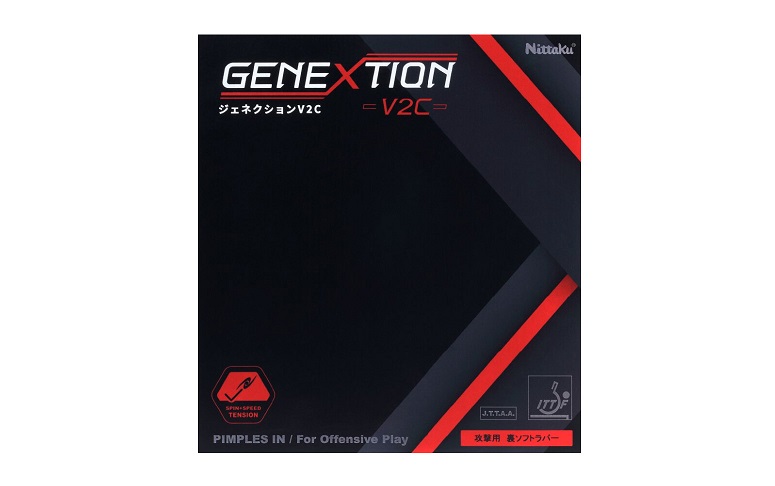
The GXTV2 comes in a black cardboard wrapper that features grey and red diagonal stripes, which resemble the left half of an “X”. The reverse side provides a brief rubber description in four different languages. The GXTV2 is protected by a non-adhesive, opaque film. In what I consider a nice touch, Nittaku provides one of its high-quality adhesive sheets to protect the topsheet once in use. The sheet has a faintly sweet, rubbery smell indicative of factory boosting. The bright red topsheet is non-translucent, non-sparkly (unlike the GXT’s), and very grippy but non-tacky. The cream-colored sponge, which feels softer than its stipulated hardness of 52.5 degrees on the ESN scale, would suggest, has a high density of tiny pores. The GXTV2 weighs 73 grams uncut (169 mm x 169 mm) and 54 grams when cut to the 158 mm x 151 mm test blade. Thus, the GXTV2 is considerably heavier than the GXT (50 grams). Testing procedure: I evaluated the GXTV2 (red, 2.0 mm) using one of my standard reference blades—the Tibhar Bernadette Szocs Signature 1 7-ply all-wood blade—paired with a Juic NeoAnti antispin rubber on the backhand. I attached the brand-new rubber to the blade as received, using two layers of the Revolution 3 normal viscosity glue. I tested the rubber over several sessions each, playing a mix of regular and match-like drills against my regular high-level practice partner (two-winged looper), using Neottec Neoplast Pro 40+ training balls throughout this test.
Playing impressions
Driving
In agreement with the description from Nittaku, my FH drives revealed the GXTV2 to be slightly slower (mid-to-high OFF), firmer feeling, and less bouncy than the GXT, which resulted in improved control. A clicking sound is produced on impact, although it is less pronounced than with the regular GXT. The FH drive shot trajectories with the GXTV2 are similarly long as with the GXT and have an even higher arc (i.e., the throw angle is medium high, if not high), resulting in plenty of clearance over the net. Unlike the regular GXT, which felt far softer than its 52.5-degree hardness designation, I would say that the GXTV2 felt pretty close to 52.5 degrees.
Looping
My diagonal warm-up FH loops were relatively fast, noticeably long, yet quite consistent, and accompanied by a clicking sound. The spin level on my loops was clearly higher with the GXTV2 than with the GXT – at times, my practice partner’s blocks went long. My down-the-line warm-up FH loops were also clearly more consistent with the GXTV2 than with the GXT, which I attribute to the less bouncy nature of the former.
The improved feeling also manifested itself in more powerful third-ball FH attacks against long pushes, as the GXTV2 allowed for a better power transfer, with shots clearing the net more easily. That said, other rubbers with harder sponges facilitate an even better power transfer. Spin levels on my FH loops seemed very respectable, especially whenever I contacted the ball in the descending phase.
The GXTV2 is more reliable than the GXT in FH loop-to-loop rallies, as it is more linear. Thus, I had to put a little more effort into the shots, but the high throw angle helped me land the shots with ease.
Blocking
Regular FH warm-up blocks felt relatively comfortable and cleared the net adequately, resulting in good consistency. However, akin to my impressions with the GXT, passive FH blocks with the GXTV2 were somewhat erratic in match-like situations, leading me to overshoot the table. Unlike the GXT, where I suspected to soft and bouncy sponge to be the cause of the erratic behavior, this behavior likely stems from the topsheet construction of the GXTV2, which seems to add rebound during passive blocks. As with the GXT, I found it more advantageous to close the bat angle when using the GXTV2 and counterloop incoming topspin shots. The resulting blocks were both more predictable and dangerous, and still managed to land on the table.
Smashing
The GXTV2 works pretty good on flat hits as it is relatively fast with efficient power transfer. Thus, whenever given a chance, I was able to put away any loose balls in hard-to-reach places.
Flicking
While I liked the GXTV2 less well for FH flicks than the regular GXT, it is still an excellent rubber for these shots. The topsheet grip allows you to execute mini-loop type flicks with confidence, especially since the rubber, while relatively fast, is more linear, resulting in good consistency. The weaker catapult and firmer sponge render the GXTV2 less suitable for pancake-type flicks, unless – I stipulate – the rubber is paired with a fast composite blade.
Pushing
I found the GXTV2 easier to use on short FH pushes than the GXT, due to its more linear nature. Thus, I had an easier time keeping short FH pushes low.
My long FH pushes against backspin serves were of excellent quality and quite spin heavy, rendering it difficult for my practice partner to produce high-quality attacking shots.
Serving
My short backspin serves were low and loaded with spin, which is a testament to the quality of the topsheet. Along similar lines, my long side/top-spin serves were reasonably long, fast, and quite spinny, which rendered them dangerous.
Conclusion
In my opinion, the Nittaku GeneXTion V2C rubber is a significant improvement relative to its predecessor. It is firmer and less bouncy, making it more predictable and reliable. It is almost as fast as the GXT, and the topsheet-sponge combination allows for better spin production and power transfer. While it might be too soft for professional players, it is an excellent rubber for intermediate and advanced topspin-oriented players who prefer counterlooping over traditional passive blocking, which was the only real weakness that I was able to identify.
About the Reviewer

Patrick 'Pong Professor' Hrdlicka is a table tennis enthusiast with a Ph.D. in chemistry who combines his analytical and experimental skills with his love of table tennis in order to test and review a wide range of table tennis equipment.