We use cookies to make your experience better. To comply with the new e-Privacy directive, we need to ask for your consent to set the cookies. Learn more.

Nittaku Acoustic SG vs Nittaku Acoustic G Revision: Does the Handle Matter?

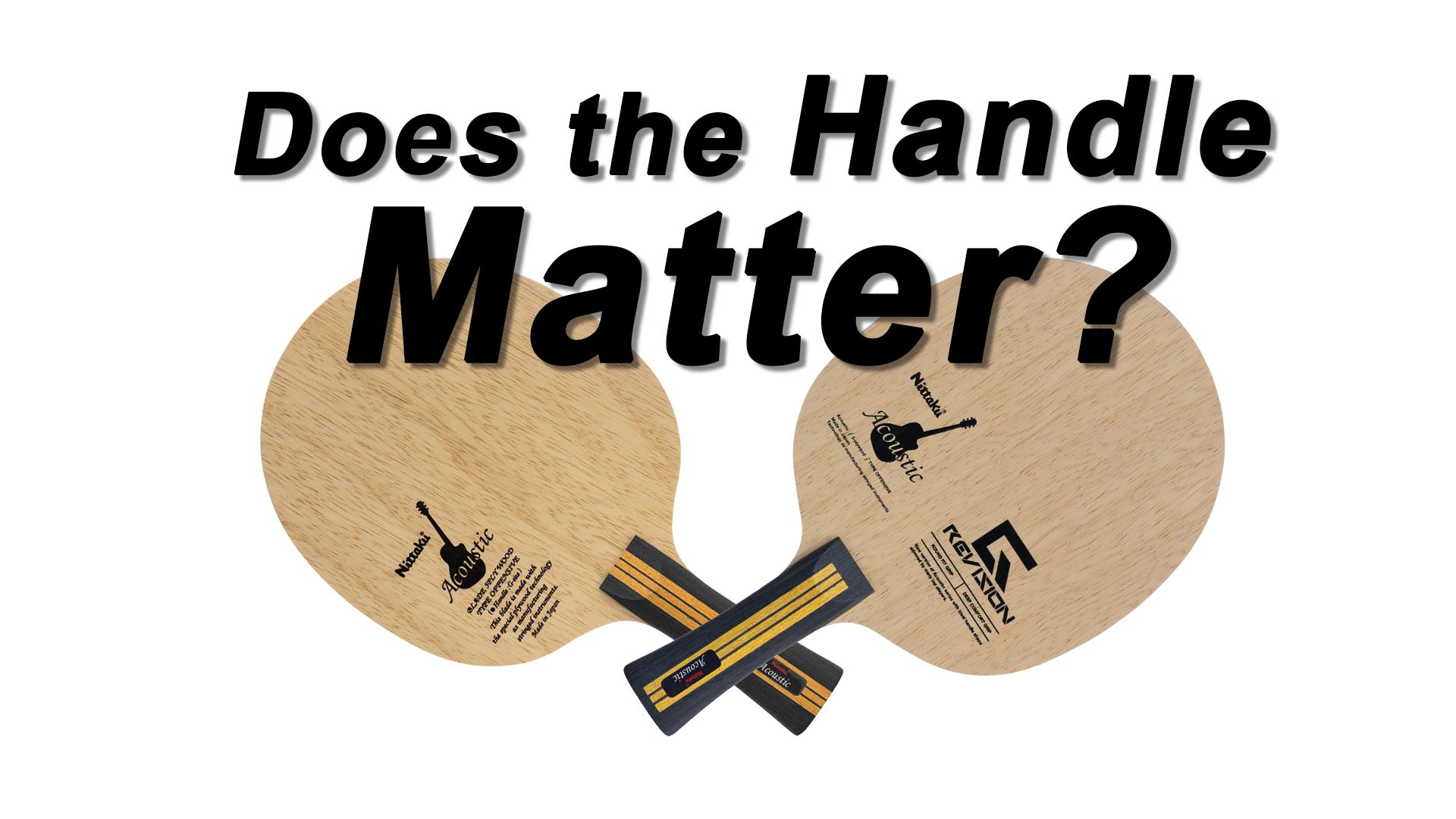
Nittaku Acoustic SG vs Nittaku Acoustic G Revision: Does the Handle Matter?
Hello, fellow TT enthusiasts and readers of the TT11 blog!
On this occasion, I set out to test and compare two versions of the classic Nittaku Acoustic blade, renowned for its excellent feeling and control. Specifically, I tested the Nittaku Acoustic SG (SG) and the newly released “G Revision” (GR) versions. These blades differ only in the design of the flared handle and the wings.

Nittaku describes the Acoustic as a blade having “mid” speed and “middle” feeling, giving it numerical ratings of 3 in both categories on a 5-point scale. The Acoustic has a unique 5-ply all-wood construction (i.e., limba-limba-tung-limba-limba) and is produced using Nittaku’s hallmark “String Instrument Manufacturing Technology”, which is a special lamination technology that – purportedly – is the main reason for the blade’s unique feeling.
One criticism of the original Acoustic blade has been that its handle is too small, which prompted Nittaku to release a large (LG) handle version. This, in turn, proved too large for some players. This led Nittaku to release the SG version, which has a handle that is between the original and LG versions (presumably “SG” stands for “standard grip”). And most recently, Nittaku released yet another version of the Acoustic, i.e., the G-Revision, which is said to have a “round fit grip” and “deep comfort grip” that is ”admired by many top players”.
As I discussed in a prior TT11 blog post, different blade handles can facilitate different stroke types and change the blade’s balance. That’s what I set out to explore in this test.
The SG version of the Acoustic blade is delivered in a brown cardboard box, which has a design that gives associations to stringed instruments. The front lip on the box lists the name of the blade along with key characteristics. The back of the box mentions that the blade is produced using similar methods as for stringed musical instruments, which allows the wood to maintain its elasticity.
My G-revision sample was delivered without the original box, so I cannot comment on its packaging.

Acoustic SG
The Acoustic SG has a classic look with a straw-colored playing surface. The FH side of the blade lists the blade name and key characteristics. The BH side is without text. The handle is dark gray with three golden vertical stripes. The oval plastic lens on the FH side is black and lists the blade’s name using a red and golden font. There is no lens on the BH side of the handle. The bottom of the handle features a golden Nittaku tag. While the blade surface is very smooth, the wings don’t appear to have been sanded. The handle of the SG is slightly sharper to the touch than that of the GR.

Acoustic G-revision
The Acoustic G-revision has a more modern appearance. This is largely due to the font types and logos used on the FH side of the playing surface, which lists the blade name and the same key blade information as the SG. Additionally, the printed text specifies that this is a new version of the Acoustic blade with an “ideal handle shape admired by many top players”. The BH side of the playing surface is without print. The handle is dark gray with three yellow vertical stripes. The rounded rectangular lens on the FH side is black and states the blade name in red and white font. The bottom of the handle features the same golden Nittaku tag as the SG. There is no lens on the BH side of the handle. Overall, the blade is smooth and comfortable to hold, even though the wings do not appear to have been sanded.
The Acoustic blades have a very thick core of tung wood, which is surrounded by a fairly thick intermediate ply (presumably limba) and a thin outer ply of limba. The SG and GR samples weighed 87 grams and 90 grams, respectively. The playing surfaces had the following dimensions (height x width x thickness): 156 mm x 150 mm x 5.7 mm (SG) and 157 mm x 150 mm x 5.6 mm (GR). The center of gravity is approximately 2.7 cm (SG) and 2.8 cm (GR) from the handle. Bouncing a ball on the naked blade produced main resonance frequencies at 1195 Hz (SG) and 1172 (GR), suggesting that both versions of the Acoustic blades are on the slower end of the scale. The ST handles had the following dimensions (length x width x height): 100.6 mm x 27.9 mm x 22.8 mm (SG) and 100.3 mm x 27.8-28.2 mm x 22.3 mm (GR). The GR ST handle feels like a minimally conical grip (narrowest near the wings, widest near the handle butt). The handle shapes of both blades are best described as hybrid SQST/RST, with the SG being closer to RST than SQST, while the GR is more rectangular (more SQST). I found the latter somewhat peculiar given Nittaku’s claim that the GR has a “round fit grip”. Looking at the measurements, the differences seem very minor. For comparison, the ST handles of the original and LG versions have the following dimensions (length x height) of 100 mm x 23 mm and 101 mm x 23.5 mm, respectively, according to Nittaku’s catalog.
Testing Procedure
I tested the two Acoustic blades using well-used sheets of DHS Hurricane 3 (black, 2.15 mm, 40-degree) and Spinlord Waran II (red, 2.0 mm) short pips as my FH and BH rubbers, respectively. I attached the rubbers to the blades using one layer of the Revolution 3 normal viscosity glue on the rubber and the blade. I tested the setups over several sessions each, playing a mix of regular and match-like drills against my regular high-level practice partner (two-winged looper) and practice matches against intermediate-level club members, using Neottec Neoplast Pro 40+ training balls throughout this test.
Side-By-Side Playing Impressions

Handle Feel
As promised by Nittaku, the SG version promotes a looser grip, whereas the GR encourages a deeper grip. As a result, the SG feels a little more head-heavy. However, the differences are modest and fairly inconsequential.
Driving
The Acoustic blades produce a strongly reverberating feeling on FH/BH drives. The throw angle is high,h, and the blades are quite slow, no more than ALL+. Combined, this results in short trajectories but plenty of clearance over the net. I was imbued with a feeling of being able to play FH/BH drives all day long without making any mistakes. The GR felt slightly softer than the SG, perhaps because the deeper grip means that your hand helps absorb some of the vibrations.
Looping
The Acoustic blades have a long dwell time and are therefore capable of producing very spinny but relatively slow FH loops, which have lots of clearance over the net. Accordingly, the consistency of my warm-up FH loops was sky-high. However, my practice partner had an easy time returning these FH loops provided he closed his bat angle a little more than usual. The situation changed when I started playing 3rd ball attacks against backspin. The exquisite control, moderate speed, and high throw angle of the Acoustic blades allowed me to place spinny FH loops in difficult-to-reach places, including extremely wide inside-out FH loops from my BH corner. The ability to place FH loops in surprising places was important since my opponent otherwise had enough time to get in position to prepare their blocks. It seemed that I was able to produce slightly more spin with the SG version, due to greater wrist flexibility.
To my surprise, considering how relatively slow the Acoustic blades are, I was able to participate meaningfully in FH loop-to-loop rallies far from the table. Naturally, I had to use slightly more physical effort, but the high throw angle of the blades allowed me to play spinny and very controlled shots. Perhaps even more surprisingly, I was also able to play effective BH fishing shots with my short pips far from the table with outstanding control.
The Acoustic blades also worked well on 3rd ball BH short pip openers against backspin. Normally, at least in my experience, short pimpled rubbers pair best with thicker blades like 7-ply all-wood blades or composite blades with energy-absorbing fibers. I would have expected the 5-ply blades to be too flexible and erratic to produce consistent BH openers. However, the Acoustic blades feel thicker than their 5.6-5.7 mm would suggest, which I attribute to the unique tung core ply that seems to have significant energy-damping properties. The deeper grip of the GR version seemed to give me slightly more stability on the BH openers, perhaps due to the slightly more restricted wrist movement.
Blocking
As discussed above, the Acoustic blades have energy-dampening qualities that work very well for passive blocks. The low speed of the blades means that overshooting the table is less of a concern, although the Acoustic’s extended dwell time and high throw angle increased the spin sensitivity of my H3 FH rubber, necessitating a flatter bat angle at times. Once again, the Acoustic blades offered exquisite control of ball placement, allowing me to direct blocks in hard-to-reach places. The slower nature of the Acoustic blades also works surprisingly well on active blocks, as the likelihood of overshooting the table is reduced, provided a proper closed angle is used.
Smashing
Unsurprisingly, smashing isn’t the Acoustic’s strongest area. That said, one is still perfectly capable of finishing a point. And, I found myself being able to land some flat hits further away from the table that likely would have gone too far with other blades, due to the moderate speed of the blade.
Flicking
FH flicks proved to be my weakest shot category when playing with the H3/Acoustic combination, since the soft feeling of this combination didn’t give me the sharp feedback I desired. Said differently, you have to rely on - and believe in - your technique rather than hoping for the blade to help you guide the shot. BH flicks, with the softer W2 short pips, worked a little better since I felt the ball better. Generally, the SG produced a slightly sharper feeling than the GR.
Pushing
The Acoustic might be one of the best blades for long FH pushes that I have tried. The extended dwell time resulted in massive spin production, which rendered it very challenging for my high-quality practice partner to produce dangerous 3rd ball attacks. He had to loop with a significantly greater upward motion, which allowed me to attack the ball with well-placed blocks.
Conversely, the moderate speed and soft feeling of the Acoustic blades gave me some challenges dialing in the right amount of input power when playing short FH pushes. Often, my FH pushes ended up too short, whereas I was better able to calibrate the length of my BH pushes with the softer, crisper-feeling W2 short pips.
Serving
Similar to my observations when pushing, I found the Acoustic blades to be excellent on serves due to the extended dwell time, which led to excellent spin production.
Conclusion
Why are more players not using slower blades like the Nittaku Acoustic? Be honest – how many matches have you lost because you didn’t produce enough power? My guess is, very few! At anything but the highest levels, it is the player who has the best consistency (i.e., produces the fewest errors) who wins. I won significantly more points during our usual match-like drills due to the sky-high control of the Acoustic blades, which encourages a controlled spin-based game with both passive and aggressive strategies. Concerning the different grip designs: the SG encourages a looser grip which, in my opinion, allows for slightly more wrist movement and – accordingly – slightly more spin generation on loops. Conversely, the GR encourages a deeper grip, which I found to be beneficial in the short game and when blocking. However, these differences are in the margins, and I doubt that many players would notice the differences in their gameplay. I warmly recommend the Nittaku Acoustic for players who want a controlled blade that allows for a mix of defensive and offensive strategies.
About the Reviewer
Patrick 'Pong Professor' Hrdlicka is a table tennis enthusiast with a Ph.D. in chemistry who combines his analytical and experimental skills with his love of table tennis in order to test and review a wide range of table tennis equipment.
