We use cookies to make your experience better. To comply with the new e-Privacy directive, we need to ask for your consent to set the cookies. Learn more.

Nittaku Acoustic Reviews

Nittaku Acoustic Reviews
Hello TT11 blog readers,
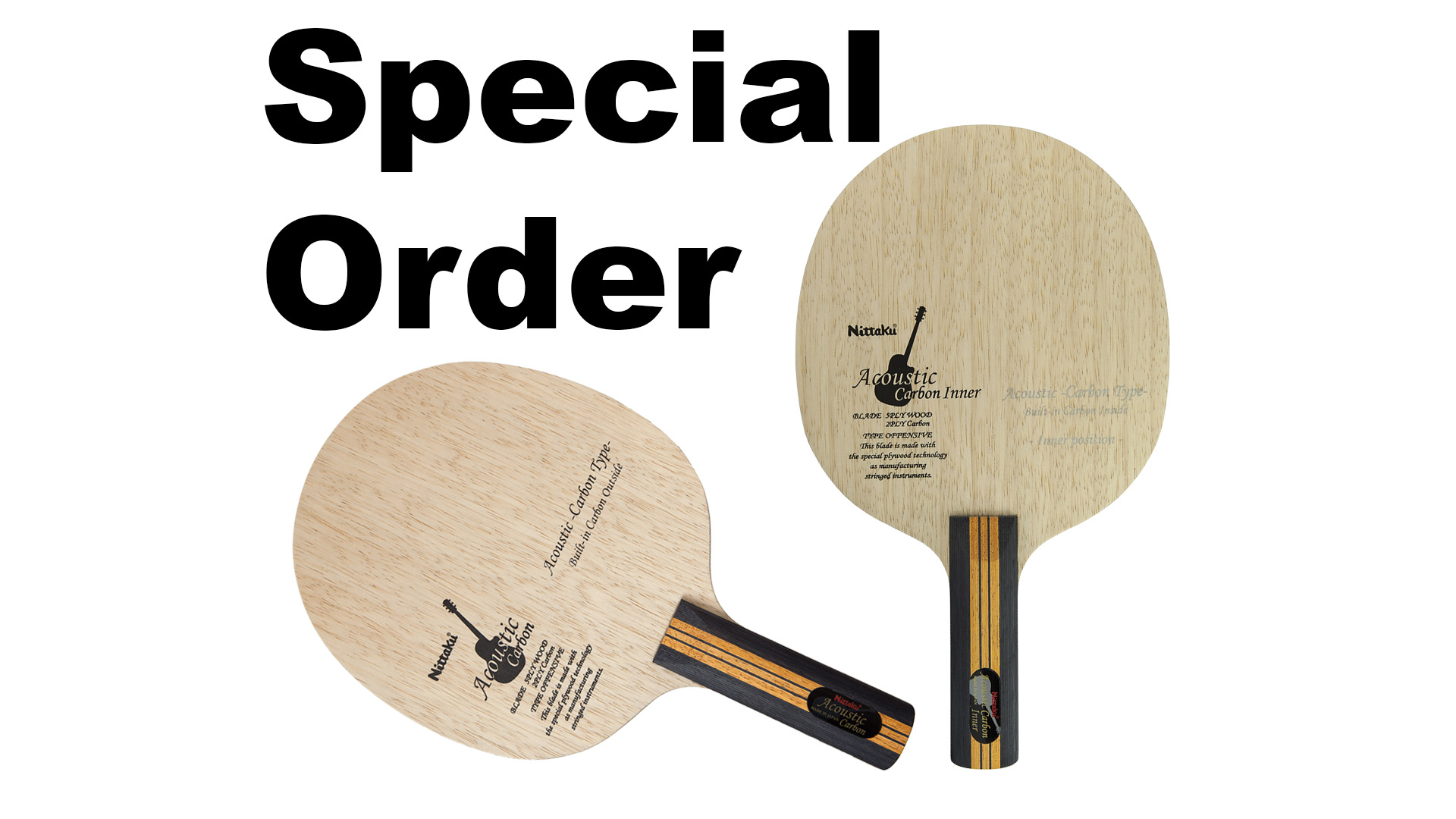
Brace yourselves for even more Nittaku Acoustic reviews! If you follow this blog, you know that I recently tested two slightly different versions of the classic Nittaku Acoustic blades, i.e., the Nittaku Acoustic SG (SG) and the Nittaku Acoustic G Revision (GR) blades, and then moved on to test the Nittaku Acoustic Carbon Inner G-revision (GRI) and Nittaku Acoustic Carbon G-revision (GRO) blades. Hold on, because this is about to get technical: This time, I am testing special-order versions of the regular (i.e., not G-revision) Nittaku Acoustic Inner Carbon (SIC) and Nittaku Acoustic Carbon (SOC) blades, not to be confused with the regular Nittaku Acoustic Inner Carbon and Nittaku Acoustic Carbon that are also available. Confused? The SIC and SOC are considered “special” because they have a thicker core than the regular version, designed to increase speed.
Since these are special-order blades, there are no unique marketing descriptions or technical ratings. Nittaku describes the 5+2 composite GRI and GRO blades, along with their non-G-revision counterparts, as offering “mid-fast” speed and a “hard” feeling, with numerical ratings of 4 (speed) and 5 (hardness) on a 5-point scale. It stands to reason that the special-order blades would be faster and feel harder. Just like the GRI and GRO blades, the SIC and SOC blades have been manufactured using Nittaku’s hallmark “String Instrument Manufacturing Technology” - a special lamination technology that promises to produce a unique feeling.
My SIC and SOC samples were delivered in a white standard Nittaku box that doesn’t provide any blade-specific information apart from the sticker on the front lip of the box, which lists the blade name and some brief characteristics. The design of the blades is very similar to the Nittaku Acoustic SG (which in turn has a slightly different design than the G-revision blades). Thus, the SIC and SOC blades have straw-colored playing surfaces. Unlike the SG, there is no print on the FH side, whereas the BH side lists the text “5.8”, a serial number, and, for the SOC, the text “Acoustic Carbon 5.8 – Outer”. The handles are dark gray with three golden vertical stripes. The generic oval plastic lens on the FH side is black and golden and simply states “Nittaku, Special Order Blade, Made in Japan”. The BH side of the handle is without a lens, while the bottom of the handle features the golden Nittaku tag. The blade surfaces are very smooth, but the wings don’t appear to have been sanded. The handle butts, however, felt a little sharp.
It stands to reason that the SIC and SOC have the same general ply construction as the GRI and GRO blades, i.e., limba-limba-tung-limba-limba, with two FE carbon layers surrounding the core (SIC) or placed below the top ply (SOC). Both blades have dominant core plies made of tung wood, which are slightly – but noticeably - thicker than in the GRI and GRO blades. The SIC core is encased by a thin FE carbon weave, followed by a thin intermediate limba ply and a very thin outer limba ply. The SOC core is surrounded by a thin intermediate limba ply, followed by a thin weave of FE carbon, and a very thin outer limba ply.
The SIC and SOC samples that I received weighed 91 grams and 88 grams, respectively, which, surprisingly, is less than the GRI and GRO samples I received for my prior reviews (95 grams and 96.5 grams, respectively), suggesting that there is something about the G-revision design that renders the blades heavier. The SIC and SOC blades have playing surface dimensions of 158 mm x 151 mm x 5.9 mm (height x width x thickness). The center of gravity is approximately 3.3 cm (SIC) and 3.4 cm (SOC) from the handle. Bouncing a ball on the naked blades produced main resonance frequencies at 1359 Hz (SIC) and 1465 HZ (SOC), significantly higher than the corresponding G-Revision blades (GRI: 1254 Hz, GRO: 1371 HZ), indicating that these blades are in the low OFF (SIC) and mid-to-high OFF (SOC) ranges. The FL handles had the following dimensions (length x width x height): 102.1 mm x 28.5-32.8 mm x 22.4-23.9 mm (SIC) and 101.2 mm x 28.2-32.6 mm x 21.3-23.6 mm (SOC). Compared to the corresponding G-revision versions (i.e., GRI and GRO), the FL handles of the SIC and SOC blades are longer, rounder, and less flared.
Testing Procedure
I tested the two Acoustic blades using well-used sheets of DHS Hurricane 3 (black, 2.15 mm, 40-degree) and Spinlord Waran II (red, 2.0 mm) short pips as my FH and BH rubbers, respectively. I attached the rubbers to the blades using one layer of the Revolution 3 normal viscosity glue on the rubber and the blade. I tested each of the setups over several sessions, playing a mix of regular and match-like drills against my regular high-level practice partner (two-winged looper) using Neottec Neoplast Pro 40+ training balls throughout this test.

Playing Impressions
Initial Impressions
Akin to my observations with the all-wood Acoustic SG and Acoustic G-revision blade, I noticed that the SIC and SOC blades encourage a looser grip, leading to a slightly more head-heavy feeling compared to the corresponding GRI and GRO blades. Personally, I prefer how the SIC/SOC blades feel in my hand over the GRI/GRO, but every player is different.
Driving
Going into this test, I honestly did not expect to notice significant differences between the SIC and SOC relative to the corresponding GRI and GRO blades. However, they do feel noticeably different, which could be due to the thicker core and/or different blade geometry. Thus, the SOC produces a more prominent cracking sound than the GRO when the ball is struck and feels more akin to a fast and stiff 7-ply all-wood blade with a soft surface ply than a standard composite blade. Surprisingly, given its thicker nature, the SOC also doesn’t feel quite as disengaged as the GRO (which I described as almost balsa-like) and has more vibrations travelling into the hand. Using the SOC, my FH and BH drives had long and rather flat trajectories, with the shots landing near the endline. The SOC is deceptively fast (mid-to-fast OFF), which forced me to be cognizant of the physical effort I put into the shots, especially on FH drives, to avoid overshooting the table.
My observations with the SIC, relative to the GRI, were very similar, though it is slightly tamer than the SOC, feeling more like a thinner 7-ply all-wood blade. Thus, the SIC also produces a more prominent cracking sensation on FH and BH drives and feels thicker and more solid than the GRI. Vibrations are felt more clearly in the hand, and this improves feeling and control relative to the corresponding GRI, even though the SIC is faster (low OFF). The SIC is slower than the SOC and easier to control.
The difference in feeling between the SIC/SOC vis-à-vis the GRI/GRO leads me to speculate that it is the tung core that produces the (nice) reverberating vibrations. Presumably, the tung core is too thin and/or the FE carbon plies too insulating in the GRI and GRO blades for vibrations to be felt, whereas the thicker tung core of the SIC/SOC increases the speed and feeling of the blades.
Looping
Unexpectedly, given the thicker nature of the blade, the SOC felt as if it embraced the ball fractionally longer on FH loops than with the GRO. At the same time, the blade is stiff, but the contact is fairly soft. As a result, my FH loops had long and slightly higher trajectories (medium-low to medium throw angle) than with the GRO. While I was not able to generate much spin when FH looping against long pushes in their ascending phase (i.e., early contact), spin levels seemed to be very respectable when contacting the ball in the descending phase (i.e., late contact). I had to moderate my input power and use compact strokes when FH looping down-the-line since the SOC is relatively fast, and shots otherwise go long. The SOC’s relatively stiff nature lends it well to loop drives, where the emphasis is on speed rather than spin.
The SIC also felt as if it embraced the ball fractionally longer than the GRI, and slightly longer than the SOC. My FH warm-up loops cleared the net comfortably (medium throw angle) and landed safely within the bounds of the table. Spin levels on FH loops against long pushes in their ascending phase seemed slightly higher than with the SOC, but as expected, more direct loop drives were slightly slower and less dangerous than with the SOC. However, it was easier to feel the ball than with the GRI, and my FH loops were faster than with the GRI.
Both the SOC and SIC work very well in FH loop-to-loop rallies and BH short pip fishing shots far from the table. Both have more than enough power reserves for the shots to reach the table, even with moderate physical effort. When using the SOC, I had to moderate my input power to avoid overshooting the table. I felt like having greater stability than with the corresponding GRI and GRO blades.
Unlike the GRO, the SOC felt more akin to a 7-ply all-wood blade on BH short pip openers against backspin. Thus, it felt more solid, though its fast and stiff nature meant that it had a narrow margin for error. Due to its slightly longer dwell time, the SIC provided a little more safety on BH short pip openers against backspin than the SOC, and felt more solid than the GRI.

Blocking
The SOC’s stiff and thicker nature gives it a very solid feeling on passive blocks, which are fast and relatively flat but with sufficient clearance over the net. Passive blocks are accompanied by a slight cracking sensation. I had to be careful not to overshoot active blocks. The SIC shared many of these characteristics but was slightly more docile and more controllable. Compared to the GRI, the SIC felt more solid and suitable for blocking.
Smashing
Unsurprisingly, both the SIC and SOC are better suited for smashing than the thinner GRI and GRO, given their faster and stiffer nature. Thus, flat hits were fast, precise, and difficult to return.
Flicking
Both blades displayed improved flicking characteristics relative to the thinner G-revision versions. Thus, the stiffer nature of the SIC and SOC blades allowed both efficient pancake-type flicks and mini-loop type FH/BH flicks. Of the two, the SOC is better suited for the pancake-type flicks, while the SIC is better suited for mini-type flicks.
Pushing
Both the SIC and SOC blades work very well on pushes. The dwell time is long enough to enable you to generate very respectable amounts of spin on the ball, all whilst producing fast pushes. Spin levels are slightly higher with the SIC, whereas pushes are slightly faster with the SOC. I also felt the ball better when FH pushing with the SIC/SOC blades relative to the GRI/GRO blades.
I found the greater speed of the SIC and SOC blades to be advantageous for short pushes. Often with slow blades, I tend to make the pushes too short, whereas these blades allowed me to get the right length on my FH pushes, which generally were very flat and difficult to attack.
Conclusion
In my opinion, the special order Nittaku Acoustic Inner Carbon (SIC) and Nittaku Acoustic Carbon (SOC) blades, which have a thicker core and greater thickness of ~5.8 mm – are a considerable improvement relative to the standard thickness versions, which felt too thin and disengaged for my taste and did not bring about the speed-enhancements I had hoped for. In contrast, the SIC and SOC blades feel more solid (great for blocking, smashes, pushe,s and short pips), are faster with good dwell time (good for looping), and produce more vibrations and a better feeling for the ball (which enhances precision and touch shots). Overall, the SIC has many similarities to thinner 7-ply all wood blades like the Tibhar Signature Szocs 1, whereas the SOC reminds me of certain Stiga Clipper versions. The SIC and SOC blades are relatively fast, making them suitable for intermediate to advanced-level players.
About the Reviewer
Patrick 'Pong Professor' Hrdlicka is a table tennis enthusiast with a Ph.D. in chemistry who combines his analytical and experimental skills with his love of table tennis in order to test and review a wide range of table tennis equipment.
