We use cookies to make your experience better. To comply with the new e-Privacy directive, we need to ask for your consent to set the cookies. Learn more.

The New Haifu Boosters

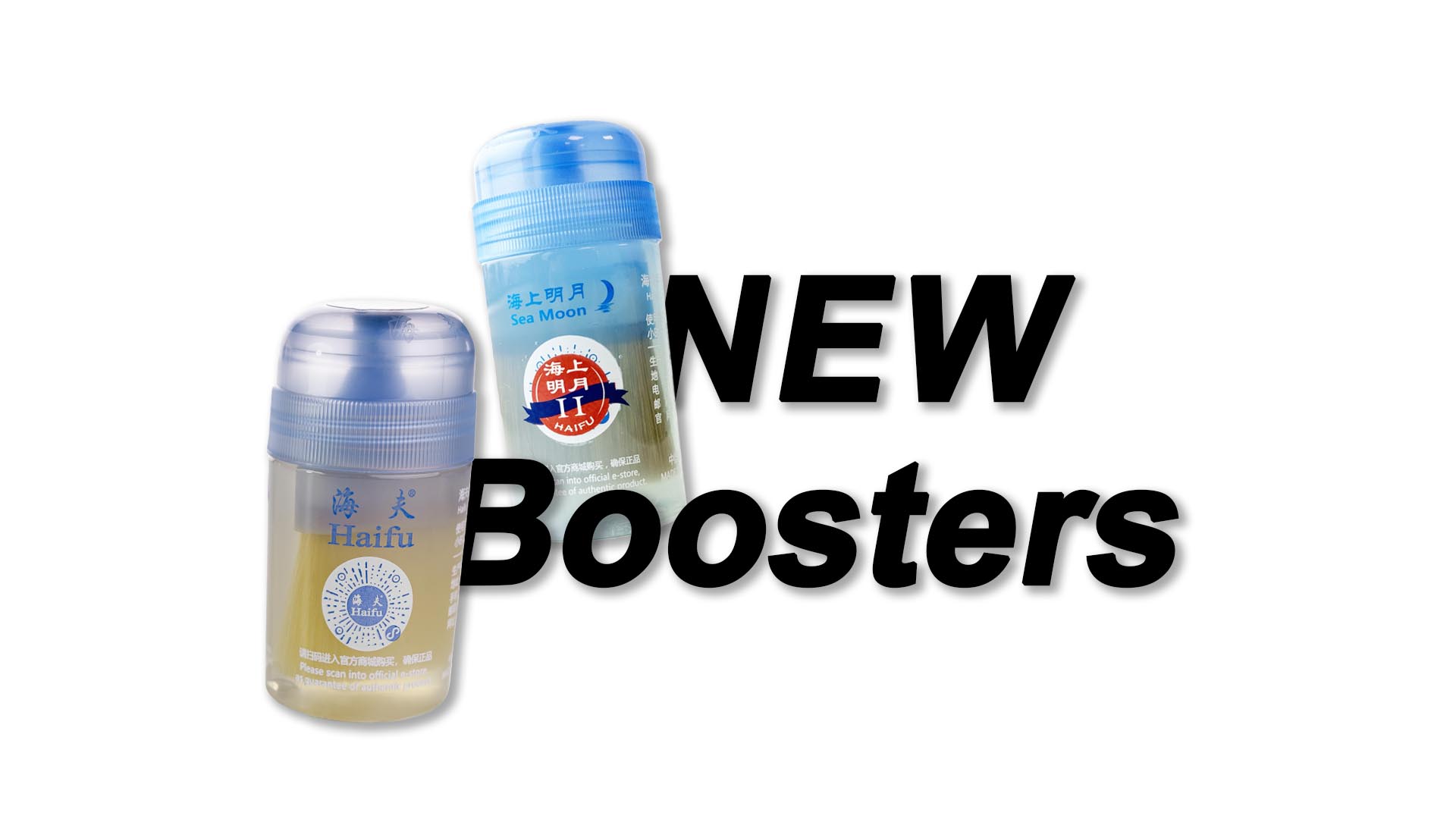
The New Haifu Boosters
Hello TT-enthusiasts and TT11 blog readers!
I have previously written two blog posts on the topic of boosting, i.e., the practice of applying certain liquids and oils on rubber sponges for potential performance gains. In the first post, I outlined the developments that led to the use of boosters, what boosters are and how they work, why boosting is controversial, the benefits of boosting, and methods for boosting. In the second post, I reviewed five different oil-based boosters from Tabletennis11.com, i.e., Falco Tempo Long (FTL), Falco Platinium (FP), Haifu Sea Moon (HSM-REG), Haifu Sea Moon National Yellow (HSM-NY), and Haifu Sea Moon National Black (HSM-NB). I recommend you read those posts for more background that will not be repeated here.
In this blog post, I am testing two new additions, i.e., the Haifu II Sea Moon II (HSM-II) and the Haifu Sea Moon National White (HSM-NW) boosters. The HSM-II is described as an enhanced iteration of the renowned HSM-REG booster, whereas the HSM-NW booster is purported to have more speed, sound, and power than the HSM-NY and HSM-NB versions.

The HSM-II is delivered in a light blue cardboard box. The directions for using the booster that are listed on the box lack detail compared to the directions provided with the HSM-NW box. Haifu states that the elasticity will increase 8.5% after 12-24 hours at “NTP,” which I assume means normal temperature and pressure. Inside the box, you will find a light blue bottle with a holographic Haifu sticker on top and the same type of information listed as on the box.
The HSM-NW also arrives in a light blue cardboard box. Two different sets of detailed directions for using the booster are provided on the box. Again, Haifu states that the elasticity can increase up to 8.5% and that the effect will last for 1 week at “NTP”. Inside the box, you will find a little light blue bottle with a holographic Haifu sticker on top and the same type of information listed as on the box.

Testing Procedure
I tested the HSM-NW and HSM-II boosters in a similar manner to my previous booster test. Thus, I boosted brand-new sheets of Hurricane 3 (H3, black, 2.15 mm, 41-degree sponge, provincial version) as follows: One thin layer of the booster (~2 grams) was applied directly on the sponge and allowed to fully absorb into the sponge. At this point, the rubber, which still had the thin protective film on, began to curl/dome in the horizontal direction. After ~9 hours, I applied a second thin booster layer (~2 grams), resulting in even more pronounced doming. Nine hours after the second application, I removed the thin protective film, which allowed curling/doming in the vertical direction. Approximately 72 hours after the second application, I applied two layers of the Revolution 3 medium viscosity water-based glue, letting each glue layer dry completely before applying the next layer. I then attached the boosted rubber to my Tibhar Samsonov Force Pro Black Edition blade with Spinlord Waran II short pips on the BH side. I tested these setups over 2-3 sessions each, playing a mix of regular and match-like drills against my high-level practice partner. Neottec Neoplast Pro 40+ training balls were used throughout this test.
Initial Observations
Both boosters have brushes integrated into their lids. The brushes have almost the same width as the bottle opening, making them a little difficult to work with, especially since they absorb a lot of booster, which needs to be scraped off on the side of the bottle. It is easy to create a mess, so be sure to work on a non-porous surface. Both boosters are slightly milky and viscous. The HSM-II is colorless, significantly thicker and stickier, and has a slightly more lemony odor than the HSM-NW. The HSM-NW has a hint of yellow and is easier to spread out than the HSM-II since it is thinner and less sticky.
Absorption
It took approximately ~2 hours and ~2.5 hours for the HSM-II and HSM-NW boosters, respectively, to be fully absorbed into the sponge, as compared to ~40 min for the HSM-REG booster and ~3 hours for the HSM-NY and HSM-NB. It took ~5 hours for the second layer of booster to become absorbed, with minimal differences between the two boosters.
Curling/Doming
Both boosters already caused significant curling/doming of the H3s after absorption of the first oil layer (rubbers still had the thin protective film on). Using a scale of 0 (none) and 5 (extreme curling), the following amounts of curling were observed after 7 h: HSM-NW (3) and HSM-II (2.5), as compared to HSM-NY (3), HSM-NB (2), and HSM-REG (1). Six hours after the second booster application (protective plastic sheet still on), the effects were more extreme than with any of the other boosters: HSM-NW (4.5) and HSM-II (4.5) as compared to HSM-NY (4) > HSM-NB (3) > HSM-REG (2).
Playing Characteristics
As a reminder, unboosted 41-degree H3 is quite tacky (can hold a ball for several seconds) and hard. It is a slow and very linear rubber that requires the player to generate power through hip rotation, weight transfer, arm swing, wrist snap, and index finger pressure. The H3 absorbs most of the incoming energy, meaning there is essentially no catapult effect. The throw angle when looping is low, often producing an uncomfortable bounce for your opponent. It is possible to generate very high amounts of spin on FH loops against backspin if a proper brushing technique is used and power from the ground is transferred to the ball. However, if the ball is hit too thickly, loops will have low levels of spin and either are very easy to return or never dip and overshoot the table. The unboosted H3 is an excellent blocking rubber due to its energy-absorbing qualities, although it is very spin sensitive. However, this feature can be exploited by countering the spin (e.g., chop or tomahawk blocks). The unboosted H3 is not well suited for flat hits due to its tackiness and low speed, and it is generally better to topspin the ball instead (alternatively, I twiddle my paddle to FH flat hit with my short pips). The rubber excels in the short game due to its slow speed and high tackiness, which affords you a feeling of being able to grip the ball and hold it on the paddle for a fraction longer, allowing you to impart more spin and/or to position the push more precisely. For similar reasons, the H3 is also an excellent service rubber, as a player can precisely regulate the amount of input power and spin. However, as with loops, a fine brushing contact is necessary for good spin generation.
The HSM-NW and HSM-II boosters both increased the speed, spin, and throw angle of the H3, giving it a more dynamic feeling. Generally, the HSM-II felt softer, bouncier, and higher-throwing than the HSM-NW. This caused me to overshoot the table at a slightly higher rate compared to the HSM-NW when looping, blocking, pushing, and – especially – counter driving with my FH. The HSM-NW, on the other hand, felt harder and crisper, with a more dynamic sponge-topsheet interface akin to my prior observations with the HSM-NY, though it is less bouncy than the latter. The throw angle remains fairly low on topspin shots (similar to the HSM-NB), resulting in a couple of my FH 3rd ball attacks catching the net, but also my FH blocks having a flatter and more dangerous trajectory.
I did not notice a difference in the sound with either boosted H3. Both boosted H3s could be used to generate high amounts of spin on long FH pushes and to produce very low and spinny short FH pushes. I enjoyed excellent consistency on my FH flicks with either boosted H3, with a slight preference for the HSM-II when playing mini-loop type FH flicks, and a slight preference for the HSM-NW when playing pancake type flicks.
The HSM-II booster feels like a faster, crisper version of the HSM-REG and is an overall improvement over the latter. This is an excellent, and relatively inexpensive, booster for H3 users, and the differences relative to the HSM-NW booster are rather subtle.
The HSM-NW feels like a hybrid of the HSM-NY and HSM-NB. The hand-feeling is not quite as crisp as with the HSM-NY, and the HSM-NW is less bouncy than the HSM-NY. The HSM-NW results in a flatter throw angle than the HSM-NY, more akin to the HSM-NB. All in all, I think the HSM-NW may be better suited for players playing closer to the table, whereas the HSM-NY is a mid-distance player’s booster, but the differences are subtle.

Updated Property Chart
Tackiness
The booster-treated H3s had similar levels of tackiness, except for the HSM-NY-treated H3, which was slightly less tacky.
Softness to touch (hard to soft): HSM-NB > FP > HSM-NW > HSM-II ~ HSM-REG ~ HSM-NY ~ FTL
Softness during play (hard to soft): HSM-NB > FP > HSM-NW > HSM-NY > HSM-II > HSM-REG ~ FTL
Sound: HSM-NY > HSM-NW ~ HSM-II ~ HSM-REG ~ FTL ~ FP ~ HSM-NB
Speed: HSM-NY > HSM-NW > HSM-II > HSM-REG > FTL > FP ~ HSM-NB
Spin: FTL ~ HSM-NY > HSM-NW > HSM-II > FP ~ HSM-REG > HSM-NB
Feeling (soft|crisp|hard): FTL ~ HSM-REG < HSM-II | HSM-NW < HSM-NY | FP < HSM-NB
Updated Final Thoughts
There are major differences in how the boosters affect the physical properties (viscosity, absorption, doming), whereas the effects are less pronounced when it comes to playing characteristics. Nonetheless, the boosters fall into three groups. On one end, there is the HSM-NB booster, which produces a H3 that requires a strong physique to take advantage of its “friction power”. Hard, minimal catapult, low “easy spin”, excellent short game, service, and blocking. While less extreme, the FP booster also belongs in this first group. Then there is the middle-of-the-road group comprised of the FTL, HSM-REG, and HSM-II boosters. They are characterized by producing H3s that are softer, bouncier, and higher-throwing, and allow for higher amounts of “easy spin”. H3s treated with these boosters are easier to play (unless pushed to their limits), but do not produce any special sound or hand feeling. The last group is comprised of the HSM-NW and HSM-NY boosters, which yields an H3 that feels and sounds more elastic and dynamic without being soft and mushy while retaining other characteristics of the middle-of-the-road group (i.e., bouncier, higher-throwing, improved easy spin). The HSM-NY would be my booster of choice for competitions, with the HSM-NW being a close second choice, while the HSM-II would be a great daily booster for the cost-conscious player.
About the Reviewer
Patrick 'Pong Professor' Hrdlicka is a table tennis enthusiast with a Ph.D. in chemistry who combines his analytical and experimental skills with his love of table tennis in order to test and review a wide range of table tennis equipment.
