We use cookies to make your experience better. To comply with the new e-Privacy directive, we need to ask for your consent to set the cookies. Learn more.

Donic BlueGrip J1

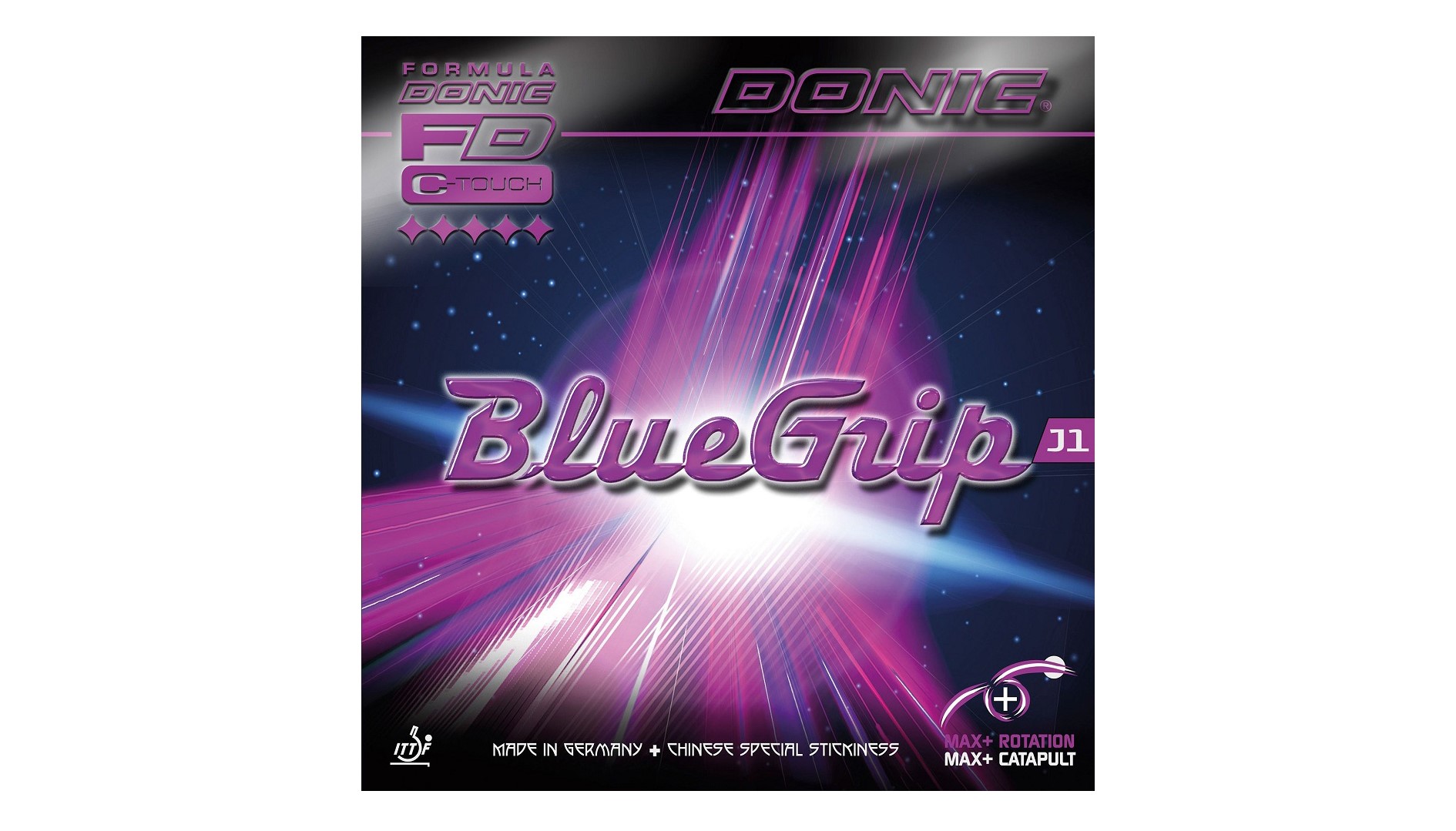
Donic BlueGrip J1
So far, I have tested four members of Donic’s BlueGrip rubber family, i.e., the C1, C2, V1, and R1. I was particularly fond of the C1 and C2 rubbers, which were introduced as being hybrid rubbers, i.e., as having sticky topsheets and very hard sponges. In this review, I evaluate the newest member of this family – the Donic BlueGrip J1. The J1 combines the topsheet mixture from the Donic BlueStar A series with the sponge structure and topsheet pimple geometry of the Donic BlueGrip C series. The sponge has a hardness of 55 degrees on the ESN scale, akin to the BlueGrip C2 rubber. The topsheet is described as slightly sticky and extremely grippy. According to Donic, the result is a highly dynamic and extremely spin-friendly rubber that combines power with good touch. Donic recommends the J1 as a rubber for “ambitious, uncompromising attacking players”
Donic lists speed/spin/control ratings of 10+/11+/6+ for the J1. As a reference point, Donic rates the BlueGrip C1, BlueGrip C2, and BlueStar A1 rubbers at 11/11++/5, 10+/11++/6, and 11++/11++/5+, respectively, suggesting that the J1 rubber will be slightly more docile, a bit less spinny, but more controllable.

The J1 is packaged inside a purple-on-black cardboard wrapper, which lists rubber-specific descriptions on its back. The inside cover lists a description of the Lifetime PLUS, Catapult PLUS, and Tension PLUS technologies that have been used in the fabrication of this rubber, and which promise:
I) an increase of 50% in possible playing hours,
II) a catapult effect that allows for more precision when returning balls, even from difficult positions,
and III) improved inner tension, resulting in a more pronounced speed glue feeling.
The J1 is protected by an opaque non-adhesive film and has a prominent, sweet, rubbery scent, which suggests it has been factory boosted, despite lying flat. The bright red topsheet is not really tacky but feels very grippy. The pimples, which seem to be rather thin and short, are only very faintly visible below the topsheet. The blue sponge has a high density of extremely tiny pores. Overall, the J1 feels slightly softer than the 55-degree label would suggest.
The uncut sheet weighs 73 g (168.5 mm x 168 mm) and 54 g when cut to the test blade (158x151 mm), as compared to 61 g, 53 g, and 52 g for the C1, C2, and A1, respectively.
Playing Impressions
Driving
The J1 is a surprisingly slow rubber with a rather short trajectory (low OFF-). Thus, my FH drives, which had relatively high throw angles, landed mid-table. When I tried to swing harder through the ball, a noticeable catapult was activated that resulted in a non-linear extension of the shot trajectory, considering the increase in input power. The ball impact feels surprisingly soft and is accompanied by a clicky sound that seems to stem from the topsheet-sponge interface. I enjoyed good consistency as long as I kept the level of input power constant.
Looping
The J1 also felt surprisingly slow on FH warm-up loops. Thus, my shots were relatively short. In addition, the FH loops generally only seemed to have average spin levels, except when I contacted the ball in the descending phase, at which point the ball seemed to penetrate deeper into the sponge, resulting in greater spin. I did, however, enjoy good consistency and control of ball placement, in part due to the relatively high throw angle.
More committed 3rd ball attacks against long pushes resulted in activation of a catapult effect that lengthened and flattened the shot trajectory. I was generally able to place the shots in hard-to-reach places with excellent precision and good consistency. However, whenever my practice partner anticipated the placement of the shot, it became relatively easy for him to overcome the moderate spin levels of the FH loops and place me under considerable pressure. Given the characteristics of the J1, I tried a couple of BH loops against long pushes. In my opinion, this is perhaps the best use of the rubber. The catapult and relatively high throw angle give these shots the necessary clearance over the net and trajectory length.
The J1 performed ok in FH-to-FH loop rallies from afar. Once again, the J1 felt soft with incomplete power transfer, resulting in shots that were relatively short but quite stable and consistent. While I wasn’t able to put my practice partner under any real pressure, I could extend the rallies and hope for an error from him.
Blocking
I found passive blocking with the J1 to be challenging due to the somewhat unpredictable activation of the catapult. Passive blocks against moderately fast loops come out relatively slow and controllable, whereas passive blocks against high-quality loops are very bouncy and high-throwing, often going long. The solution to this is to use more active blocking strokes, as this flattens the trajectory and results in more consistent activation of the catapult effect.
Smashing
The J1 actually works ok on flat hits and smashes, producing a clicky feeling, but the shots are not particularly fast.
Flicking
Unfortunately, the J1 does not produce a crisp feeling on FH flicks. In fact, flicks felt soft and muddled. I had more success using the mini loop FH flick technique than the pancake-type technique. Mini-loop type FH flicks cleared the net and could be placed with reasonably good precision around the table.
Pushing
The J1 seemed to produce respectable spin levels on long FH pushes, judging by the struggles my practice partner was going through when attacking these shots. I attribute this to the relatively soft nature of the rubber and the excellent grip level of the topsheet. That said, sometimes when I mistimed the FH push, the catapult appeared to activate, resulting in FH pushes that overshot the table.
The relatively slow nature of the J1 on low-input power shots meant that I was able to competently execute short pushes. In fact, the rubber almost seemed too slow at times, leading to pushes that failed to clear the net.
Conclusion
In my opinion, the Donic BlueGrip J1 is too soft as a FH rubber for advanced players, as they will hit beyond the rubber’s compressibility, resulting in incomplete power transfer. However, I believe the J1 rubber has considerable potential as a BH rubber for many players. Its relatively high throw angle and performance on active blocking and flicking, will work well in the BH, where players typically generate less power.
About the Reviewer
Patrick 'Pong Professor' Hrdlicka is a table tennis enthusiast with a Ph.D. in chemistry who combines his analytical and experimental skills with his love of table tennis in order to test and review a wide range of table tennis equipment. 