We use cookies to make your experience better. To comply with the new e-Privacy directive, we need to ask for your consent to set the cookies. Learn more.

DHS W968

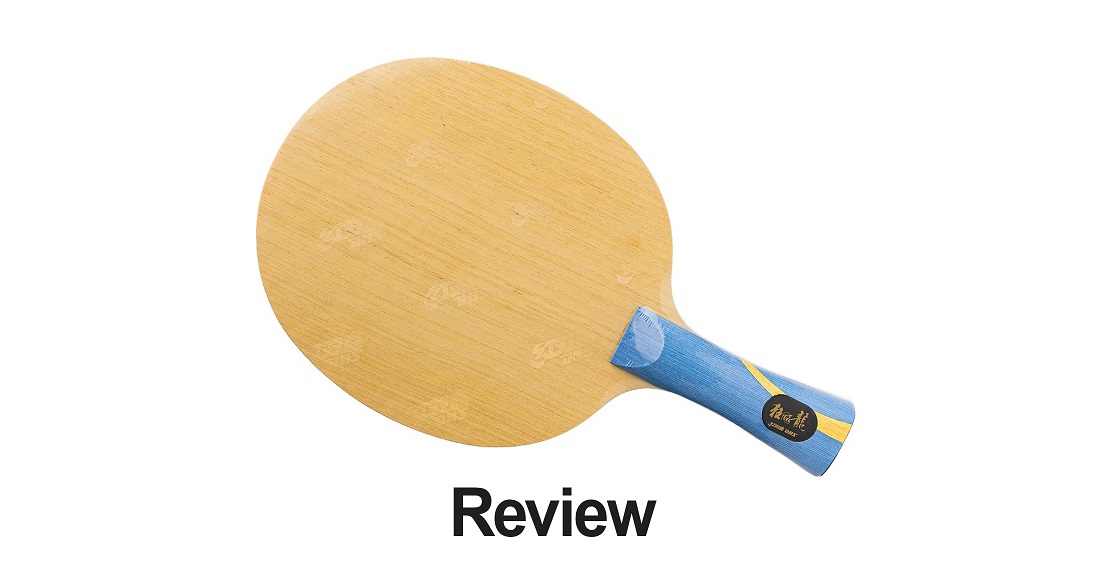
DHS W968
Welcome to the third and final part of the three-part series in which I reviewed the Nittaku H301 NXD (H301NXD), the DHS Hurricane Long 5H (HL5H), and the mythical DHS W968.
In this blog post, I review the W968.
Introduction
The W968 is a limited-edition version of the classic Hurricane Long 5, specifically designed and modified for one of the sport’s greatest players: Ma Long. The materials for this blade are carefully selected, stored, and processed with extraordinary attention to quality and consistency. Each production step is meticulously controlled by DHS, resulting in a blade that meets the standards expected of Chinese national team members.

Packaging
The W968 comes in the same beautiful, sturdy, high-end box as the HL5 and HL5H, which has a magnetic closing mechanism and thick black interior foam padding that provides exceptional protection for the blade during transport. Ma Long is depicted prominently on the front of the red box. As was the case for the HL5 and HL5H blades, the W968 is shrink-wrapped and includes holographic authenticity stickers. Unlike the HL5H, the W968 does not include a separate certificate, but comparable information is printed on a sticker on the front lip of the box.

Appearance and Measurements
The W968 looks virtually identical to the HL5H: the playing surfaces are very light, straw-colored, and free of any print. The wood grain of the outer limba ply of my W968 sample was denser, more uniform, and more visually appealing than that of the HL5H.
The handle is bluish-grey with a golden arc spanning from the middle of the handle to its end. It features a simple plastic lens on the FH side (golden font on black), a silver dragon symbol on the back, and a circular lens with an image of Ma Long on the butt. The blade name and serial number are printed on the side of the handle. The W968 has smooth playing surfaces and edges, but the wings are not sanded. I was also slightly surprised to see a couple of composite fibers protruding from the side of the W968.
The W968 (and HL5H) appears to have the same basic ply structure as the original HL5: limba–ayous–composite–ayous–composite–ayous–limba. The main differences lie in the nature of the composite layer (blue arylate-carbon for the W968) and in the thickness of the individual plies. The W968 as aslightly thinner core than the HL5H, but a substantially thicker composite layer. The intermediate and, especially, the outer plies are thin.
The playing surface of the W968 is slightly larger than that of the other two blades, with the following dimensions (height x width x thickness): 159 mm x 151 mm x 5.9 mm. The FL handle is the longest of the three, having the following dimensions (length x width x height): 101.3 mm, 25.8-34.6 mm, and 22.8-25.9 mm. My W968 sample weighed 91 grams. Bouncing a ball on the naked blades produced a resonancy frequency of ~1336 Hz, being marginally lower than for the other blades, suggesting it is a blade in the high OFF- range.
Testing Procedure
I evaluated the W968 in exactly the same manner as the other blades. Thus, I tested the W968 using well-used sheets of DHS Hurricane 3 (H3, black, 2.15 mm, 40-degrees) and Yasaka AntiPower (YAP, red, 1.5 mm) antispin as my FH and BH rubbers, respectively. The rubbers were attached using one layer of the Revolution 3 normal viscosity glue on both the rubber and the blade. I tested the setup over 3-4 sessions, during which I played a mix of regular and match-like drills against my usual high-level practice partner (a two-winged looper). Neottec Neoplast Pro 40+ training balls were used throughout.
Playing Impressions
Initial impressions: Like the HL5H, the W968 felt comfortable and nimble in hand. Its relatively narrow neck allows for small adjustments and easy twiddling, and it has a slightly head-heavy character that gives the impression of increased power.
Driving
FH drives with the W968, which produced a softer feeling than with the HL5H. On low-impact FH drives, it behaves like a mid-to-high OFF- blade, but when a snappier motion is used, a catapult effect engages, making the blade feel closer to mid-OFF. Shot trajectories were relatively flat and long, particularly on higher-impact drives, yet the ball still cleared the net and dipped before the end line. Similar observations applied to my BH antispin drives.
Looping
My FH warm-up loops were very consistent, clearing the net without overshooting the table. The shots were solid - neither exceptionally fast nor highly spinny - but I could generate more spin when contacting the ball in its descending phase, which made it challenging for my practice partner to keep blocks on the table. The blade’s soft, almost woody feel transmits very little vibration to the hand. The degree of bounciness depends on input power, which initially made finding the right shot length a little tricky. When I alternated two diagonal loops with one down-the-line loop, I occasionally overshot the table, but I was able to adjust my level of input power to improve consistency.
My third-ball FH attacks against long pushes were not supremely fast but carried good spin. I was able to place shots with excellent precision in hard-to-reach places, which won me many points. The throw angle is high enough to clear the net while keeping trajectories deep and penetrating.
The W968 was comfortable in FH loop-to-loop rallies far from the table, helping me land shots consistently, though they were not as fast or powerful as I had anticipated.
The blade felt slightly “thin” and flexible on BH antispin attacks against long pushes, causing some of my shots to go long unless I used a wristy motion to help them dip. With focus, I could produce nice rolling shots with flat trajectories.
Flicking
The soft and occasionally bouncy nature of the W968 makes it well-suited for mini-loop flicks against short pushes, providing enough dwell time to clear the net. While pancake-type flicks are possible, the blade lacks a bit of stiffness and speed - especially with a minimally boosted H3 - for highly dangerous flicks. Conversely, BH flat hits with a very soft antispin rubber were fun, as the blade’s bounciness allowed fast, penetrating shots when the ball was contacted at its zenith.
Blocking
My FH warm-up blocks were predictable, absorbing incoming energy and producing shots that cleared the net safely. The feeling is soft and muted. More active blocking and counterlooping seemed to activate a catapult effect, initially making it tricky to keep active blocks on the table. I resolved this by stepping slightly back and/or relaxing my arm and wrist, which resulted in fast, well-placed blocks that were difficult for my practice partner to return. BH antispin blocks were similarly consistent and reliable.
Smashing
While not extremely fast, you can easily put away any shots that sit up with the W968. The blade’s bouncy character unfolds with greater input power, enhancing smash effectiveness.
Pushing
The moderate speed and soft feel produced by the W968 make it easy to consistently execute long, spinny FH pushes against backspin serves. Overly aggressive or thickly hit pushes can activate the catapult, sending the ball past the table. Thus, one needs to moderate input power.
The W968 works well on short pushes, as the minimal input power prevents the catapult from becoming activated, resulting in low, difficult-to-attack shots.
Conclusion
The DHS W968 is a well-balanced blade with a soft feel, making it ideal for two-winged loopers. While not exceptionally fast, more aggressive strokes activate a catapult effect that can extend shot trajectories. When paired with fast European or Japanese rubbers - or heavily boosted H3 - it can become a highly dangerous setup (just ask Ma Long!).
Overall conclusion
Of the three blades tested, the DHS Hurricane Long 5H remains my personal favorite due to its faster, slightly stiffer, and crisp nature, consistent with my preference for 7-ply all-wood blades. The W968 would likely be the blade of choice for two-winged loopers, while I feel the Nittaku Hurricane 301NXD may suit intermediate-level players better.
About the Reviewer

Patrick 'Pong Professor' Hrdlicka is a table tennis enthusiast with a Ph.D. in chemistry who combines his analytical and experimental skills with his love of table tennis in order to test and review a wide range of table tennis equipment.