We use cookies to make your experience better. To comply with the new e-Privacy directive, we need to ask for your consent to set the cookies. Learn more.

DHS Hurricane Long 5 Golden and DHS Hurricane Wang Chuqin

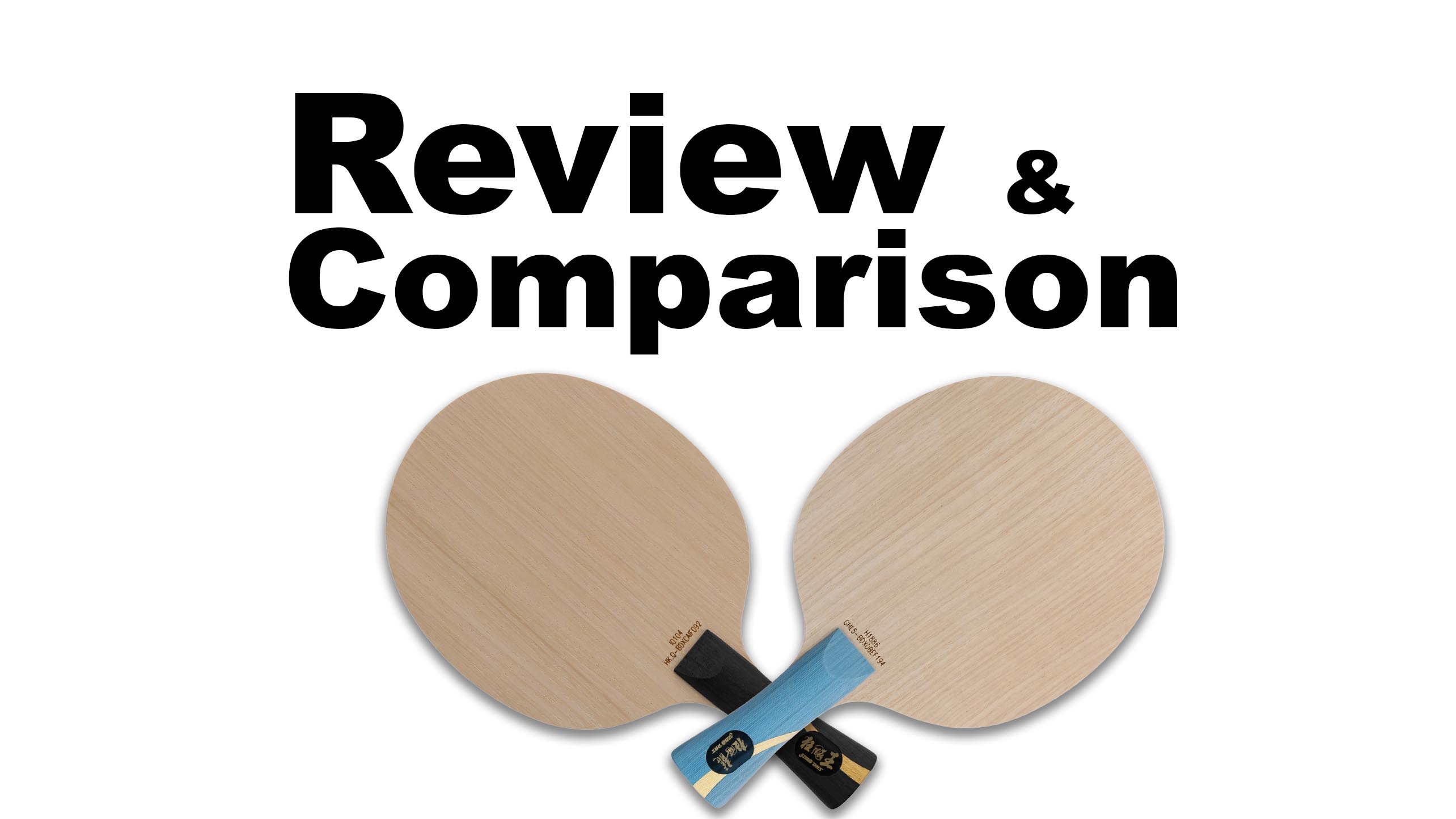
DHS Hurricane Long 5 Golden and DHS Hurricane Wang Chuqin
Hello again, TT11 blog readers,
This time I am testing two 5+2 inner ply composite blades from Double Happiness (DHS), i.e., the DHS Hurricane Long 5 Golden and DHS Hurricane Wang Chuqin. DHS blades are very popular with Chinese National Team members and recreational players alike. I have previously tested several DHS blades, including the regular Hurricane Long 5 (HL5), the 301, and the 301X, and found them to have interesting playing characteristics that support aggressive two-winged loopers.
The DHS Hurricane 5 Golden (HL5G) blade is described as having a thicker core than the regular HL5 and a center of gravity that is shifted closer to the head, allowing for faster and more powerful swings. In addition to greater speed, the thicker core is also asserted to produce a solid feeling that instills confidence. DHS recommends the HL5G for players with aggressive playing styles who seek a perfect balance of speed and control.
The DHS Hurricane Wang Chuqin (HWCQ) is said to produce a more controlled, slightly softer feeling than the HL5, with a good balance of speed and spin that’s suitable for Wang Chuqin’s aggressive playing style, which combines powerful loops with a need for control.
Both blades come in beautiful, sturdy, high-end boxes with magnetic closing mechanisms and a black interior foam padding, which provides outstanding protection during transport. The front of the purple HL5G box features a large photo of Ma Long in his iconic celebratory pose after winning the 2021 Men’s Singles Olympic Competition. The side lip of the box lists Ma Long’s major tournament victories in Chinese. The red HWCQ box features a photo of Wang Chuqin in a victorious pose.
The blades arrive wrapped in shrink wrap and come with certificates listing the serial number, name, weight, thickness, and other blade measurements.
The surface plies of the HL5G are very light straw colored, and are without any print except for the serial number, which is printed where the thumb rests on the FH side. The handle is blueish-grey with a golden arc that spans from the middle of the handle to its end. The handle features a simple black and gold lens on the front, a silver dragon symbol on the back, and a circular lens with an image of Ma Long on the bottom. The HWCQ has a very similar appearance except for the handle’s main color being dark grey, and having a different silver dragon symbol on the BH side of the handle, along with a circular lens on the bottom of the handle featuring a photo of Wang Chuqin. Both blades have very smooth playing surfaces and edges and look great. However, I was disappointed to see a couple of fibers coming off the outer ply at the conclusion of this test when I was peeling off the rubbers. I would have expected blades in this price range to have sturdier constructions and/or to have been sealed from the factory. I recommend you seal your HL5G and HWCQ blades with a sealer like the Revolution 3 lacquer if you plan on replacing rubbers.
The HL5G has the same general ply construction as the HL5, i.e., limba-ayous-arylate-ayous-arylate-ayous-limba. The core is relatively thick, and the yellow and blue arylate carbon weave is also quite prominent, while the intermediate and outer plies are quite thin. The ply composition of the HWCQ appears to be very similar to the HL5G, except that the core is slightly thinner.
The playing surfaces of the blades have the following dimensions (height x width x thickness): 158 mm x 150 mm x 6.0 mm (HL5G) and 159 mm x 150 mm x 6.0 mm (HWCQ). The FL handle of the HL5G has the following dimensions (length x width x height): 100.4 mm, 25.9-34.4 mm, and 23.7-26.6 mm, while the HWCQ FL handle is slightly longer and slimmer: 101.1 mm, 25.4-33.9 mm, and 22.7-25.9 mm. My samples weighed 92 grams (HL5G) and 90 grams (HWCQ). Bouncing a ball on the naked blade produced resonance frequencies of ~1348 Hz (HL5G) and 1240-1290 Hz (HWCQ) with a maximum at 1277 Hz. This would suggest that both blades are in the high and low OFF- range, respectively. The centers of gravity of both blades are ~3.0 cm from the top of the handle.
DHS Hurricane Long 5 Golden

Initial Impressions
The HL5G is very comfortable to hold, but some players may find the handle to be too thin. I enjoyed the handle, as it encourages a loose grip and allows for small adjustments between FH and BH strokes. The blade’s balance seems to be tilted towards the head.
Driving
The HL5G feels more solid, direct, and woody than I remember the regular DHS Hurricane Long 5. The HL5G is also faster than the regular HL5. I originally categorized the HL5 as an OFF+ blade. In hindsight - and with far greater testing experience - I would probably recategorize the HL5 as a mid OFF-blade today, while the HL5G feels like a low OFF blade. The feeling produced by the HL5G on FH drives is direct and medium-stiff, though not particularly carbon-like, presumably due to the blade’s inner ply composition. Akin to my observations with the HL5, I actually found the feeling quite pleasant for a composite blade. My FH/BH drives were fast, with long and relatively flat trajectories, though I still enjoyed sufficient clearance over the net and excellent consistency.
Looping
My warm-up FH loops were fast and relatively flat (medium-low to medium throw angle) with average spin levels as the dwell time is medium. Although the HL5G doesn’t feel particularly bouncy in itself, the blade’s head-tilted balance gives it a feeling of generating more power per unit of physical effort than other blades.
Third ball FH attacks against backspin quite fast while carrying an average amount of spin. Although the HL5G is fast, it wasn’t so fast that my consistency suffered. It is advantageous, however, to use smoother (as opposed to jerkier) motions and softer hands to avoid overshooting the table. My BH short pip 3rd ball attacks against backspin also required slight restraint and a more wrist-engaging technique to avoid overshooting the table. However, once mastered, my attacks were fast, quite dangerous, and consistent. The HL5G strikes a good balance between speed, dwell time, and control, though it requires a player to have a good feeling in their hands.
The stable and fast nature of the HL5G, along with its reasonable throw angle, facilitates FH loop-to-loop rallies far from the table. Thus, I was able to slug away and still land the shots with good consistency. I made similar observations concerning BH short pip fishing shots far from the table, and found the HL5G to be quite delightful for these shots.
Blocking
The HL5G produces a solid, medium-stiff feeling on blocks. I enjoyed excellent consistency during FH/BH warm-up blocks, but the head-tilted balance and overall fast nature of the blade occasionally caused me to overshoot the table when FH blocking during more match-like situations. Once again, I found the use of softer, more relaxed hands to be critical for improved consistency.
Smashing
The fast and relatively stiff nature of the HL5G lends itself well towards finishing off points with smashes.
Flicking
The HL5G works well for flicking. The dwell time is long enough to facilitate classic mini-loop type flicks, yet the blade is stiff and fast enough to allow for the generation of fast and dangerous pancake-type flicks with good consistency. The medium-stiff nature of the HL5G worked particularly well for BH flicks with my short pips, which felt crisp and gave my practice partner lots of trouble.
Pushing
The head-tilted balance of the HL5G allows for the generation of dangerous FH long pushes against backspin serves, since they are fast and quite heavy on the spin. At the same time, the relatively non-bouncy and direct nature of the HL5G also works surprisingly well for short pushes and touch shots. Thus, I was able to play short and flat pushes as good as with any blade.
Conclusion
It is easy to understand why DHS chose to make the Golden version of the Hurricane Long 5. The regular HL5 was already an excellent blade with a good balance between power and feeling. The HL5G adds extra power needed in the 40+ era, whilst maintaining a good, woody feeling. The HL5G facilitates all modern techniques and even works quite well with short pips. This is definitely not a blade for beginners or even intermediate-level players, but rather for experienced players who have a good feeling in their hands.
DHS Hurricane Wang Chuqin

Initial Impressions
The HWCQ is also quite comfortable to hold, but the handle feels even thinner than the HL5G. A few times, it almost felt as if I was about to drop the paddle while playing. Some players might want to wrap the handle in grip tape. The balance of the HWCQ is tilted more towards the center compared to the HL5G.
Driving
The HWCQ feels thinner, softer, and slower compared to the HL5G and produces a more reverberating feeling upon striking the ball. While the base speed of the HWCQ is lower than the HL5G (mid OFF-), it is significantly bouncier (i.e., less solid) and feels faster on higher impact shots. Thus, FH/BH drives played with regular input power have medium-long trajectories, but when you start hitting with a little bit more force, the trajectory extends more than one would expect. Irrespective of this observation, I enjoyed good consistency.
Looping
The HWCQ is a looper’s blade. Standard warm-up FH loops are moderately fast with a medium arc, allowing for an exceptional consistency, though the spin levels are only average unless the ball is contacted late in the descending phase. A good amount of vibrations are sent into the hand, and a slight cracking sound is produced upon striking the ball. Akin to my observations above, the HWCQ feels quite thin and bouncy whilst FH looping – or perhaps more precisely – the blade has an additional gear when looping with greater force. This caused some of my more powerful loops to blast past the table, which I found surprising given that the blade’s base speed is more modest than the HL5G’s. As such, I found it even more important to use the feeling in my hands to control the length of my shots.
Third ball FH attacks against long pushes are moderately fast but can be placed with very good precision. Third-ball attacks played over-the-table were particularly easy to control. The throw angle is medium to medium-high, and the dwell time is above average. Whenever I played shots with greater input power, the shots were teetering on going long.
Third ball BH short pip attacks against backspin required me to use soft hands to avoid overshooting the table, as the thin and fairly bouncy nature of the HWCQ became particularly evident on these shot types. Once mastered, I was able to execute my BH attacks with good consistency, although the shots weren’t fantastically fast.
The bouncy and relatively high-throwing nature of the HWCQ allows for consistent loop-to-loop rallies far from the table, both from the FH and BH side, although I struggled to overpower my practice partner.
Blocking
The HWCQ produces a relatively soft and rather thin feeling on blocks. The consistency of my FH/BH warm-up blocks was good, with the shots having plenty of clearance over the net. However, the blade’s non-linear nature meant that blocking during more match-like situations was less consistent, with many of my passive blocks going long. Stated differently, the HWCQ does not absorb incoming power particularly well. This is a blade that benefits from a more active blocking stroke.
Smashing
While the HWCQ ultimately gets the job done, this isn’t a blade that excels at smashing using hard, non-bouncy rubbers like Hurricane 3 due to its relatively modest speed. However, smashing improved whenever I used my softer short pips.
Flicking
The HWCQ works very well for flicking. The blade is slow enough, has long enough dwell time, and sufficiently high throw angle, to allow for classic mini-loop flicks to be executed with high consistency. The HWCQ lends itself less well for pancake-type flicks due to its moderate speed and soft nature, but its bounciness helps put some pace on these shots.
Pushing
The HWCQ generally works very well on FH long pushes against backspin serves. The longer dwell time allows for an extended ball contact, and the moderate speed of the blade generally ensures that the pushes are spinny, staying within the confines of the table. Occasionally, however, it felt as if a catapult was activated, leading me to substantially overshoot the table. Thus, it is important to use a consistent amount of input power.
Short pushes and touch shots were easy to execute with the HWCQ given its moderate pace and above-average dwell time.
Conclusion
In my opinion, the DHS Hurricane Wang Chuqin is a blade that will suit two-winged loopers who have a lot of feeling in their hands and who can utilize the different gears of the blade to their advantage. The thin nature of the blade renders it less well-suited for passive blockers, flat hitters, and pimple-out players, but it will suit players who use over-the-table techniques such as flicking and looping off-the-bounce.
Final Thoughts
The HL5G and HWCQ blades cater to two slightly different player types. The HL5G is better suited for players with more aggressive and flatter strokes (power-looping, smashing, blocking with a neutral bat angle), whereas the HWCQ is more geared towards players who mainly loop, counterloop, and flick.
About the Reviewer
Patrick 'Pong Professor' Hrdlicka is a table tennis enthusiast with a Ph.D. in chemistry who combines his analytical and experimental skills with his love of table tennis in order to test and review a wide range of table tennis equipment.
