We use cookies to make your experience better. To comply with the new e-Privacy directive, we need to ask for your consent to set the cookies. Learn more.

Nittaku ACTEC: Masterful Blade Technology?

Nittaku ACTEC: Masterful Blade Technology?
Dear TT-enthusiasts and TT11 blog readers,
This time, I am reviewing a special, recently released blade: the top-end Nittaku ACTEC. The ACTEC is a new addition to Nittaku’s German-made Meister (German for “master”) series, which includes the Nittaku Holz Sieben, Nittaku Basaltec Inner, and Nittaku Basaltec Outer.
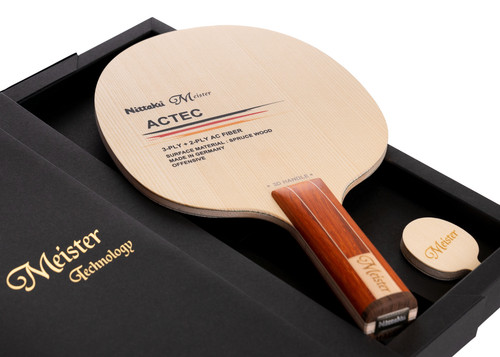
The ACTEC has a 3+2 ply composition with an outer ply of spruce wood and arylate carbon fibers that surround the thick core, which I believe is made of kiri wood. The ACTEC is purported to offer a softer touch and be more enjoyable to play with than the Basaltec blades. The use of arylate carbon instead of basalt fibers is said to result in a more dynamic blade with exceptional power for offensive shots, whilst maintaining good control, allowing players to execute precisely placed shots and touch shots.
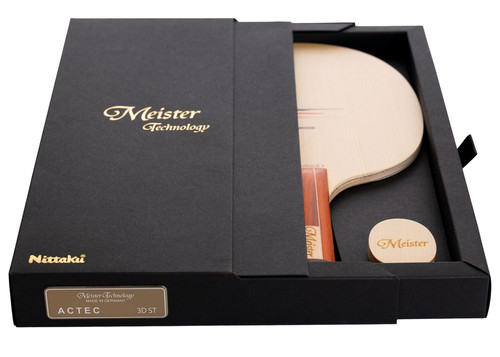
My sample of the ACTEC was delivered without the original box, so I cannot comment on the packaging. In addition, at the time of writing this review, minimal background information was available about the ACTEC from Nittaku.
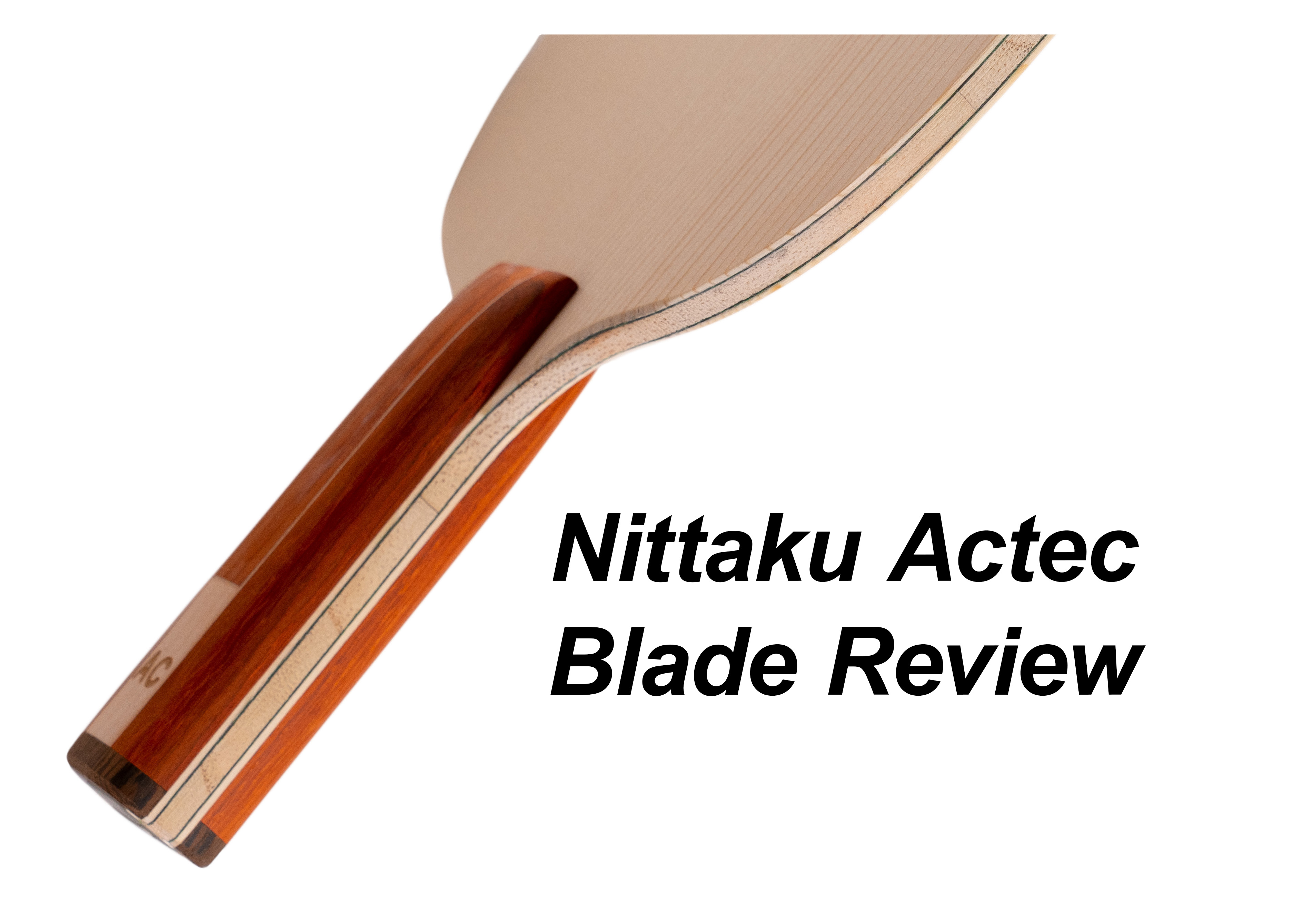
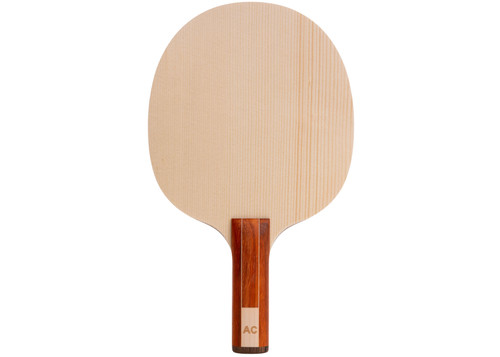
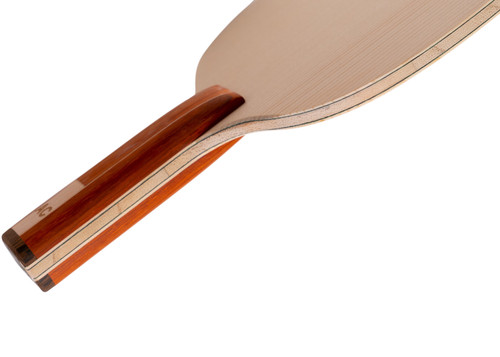
The ACTEC has a lovely rustic look. The playing surface is straw-colored and has beautiful, dark pinstriped vertical grain. The FH side lists the blade name and features a graphic depicting the German flag and descriptive technical information. There is no text or print on the BH side. The 3D flared handle is beautiful and very smooth. It is made of a red wood type and features two thin, straw-colored vertical stripes. In lieu of a lens, there is a wooden insert that reads “Meister” on the FH side and “AC” on the BH side. A silver tag is placed on the bottom of the handle, which reads “Nittaku, Meister Technology, and Made in Germany”. The blade surface is surprisingly rough and undulating, which is characteristic of spruce plies. The blade wings are sanded smooth. All in all, this is a beautiful blade that exudes high-quality craftsmanship.
My ACTEC sample weighed 88 grams and had the following dimensions (height x width x thickness): 156 mm x 151 mm x 6.6 mm. The ACTEC’s center of gravity is approximately 2.7 cm from the handle. The naked blade ball bounce test produced a main resonance frequency at 1570 Hz, indicating that the ACTEC is a very fast and/or stiff blade. The ACTEC handle has a 3D design that promises to provide a snug fit during play. The dimensions of the FL handle were as follows (length x width x height): 99.8 mm x 27.0-33.2 mm x 21.7-25.5 mm.
Testing Procedure
I evaluated the ACTEC blade using well-used sheets of DHS Hurricane 3 (H3, black, 2.15 mm, 40-degree) and Spinlord Waran 2 (W2, red, 2.0 mm) short pips as my FH and BH rubbers, respectively. I attached the rubbers to the blade using one layer of the Revolution 3 normal viscosity glue on each of the rubber and the blade. I tested the setup over five sessions, playing a mix of regular and match-like drills against my regular high-level practice partner (two-winged looper) and practice matches against intermediate-level club members, using Neottec Neoplast Pro 40+ training balls throughout this test.
First Impressions
The ACTEC feels well-balanced, with a center of gravity closer to the handle. As a result, the blade felt lighter than expected. The ACTEC’s 3D FL handle is one of the most comfortable that I have tried, even though its below-average length initially worried me. The fit is excellent, and the handle allows for easy micro-adjustments during gameplay.
Driving
The initial feeling upon striking the ball during FH drives is soft, yet the blade produces a noticeable cracking sensation and generates a good amount of feedback in the palm. Overall, I would say that the ball feeling is pretty good considering that this is a composite blade with a very high resonance frequency. The ACTEC is a much faster blade than its soft feeling would suggest, due to its bounciness. I would categorize it as a mid-OFF blade with a strong catapult effect. The ACTEC has a noticeably higher throw angle than either of the Lebrun blades I tested recently. As a result, I enjoyed plenty of margin over the net on my FH drives, which landed deep on the table. Similarly, BH drives felt crisp and also benefited from the higher throw angle.
Looping
As with FH drives, the feeling on FH loops is quite soft, but with added crispness from the arylate carbon, which gave me added confidence. The ACTEC feels as if it embraces the ball, while being quite springy. This extended dwell time results in improved spin generation and a medium to medium-high arc. This meant I could play relatively fast and spinny third-ball attacks against long pushes with good consistency, although the blade’s springiness caused me to overshoot the table, particularly during match-like situations.
The ACTEC offers plenty of power and bounciness for FH loop-to-loop rallies away from the table. In fact, I had to hold back to avoid overshooting the table. The long-distance FH loops benefited from the medium-high throw angle produced by the ACTEC/H3 combination and were noticeably spinnier than with the Lebrun composite blades.
BH attacks against long pushes were generally quite controllable, though I again had to be careful not to overshoot the table, due to the blade’s bounciness.
Flicking
The ACTEC’s soft and bouncy nature requires trusting your technique when playing FH flicks, because you don’t get much immediate feedback on these low-impact shots. The blade does much of the work, and it is possible to produce long-trajectory FH flicks with little power input. The extended dwell time renders it relatively easy to guide the FH flick over using a mini-loop type stroke. I felt more immediate feedback on my BH flicks (played with the softer W2 short pips). The flicks had long trajectories and were very consistent by my standards. And again, I found it easy to lift the ball over the net, even with short pips!
Blocking
The ACTEC felt relatively crisp and solid on warm-up FH and BH blocks. However, FH blocking during match situations proved trickier due to the blade’s fast nature and bounciness, which caused me to overshoot a surprising number of FH blocks and FH loop drives unless I used soft hands. It is as if the absorbing nature of the arylate carbon weave is fighting against the springier nature of the spruce ply.
Smashing
The bouncy nature of the ACTEC lends itself well to flat hits and smashes, as it can produce considerable speed and long shot trajectories. However, it feels a bit unusual to flat hit with a blade that generates such a soft feeling on impact. I found it challenging to get the power just right.
Pushing
The extended dwell time that the ACTEC offers allows for increased spin on long pushes, though care is needed to avoid overshooting the table due to the blade’s bounciness (though this is less of a problem on low-impact shots). My practice partner seemed to struggle more than usual when attacking my long FH pushes. It’s also possible to play low, short pushes with the ACTEC, but soft hands are necessary to compensate for the blade’s bounciness.
Serving
The extended dwell time of the ACTEC allows for more spin to be imparted on the ball when serving, whether executing short pendulum backspin serves or long topspin/sidespin serves.
Conclusion
The Nittaku ACTEC is a gorgeous, fast, and springy blade. It offers a soft feeling similar to some high-quality hinoki blades I’ve tested previously. These characteristics will appeal to some but not all players. If you prefer a less bouncy, more direct blade, the ACTEC may not be for you. However, if you prefer a blade that does a lot of the work for you and you enjoy playing from mid-distance or even further from the table, the ACTEC will suit you well.
About the Reviewer
Patrick 'Pong Professor' Hrdlicka is a table tennis enthusiast with a Ph.D. in chemistry who combines his analytical and experimental skills with his love of table tennis in order to test and review a wide range of table tennis equipment.
